Everyone who counts microplastics in soil counts them a little differently. That means the numbers we already have cannot be stacked against each other cleanly. Under occurrence and spatial distribution the measurement work is spread across four competing methods, with no standard one.
Start with the sampling, because that is where the trouble begins. One review states it flatly: no standard soil microplastic sampling and extraction method exists (Sajjad et al., 2022). Before anyone gets to how much plastic is in a field, they first have to invent or borrow the way they will pull the particles out of the dirt and decide what counts. That same review still names the big inputs, with plastic mulch film the largest, and puts hard figures on the scale: near 700,000 tonnes reaching farmland each year across Europe and North America, and up to 90% of Swiss floodplain soils polluted. Those numbers are useful. The catch is that when the sampling recipe underneath them differs from lab to lab, two 90% figures might not mean the same thing.
The divergence widens once you look at how the experiments are run. In one greenhouse study, researchers mixed regular polyethylene and biodegradable PLA into a silty loam at 0.5% by weight, across three particle sizes, then dry-sieved the soil into aggregate classes and read the bacteria by 16S sequencing (Han et al., 2024). One dose, one set of sizes, one sieving protocol, one sequencing readout, every one a choice another lab could make differently. A second team studying the microplastisphere, the thin zone where soil meets plastic, reached for a different toolkit: soil zymography to map enzyme hotspots and substrate-induced growth respiration, using a PHBV biopolymer instead of PE or PLA (Zhou et al., 2021).
The results do talk to each other, which is exactly what makes the missing common method sting. Han concludes biodegradable plastic harms soil about as much as regular plastic, so swapping would not help. Zhou shows a biodegradable polymer being eaten by microbes as a carbon source, creating hotspots of faster turnover, a genuinely different picture of what biodegradable does in the ground. I cannot referee that tension, because the doses, the polymers, and the readouts all differ.
A separate review sharpens the worry: most of the evidence we lean on comes from short, high-dose lab jars, and it calls for long-term field studies at realistic amounts (Aralappanavar et al., 2024). With the underlying reviews already framing soil as understudied next to the ocean (Guo et al., 2020), we are building a young field's occurrence map out of measurements that were never designed to line up.
- Type
- Un-harmonized methods
- Field
- Soil microplastic measurement
- Comparative basis
- Four competing methods on one soil
- Methods
- Sampling and extraction, 16S, zymography, sieving
Why this is answerable now
Reviews ask for it
A 2024 review says the quiet part plainly: most evidence is short, high-dose lab jars, and the field needs long-term field studies at realistic amounts (Aralappanavar et al., 2024). The demand for comparable numbers is already on the record.
A named, admitted gap
You rarely get a cleaner opening than a review stating no standard soil microplastic sampling and extraction method exists (Sajjad et al., 2022). That is a stated hole waiting for someone to close, not one you have to argue for.
The sources keep growing
With mulch film the largest input and hundreds of thousands of tonnes reaching farmland yearly (Sajjad et al., 2022), the contamination is not slowing. A common yardstick set now measures the whole rising curve the same way instead of retrofitting it later.
Enough methods to compare
Between 16S sequencing with aggregate sieving (Han et al., 2024) and zymography with growth respiration (Zhou et al., 2021), the toolkit is already rich. This is the moment to compare tools head to head, before four parallel methods harden into four permanent ones.

Sources cited
Papers I read for this question. These notes distinguish reviews from primary studies and identify the limits of my access.
The 2020 review that said soil was ignored next to the ocean.
Effects swing by dose and soil. Calls for realistic-dose field work.
States plainly there is no standard way to sample or extract.
04Microplastics alter soil structure and microbial community
Primary experimentOne recipe: one dose, one soil, one readout, hard to compare.
A different toolkit entirely: zymography and respiration. Abstract only.
What’s missing — the gap
A field that already admits it has no standard sampling and extraction method (Sajjad et al., 2022), and whose reviews keep asking for realistic-dose field studies (Aralappanavar et al., 2024), has not yet run one soil sample through its competing methods side by side. So the question is: do the leading soil-microplastic sampling, extraction, and counting methods return the same occurrence numbers on identical soil, or do they diverge enough that current cross-study comparisons are unsound?
Right now the doses, polymers, and readouts differ between the studies we lean on, so a reader cannot tell whether two occurrence numbers describe the same soil or two different rulers. The smallest honest test is to point several methods at one shared soil and see whether they agree. Until someone does, the maps we compare are built from measurements that were never designed to match.
First moves
- 1
Split one soil, four ways
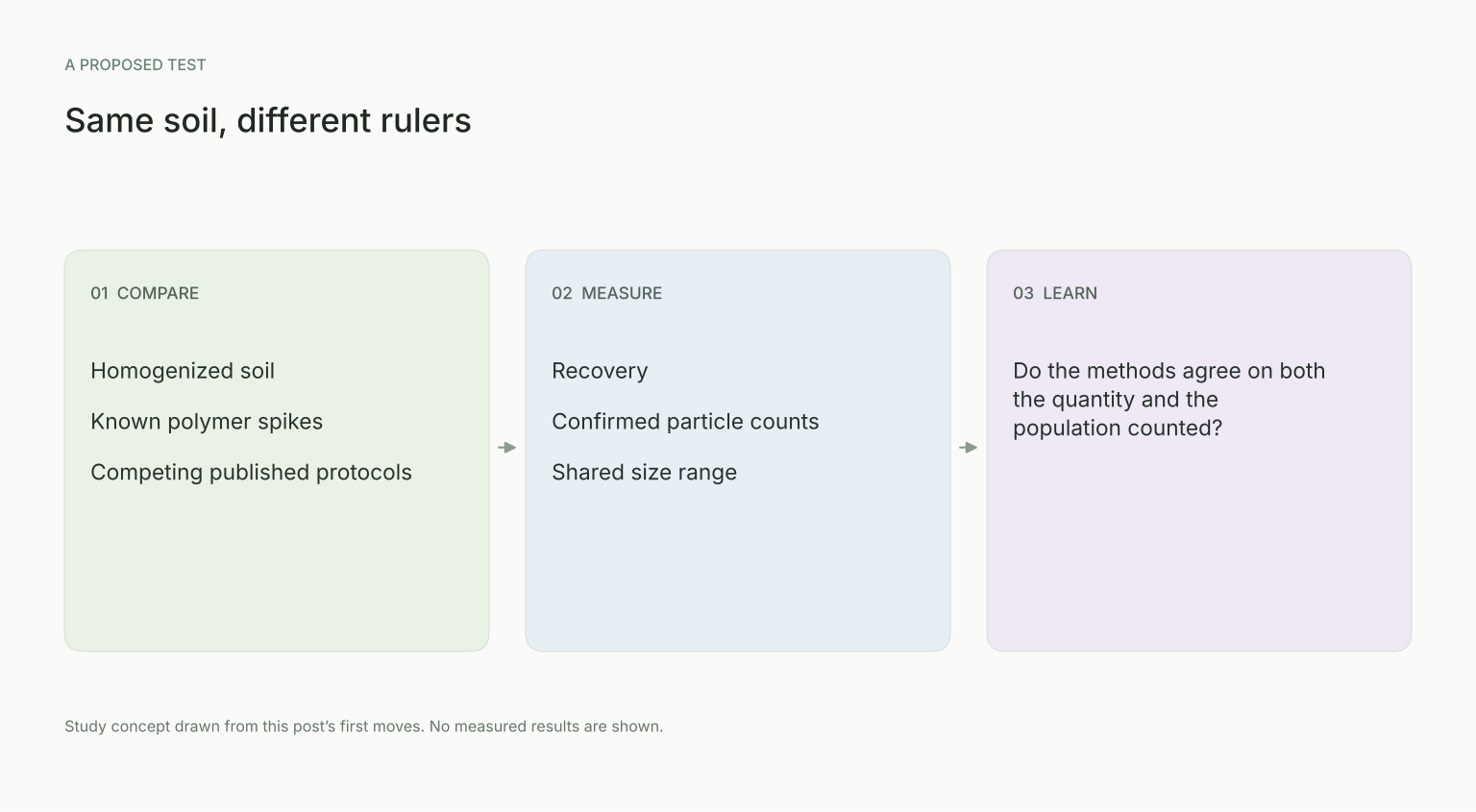
Take a single well-mixed field soil, divide it into replicate subsamples, and run each through a different published sampling-and-extraction method. If the methods disagree on particle counts from the same dirt, you have measured the size of the standardization gap directly.
- 2
Spike a known dose and see who finds it
Add microplastics at a known, realistic amount, then test which extraction methods recover the true quantity. Recovery rate is the missing common yardstick, and it is checkable against a number you set yourself.
- 3
Re-run two experiments on shared particles
Give both toolkits, Han's sieving and 16S and Zhou's zymography and respiration, the same polymer at the same dose. That shows whether biodegradable-is-risk-equivalent and biodegradable-is-a-turnover-hotspot really conflict or are just artifacts of different methods.
My working hypothesis
The missing shared method is not my inference, it is the reviews' own stated finding, which makes this one of the cleanest gaps in the whole set. A split-soil round-robin is cheap and would measure the gap directly. Until the leading methods are pointed at the same soil, I do not think anyone can honestly say two occurrence numbers agree, and most of our cross-study comparisons are running on trust.
An invitation
If you sample soil for microplastics, you already own one of the four methods this field is quietly using, and you probably know its quirks better than anyone. I would love to see even two of these methods pointed at the same bucket of soil, because until they are, I do not think any of us can honestly say our occurrence maps agree. Am I wrong to find it strange that we keep comparing numbers no one has yet shown are comparable?
Questions about this gap
What does a split-sample comparison control?
It gives competing methods portions of the same homogenized soil. That removes much of the between-site variation from the methods comparison.
Why add a known mixture of particles?
The known input makes recovery measurable. It helps distinguish a low environmental count from a method that failed to retrieve part of the mixture.
Can two methods agree and still miss particles?
Yes. Agreement is not the same as accuracy. Recovery experiments, blanks, and stated detection limits are needed alongside the comparison.
Why does the size cutoff matter?
Methods that count different size ranges are not measuring the same population. A shared cutoff or explicitly separated size bins makes comparisons more meaningful.
Would one successful test create a universal standard?
No. It would be a useful benchmark. Validation across soil matrices, polymers, and particle sizes would still be needed before broad adoption.