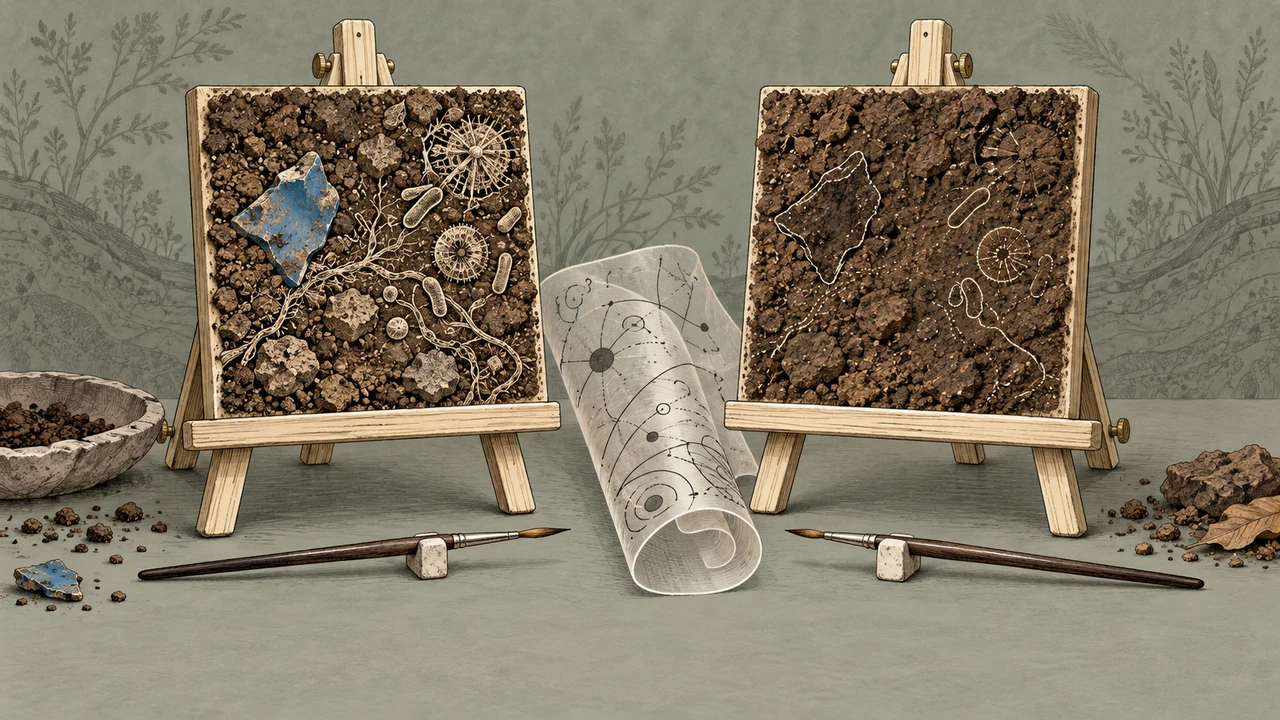
A lot of what we know about microplastics in soil rests on single experiments that read beautifully and get cited everywhere. Cited is not the same as confirmed. When I line up the primary studies in the removal-and-cleanup corner, I keep asking the same blunt question: has anyone reproduced this, at a realistic dose, in a real field, more than once? For a surprising amount of it, the honest answer is not yet.
Start with a striking result. In a one-year rice-wheat rotation, Han and colleagues mixed polyethylene and PLA into a silty loam at 0.5% by weight and watched the soil come apart at the crumb scale. Small clumps rose from 17% to as high as 35%, big clumps fell from 84% to about 65%, and the average clump size dropped from 1.4 to about 1.0 mm. Put plainly: the plastic broke the big, healthy clumps into smaller ones, and it barely mattered whether the plastic was conventional or biodegradable. That is a clean, quantified, important claim. It is also one experiment.
Now put a second primary study next to it, because this is where confirmation gets interesting. Zhou and colleagues added a biodegradable plastic, PHBV, and landed somewhere almost opposite. Microbes ate it as food, growing faster and building a more active biomass at the plastic surface, with two enzyme activities 0.6 to 5.0 times higher and the number of species actually rising, favoring Acidobacteria and Verrucomicrobia.
So the two disagree on a basic point. Han's plastic lowered the variety of microbes. Zhou's raised it. Both are single-lab results using different polymers and methods, and nobody has run them head-to-head. I can't tell yet whether they truly disagree or are measuring two different plastics in two different soils.
The reviews say the quiet part out loud. Aralappanavar and colleagues note that most of the microbial and nutrient evidence comes from short, high-dose lab jars, and they call for long field studies at realistic amounts. Sajjad and colleagues add the reason confirmation is so hard: there is still no standard way to sample and extract soil plastic. When every lab uses its own dose, its own polymer, and its own extraction, a second team can't cleanly repeat a first team's experiment even if it wants to.
Guo and colleagues frame the whole corner: soil is a real, understudied place for plastic, and inputs like mulch film and sludge keep arriving. The primary literature is growing fast. The machinery that would let us say 'yes, this repeats' has barely been built.
- Type
- Under-confirmed, unreplicated
- Field
- Soil microplastic remediation
- Comparative basis
- Single experiments vs. repeats
- Methods
- Aggregate assays, 16S sequencing, zymography
Why this is answerable now
Fast primary, thin confirmation
New primary experiments on soil plastic arrive quickly, but Aralappanavar and colleagues flag that most rest on short, high-dose lab jars rather than reproduced field work. Now is the moment to confirm the loudest results before they harden into textbook facts.
The biodegradable promise
Han concludes biodegradable plastic harms soil about like conventional, while Zhou shows a biodegradable polymer becoming a microbial food source. Policy is already nudging farmers toward biodegradable plastic, so whether that swap helps is worth settling this year.
No shared ruler yet
Sajjad and colleagues note there is still no standard soil-plastic sampling and extraction method. Agreeing on one now is what makes every future repeat comparable instead of orphaned.
Soil is still neglected
Guo and colleagues argue soil stays understudied next to the ocean, even as mulch film and sludge keep arriving. The catch-up is happening, and making it reproducible is the part that lasts.

Sources cited
Papers I read for this question. These notes distinguish reviews from primary studies and identify the limits of my access.
Frames soil plastic as real and neglected. The corner's starting point.
Reviewers name the replication problem: mostly short, high-dose lab jars.
No standard method, so independent repeats are hard to run.
04Microplastics alter soil structure and microbial community composition
Primary experimentPlastic broke soil clumps, biodegradable and not. One experiment.
05The microplastisphere: biodegradable microplastics alter soil microbes
Primary experimentMicrobes ate biodegradable plastic, diversity rose. Clashes with Han.
What’s missing — the gap
If two independent labs ran the same soil-plastic experiment at the same realistic field dose with the same extraction method, would the headline effects on soil structure and microbial diversity actually reproduce, or do our current single-experiment results not survive being repeated?
Han and Zhou point in different directions on microbial diversity, and each is a single lab using its own polymer and method. Without a shared dose and a shared extraction, a second team can't cleanly repeat either one. So we can't yet tell whether the two studies truly disagree, or whether one of them simply hasn't been checked. The confirming work has barely started.
First moves
- 1
Run the same experiment twice, on purpose
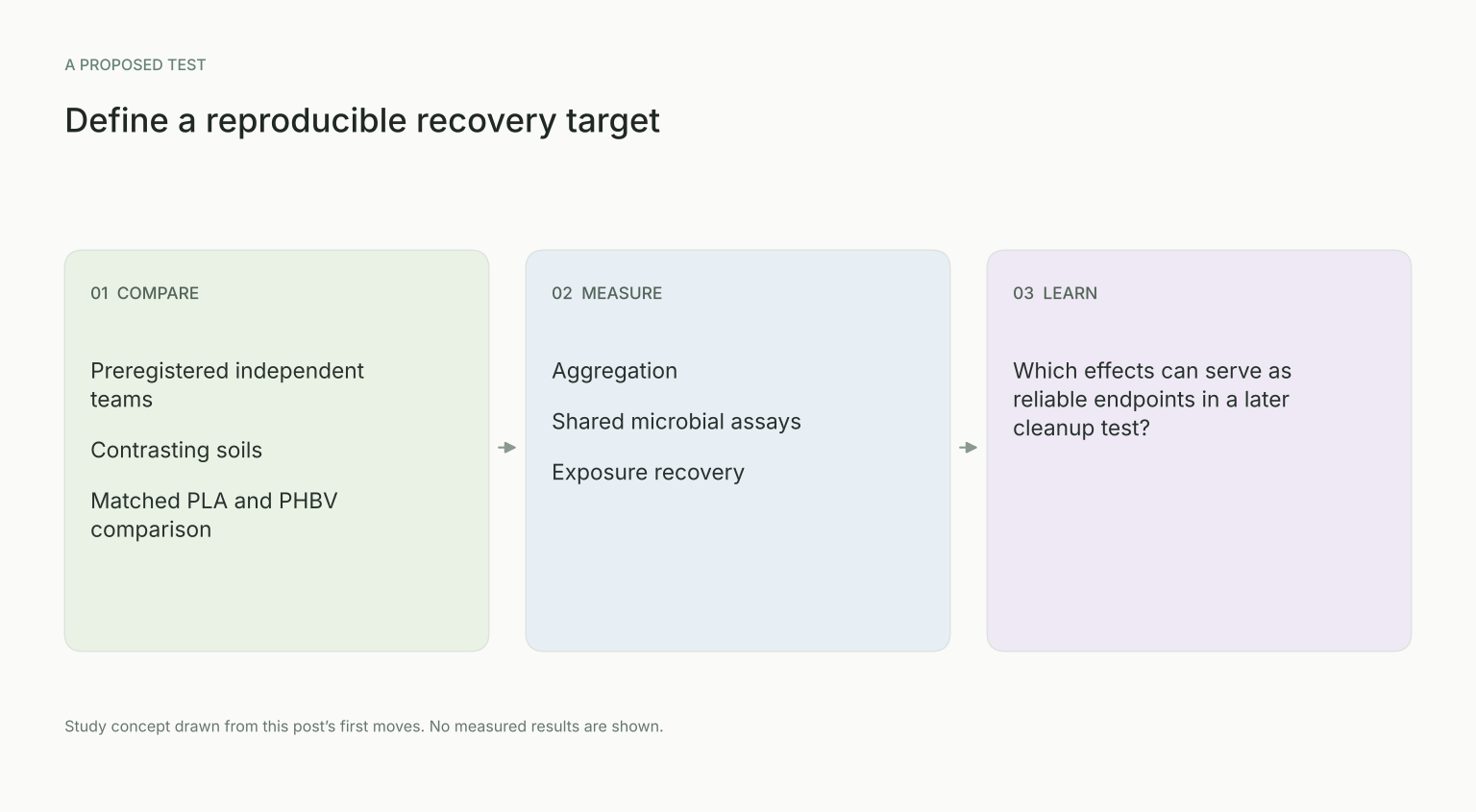
Take Han's aggregate-breakdown result and repeat it as a pre-registered, two-lab study in at least two soils at a dose closer to field reality than 0.5% by weight. Agreeing in advance on what counts as a reproduced effect is half the work.
- 2
Put the two biodegradable stories together
Han's PLA and Zhou's PHBV point in different directions on microbial diversity. Run both polymers side by side in one soil, with the same sequencing and enzyme assays, so we learn whether the disagreement is about the plastic or the method.
- 3
Pin down one extraction method first
Before more primary results pile up, a small ring trial where several labs extract plastic from the same spiked soil would show how much of our variation is real and how much is just different rulers. That directly addresses the gap Sajjad named.
Where I land
Where I land: this corner looks like a field building fast on foundations it never went back to check. I think Han's biodegradable-is-not-benign result will hold up and some of the diversity numbers will move once someone repeats them. The checking is far less glamorous than the next new effect, which is exactly why so little of it has happened. One honest two-lab repeat would teach me more than another single striking result.
An invitation
If you run soil-plastic experiments, I keep imagining the honest version of your lab notebook: the result you'd bet money survives someone repeating it, and the one that quietly worries you. From the outside this looks like a field building fast on foundations it never circled back to check, and the checking is far less glamorous than the next new effect. Maybe the repeats are already out there under search terms I haven't tried. How much of what we already call known is just a first result nobody went back to confirm?
Questions about this gap
What does this post want independently confirmed?
It focuses on structural and microbial effects that help define what recovery would mean. It does not report a completed test of a cleanup technology.
Why compare PLA and PHBV within one experiment?
They are different biodegradable polymers. Testing them with matched soil and assays is more informative than treating results from separate experiments as a direct contradiction.
What is the value of preregistration here?
It specifies the claim, endpoint, and comparison before results are known. That makes agreement and disagreement with the original study easier to interpret.
Why agree on extraction before comparing effects?
If laboratories recover different fractions of the plastic, their reported exposures may not be comparable even when the nominal dose is the same.
What would make a future cleanup claim stronger?
After establishing reproducible endpoints, test the treatment against those endpoints while also measuring material fate. Removing particles and restoring soil function should remain separate questions.