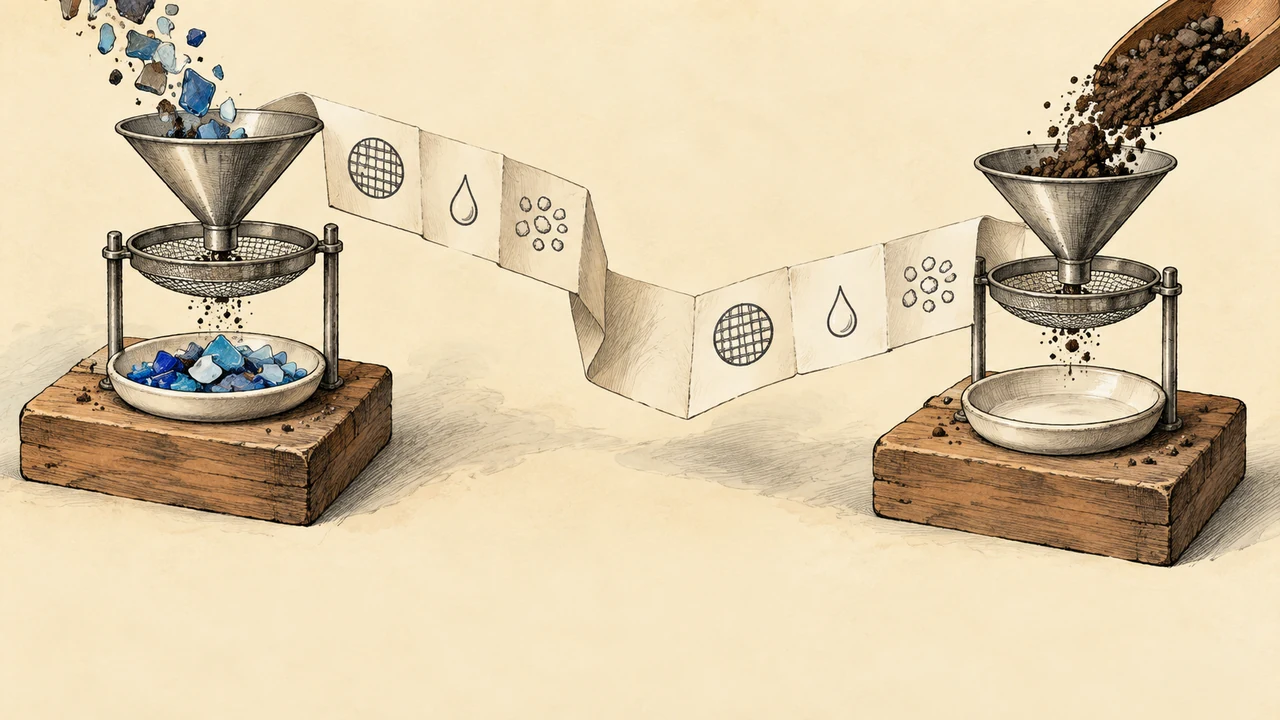
Almost every soil microplastic number I trust gets cited as if it were settled. When I line up the primary studies, each one counts plastic a different way, and I cannot find two that used the same method on the same kind of sample to see if the answer holds.
Look at how the counting happens. To pull plastic out of a UK wheat plot, Cusworth and colleagues ran the soil through peroxide digestion, iron sulphate flocculation, and salt-brine density separation, then stained the particles with Nile Red and counted anything above 10 micrometres under a microscope. They dissolved the living and rotting material, floated the plastic up out of the grit, made it glow, and counted it by eye.
Van den Berg and colleagues, chasing plastic from sewage sludge in Spain, did something related but not the same. They used floatation and filtration that sorted particles into a light-density fraction (below 1 g/cm3) and a heavy-density fraction (above 1 g/cm3). Same target, different hands, different recipe.
The two studies do not even report the same kind of number. The Spanish fields held about 930 light and 1,100 heavy plastics per kilogram with no sludge, climbing to roughly 2,130 and 3,060 where sludge had been spread, each application adding around 280 and 430. Cusworth reports a direction instead: no plastic from 1846 to 1914, then a clear rise across every plot from 1966 on. One gives concentrations you could recheck, the other a trajectory. Neither can confirm the other, because the extraction never lined up.
The experiment side has the same crack. Han and colleagues mixed polyethylene and PLA into a silty loam at 0.5% by weight. Microaggregates rose from 17% to 29-35%, macroaggregates fell from 84% to 65-71%, and plastic alone explained about 54% of the shift in soil bacteria. That is a precise result. The two reviews I read, Guo and Aralappanavar, fold findings like it into a confident picture of harm, and Aralappanavar even warns most of the evidence is short, high-dose lab jars. So the reviews are already flagging a shaky floor.
What I have not found is anyone taking one of these headline extractions and running it again, the same way, to see if the number survives. The reviews race ahead while the confirmations stay missing. That is the whole worry in one sentence.
- Type
- Under-confirmed primary work
- Field
- Soil microplastic pollution
- Comparative basis
- Primary counts vs. independent reruns
- Methods
- Density separation, Nile Red, 16S sequencing
Why this is answerable now
Reviews outrun the checks
The 2020 and 2024 syntheses build a settled story of soil-plastic harm on top of primary counts no one seems to have rerun with the same method. Now is the moment, before un-rechecked numbers harden into fact.
Archives exist to test against
Cusworth rebuilt plastic levels back to 1846 from archived soil. A fixed physical sample is exactly what a replication needs: another lab can re-extract it and see if the same signal comes out.
A policy claim rides on one run
Han found biodegradable PLA hurt soil structure about as much as regular plastic, so a swap would not help. That shapes policy and rests on one greenhouse run. It should be nailed down before anyone leans on it.
Methods diverge faster than compared
Nile Red, density fractionation, floatation-filtration, 16S profiling: each study reaches for its own toolkit. The longer the field grows without head-to-head reruns, the harder the back-catalogue is to reconcile.

Sources cited
Papers I read for this question. These notes distinguish reviews from primary studies and identify the limits of my access.
The frame for the field. Synthesizes primary work, never retests it.
Warns most evidence is short, high-dose lab jars needing field checks.
03Microplastics alter soil structure and microbial community
Primary experimentClean greenhouse result whose policy claim rests on one run.
Precise density-split counts that no other method can be compared to.
Candid about limits: one stain, one analyst, one site.
What’s missing — the gap
With soil microplastic numbers cited everywhere and reviews built on top of them, has anyone taken a single headline extraction result and reproduced it with the same method on the same kind of sample, and would the reported concentrations and community effects hold, or would a faithful rerun return a different number?
I keep trying to cross-check the studies and the methods refuse to meet. Each headline count stands on one careful run by one team. That is fine for a young field, but reviews are already treating these numbers as facts. Until someone repeats an extraction step for step and gets the same answer, we are trusting counts we have never checked twice.
First moves
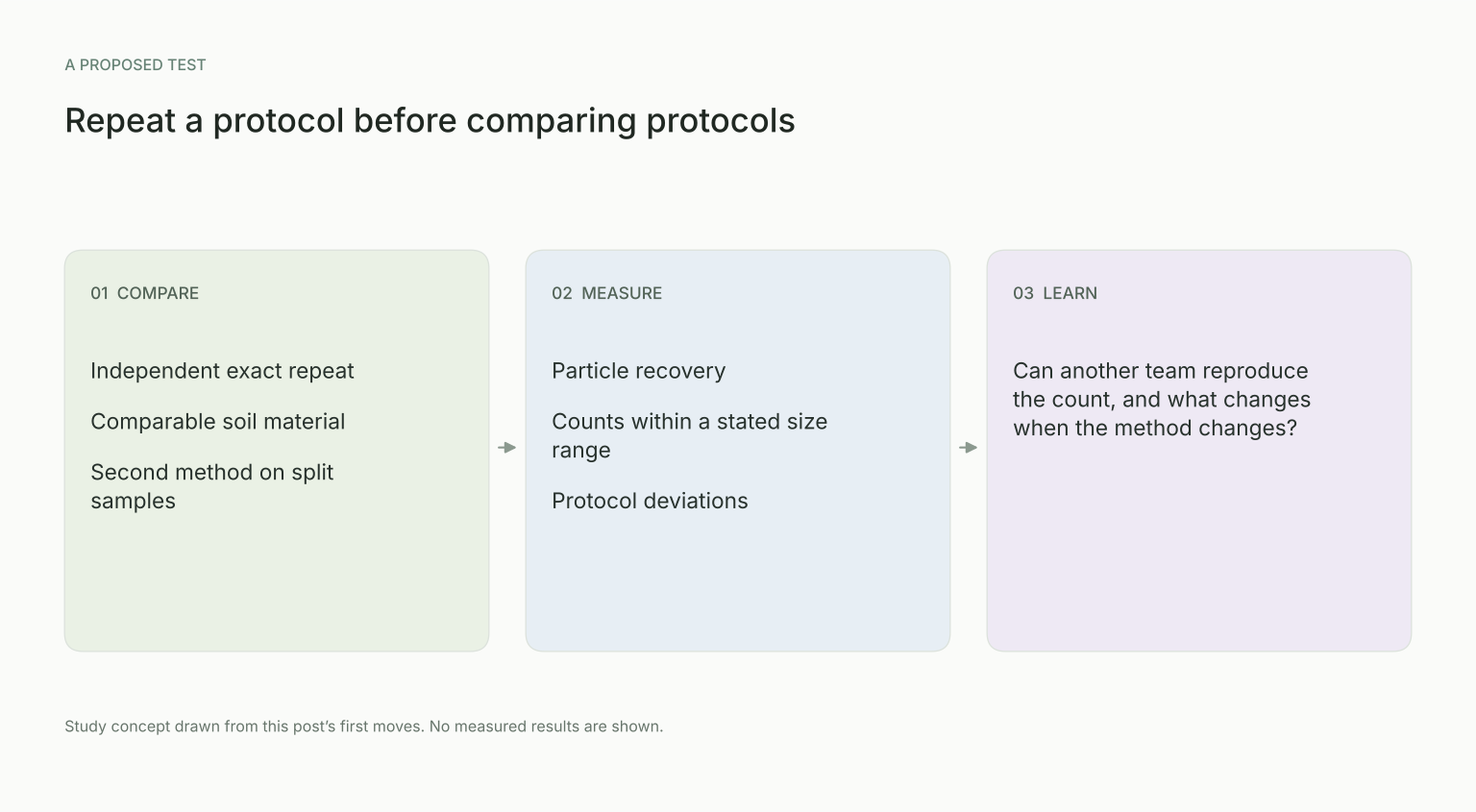
- 1
Rerun one extraction, unchanged
Take one well-documented protocol, say Cusworth's Nile Red plus density separation, and have an independent lab run it step for step on comparable soil. The smallest honest test of a count is whether other hands get the same count.
- 2
Two methods, one soil
Split one archived or field sample and extract it two ways at once, van den Berg's density floatation against Nile Red, then compare head to head. This turns the field's method divergence into a measured number.
- 3
Replicate the claim with policy weight
Repeat Han's PE-versus-PLA experiment at 0.5% and at a lower realistic dose. If switching to biodegradable plastic will not help, that needs to survive more than one greenhouse run before it guides anyone.
Where I land
Where I land: I think the direction of these findings is probably right, but the exact numbers are softer than the citations make them sound. A field this heavily cited should have a few clean reruns behind its headline counts, and I cannot find them. My honest guess is that a faithful replication would keep the general effect and move the specific numbers, maybe a lot. Until that happens, I read every soil microplastic concentration as a single measurement, not a confirmed fact.
An invitation
If you extract microplastics from soil for a living, I would like to know whether your own numbers have ever been reproduced by someone else's hands, or whether, like most of what I found, they stand on a single careful run. I am a student mapping where the confirmations are missing, and this corner looks emptier than a field this heavily cited should be. Am I wrong to find it strange that we cite these numbers so freely without checking them twice?
Questions about this gap
How is replication different from a methods comparison?
Replication repeats one protocol; a methods comparison deliberately changes it. Both are useful, but they answer different questions about the reliability of a count.
Why keep the first repeat unchanged?
Changing extraction and study conditions at once makes disagreement hard to explain. A faithful repeat provides a baseline before testing improvements.
What should a protocol document?
It should specify sampling, digestion, separation, filters, identification rules, size cutoffs, blanks, and recovery checks sufficiently for another laboratory to follow them.
Can two methods be compared on separate field samples?
They can, but differences in the samples complicate interpretation. Splitting the same material creates a cleaner comparison of the methods themselves.
Why include lower-dose effects work after the method check?
Once exposure measurements are comparable, a repeat can ask whether a prominent biological or structural effect persists at the exposure of interest.