Plastic in the ground breaks up soil clumps and changes how water soaks in. You will read that in almost every paper on the subject, cited like a settled fact. When I go looking for the moment a second lab confirmed it, the evidence gets thin.
Start with the strongest single piece of primary evidence. In a one-year rice-and-wheat greenhouse experiment, Han and colleagues mixed polyethylene and biodegradable PLA into a silty loam and watched the soil change. The tiny clumps rose from 17% to between 29% and 35%, the big clumps fell from 84% to between 65% and 71%, and the average clump size dropped from 1.4 mm to about 1.0 to 1.1 mm.
The plastic turned well-built soil crumbs into loose grit, and it barely mattered whether the plastic was conventional or biodegradable. The same experiment found plastic explained about 54% of the difference in which bacteria showed up. That is a clean, specific result. It is also, as far as I can find, a single study: one soil, one greenhouse, 0.5% plastic by weight, three replicates.
Now set that next to how the reviews describe it. Sajjad and colleagues report that plastic alters soil structure, porosity, bulk density, water-holding capacity, and infiltration, then add that the effects vary by type and concentration, and that there is still no standard way to sample and extract soil plastic. Aralappanavar's team is blunter about the base underneath: most evidence comes from short, high-dose lab pots, and they call outright for long field studies at realistic amounts.
The reviews are not disagreeing with Han. They are telling you that a headline effect measured once, at a dose far above field reality, with no shared protocol, has not yet been put through the checks that turn a finding into a fact.
So the pattern is a mismatch. There is substantial primary work reporting that plastic changes soil structure, and real review attention to plastic as an emerging soil pollutant. Guo frames it that way (Guo et al., 2020), and Kumar flags nonlinear soil behaviour and the lack of standard methods as open problems (Kumar et al., 2020).
What I cannot find is the step in between: the boring, essential, do-it-again work that checks whether the clump-breakdown effect survives a different soil, a different lab, and a dose that matches what actually ends up in a field. The claim is everywhere. The replication is thin.
- Type
- Under-confirmed primary work
- Field
- Soil physics and chemistry
- Comparative basis
- One greenhouse vs. independent labs
- Methods
- Aggregate sieving, 16S sequencing, dose-response
Why this is answerable now
The load is already there
Sajjad's review estimates roughly 700,000 tonnes of plastic reach farmland in Europe and North America each year, with up to 90% of Swiss floodplain soils already polluted. This is happening. The open question is whether the effects we keep reporting are real, and that is what a replication answers.
The safe substitute may not be
Han found biodegradable PLA damaged soil structure about as much as conventional PE. If that holds, switching farms to biodegradable film is a false comfort. That is a policy-relevant claim that needs a second lab before anyone builds a rule on it.
The tools are ready
The primary work already uses 16S sequencing, clump size-sorting, and carbon fingerprinting. The methods to reproduce these results exist. What is missing is the decision to run the same protocol twice.
No shared ruler yet
Sajjad and Kumar both note there is still no standard way to sample, extract, or count plastic in soil. That is usually a sign a field is young enough that a well-designed replication now can set the reference method everyone else measures against later.

Sources cited
Papers I read for this question. These notes distinguish reviews from primary studies and identify the limits of my access.
The 2020 review that framed soil plastic as a real, understudied threat.
Says the base is short, high-dose lab work. Calls for field studies.
Effects vary by type and dose. No standard measurement method yet.
04Microplastics alter soil structure and microbial community
Primary experimentThe single greenhouse result the whole claim rests on.
Flags nonlinear soil behaviour and no standard detection methods.
What’s missing — the gap
If several independent labs added the same plastic to their own soils, at the amounts a real field actually reaches, would they all see soil clumps break down and average clump size drop the way the single greenhouse study reports? Or does the effect quietly disappear once you leave the high-dose lab pot?
Right now the answer rests on one greenhouse. Han's result is clean and well-instrumented, but it is one soil at 0.5% plastic by weight, a dose far above field reality. Sajjad shows the effects swing with type and concentration, and Kumar warns the soil response may not be a straight line. Until a second lab runs the same test in different dirt at a real dose, the clump-breakdown effect is widely cited and barely confirmed.
First moves
- 1
A ring test of one effect
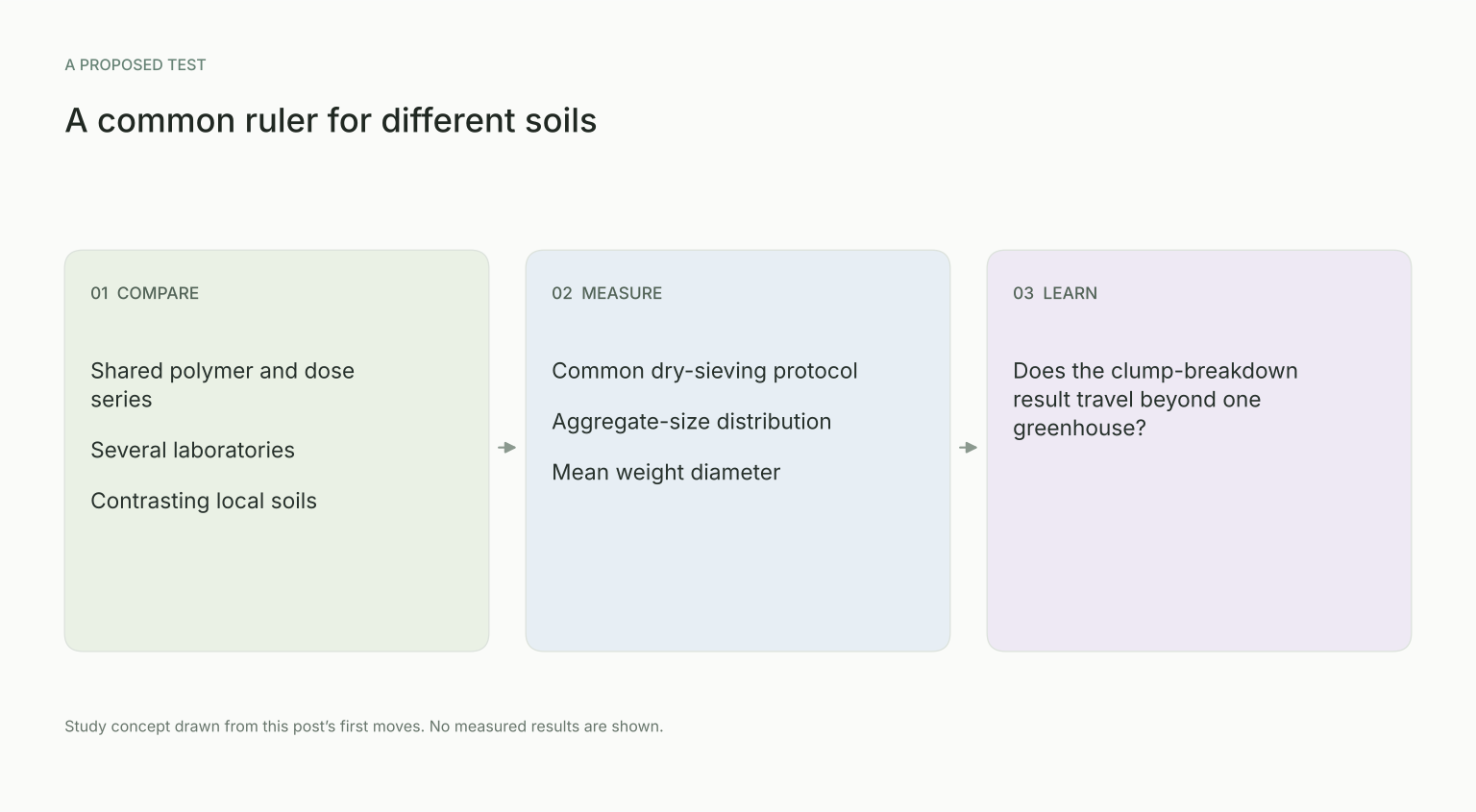
Pick the most-cited claim, plastic lowering average clump size, and have three or four labs run the same protocol on their own local soils, using Han's dry-sieving method as the shared ruler. Same plastic, same dose steps, different soils. The output is simple: does it reproduce, and does the size hold?
- 2
Walk the dose down to reality
Most confirming evidence sits at high doses like 0.5% by weight. Run one clean dose series from that benchmark down to measured field loads. If the clump effect is nonlinear or vanishes at real doses, that is the most useful thing we could learn, and Kumar's review predicts it might.
- 3
Re-test the biodegradable claim
Han's finding that PLA damages structure about as much as PE is high-stakes and, right now, singular. Reproduce that head-to-head, conventional versus biodegradable, same soil, same dose, in at least one independent lab before anyone treats biodegradable film as the fix.
Where I land
Where I land: I believe Han's effect is probably real in that soil, but I would not build a policy on it yet, and I would bet its size shrinks at field doses. The claim has been cited far more often than it has been checked. One honest replication in a second lab would tell us more than the next ten papers that assume the first was right.
An invitation
If you run a soil lab, you already have the sieves, the sequencer, and the soil. The missing part is someone willing to do the unglamorous work of running a published experiment again to see if it holds. Before the clump-breakdown claim hardens into textbook fact on one greenhouse, has anyone reproduced it in your soil? If not, what would it take, or am I wrong to find that as strange as I do?
Questions about this gap
What is the main outcome to reproduce?
The proposed repeat focuses on aggregate-size distribution and average clump size after a defined plastic exposure, using a shared measurement method.
Why use several laboratories and local soils?
Independent teams test reproducibility, while contrasting soils test generality. Both are useful, but the design must distinguish laboratory effects from soil effects.
What does a dose series add?
It tests whether the response changes gradually, appears only above a threshold, or becomes undetectable at lower exposure. A single high dose cannot resolve that pattern.
Why repeat the biodegradable comparison separately?
The conclusion has practical implications, but one polymer comparison in one soil cannot establish how all biodegradable materials behave.
Does a failed low-dose repeat disprove the greenhouse result?
No. It could show that the original result is exposure-dependent. That is a limit on generalization, not necessarily an error in the original experiment.