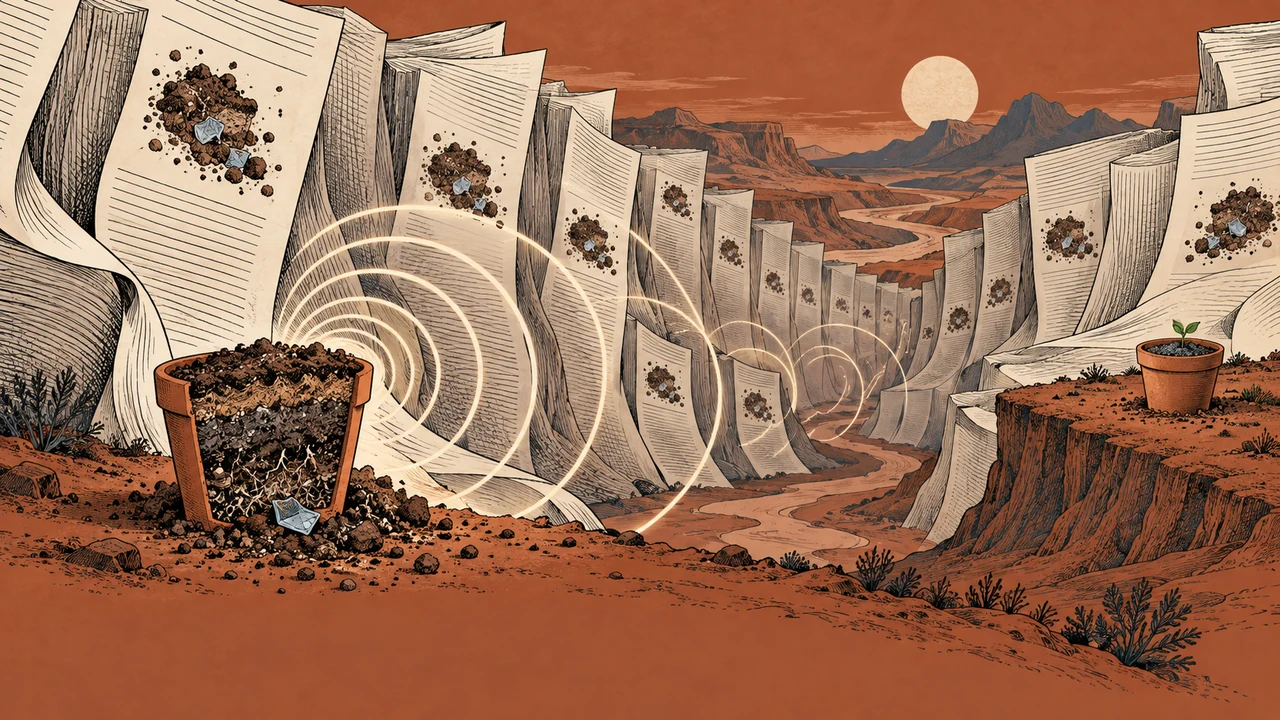
One result shows up in the intro of nearly every soil-microplastics paper: plastic reshapes how soil holds together and rearranges the microbes inside it. Trace that sentence back and you often land on a single greenhouse experiment that, as far as I can find, nobody has run again.
Take the clearest example. In a one-year rice-wheat rotation, both regular polyethylene and biodegradable PLA were mixed into a silty loam at 0.5% by weight, and both pushed the soil toward finer structure. Microaggregates rose from 17% to 29-35%, macroaggregates fell from 84% to 65-71%, and the mean weight diameter dropped from 1.4 mm to about 1.0-1.1 mm, with plastic explaining roughly 54% of the shift in bacteria (Han et al., 2024). The crumbs got smaller, the soil held together less well, and the microbes moved right along with the structure. That is a specific, quotable finding. It is also one experiment, three replicates, one soil, one season.
Set that next to a second primary study. Zhou and colleagues looked at the microplastisphere, the thin zone where soil meets a plastic particle, and found a biodegradable polymer, PHBV, being eaten by microbes, which raised enzyme activity to 0.6-5.0 times the surrounding soil and lifted microbial variety (Zhou et al., 2021). One paper says the plastic makes the microbes more competitive and the structure looser. The other says a biodegradable plastic feeds the microbes and raises diversity. They are not flatly opposed, and they are not obviously the same story either.
Here is the catch. The reviews sitting above both note that most of this evidence comes from short, high-dose lab jars, with no standard way to sample or extract microplastics from soil in the first place (Aralappanavar et al.; Sajjad et al.). Two labs cannot even line their numbers up, because they are measuring on different rulers.
This is what keeps nagging at me. Occurrence and spatial distribution has a real pile of primary work behind it, and the reviews agree the topic matters and that soil has been studied far less than the ocean (Guo et al., 2020). Agreeing a topic matters is not the same as confirming any one of its headline results. I keep wondering which effects, the shrinking crumbs, the competitive microbial networks, the verdict that biodegradable is just as bad, would survive a second lab, a real field, and a dose the soil actually sees.
- Type
- Under-confirmed, rarely repeated
- Field
- Soil microbial ecology
- Comparative basis
- Primary results vs. replication
- Methods
- 16S sequencing, aggregate sieving, zymography
Why this is answerable now
No shared method
There is still no standard way to sample or extract microplastics from soil (Sajjad et al.), so two labs studying the same effect may not be measuring the same quantity. You cannot repeat a result you cannot measure the same way twice.
Lab, not field
The reviews are blunt that most evidence is short, high-dose lab jars, and they call for long-term field studies at realistic amounts (Aralappanavar et al.). The biggest confirmation experiments have not been run yet.
A decision rides on it
Han concludes biodegradable plastic harms soil structure about as much as regular plastic, so swapping would not help. That is close to a policy recommendation resting on one experiment, the kind of claim that should be repeated first.
Soil is behind the water
Guo documents that soil has been studied far less than the ocean. Occurrence and distribution is where primary work has piled up fastest, which makes it where under-confirmed results can hide the longest.

Sources cited
Papers I read for this question. These notes distinguish reviews from primary studies and identify the limits of my access.
The 2020 review that said soil was ignored next to the ocean.
Best current summary. Calls the evidence suggestive, not confirmed.
Top source is mulch film. No standard way to measure yet.
04Microplastics alter soil structure and microbial community
Primary experimentOne greenhouse, three replicates. The result nobody has repeated.
Microbes ate the biodegradable plastic and sped up. Abstract only.
What’s missing — the gap
For microplastics in soil, do the headline primary results, the aggregate-structure shift and the microbial-community reshuffle from single greenhouse and microplastisphere experiments, reproduce in independent labs and in real fields at realistic amounts, or are they artifacts of short, high-dose, non-standardized jars?
The whole area has grown fast on primary work that few people have gone back to confirm. Han's aggregate result rests on one soil and three replicates. Zhou's microplastisphere result is available only as an abstract. Both are strong studies, and neither has clearly been run again at a dose the soil would ever really see. Until someone repeats them on purpose, we do not know which effects are real and which belong to the jars.
First moves
- 1
Rerun the aggregate result on purpose
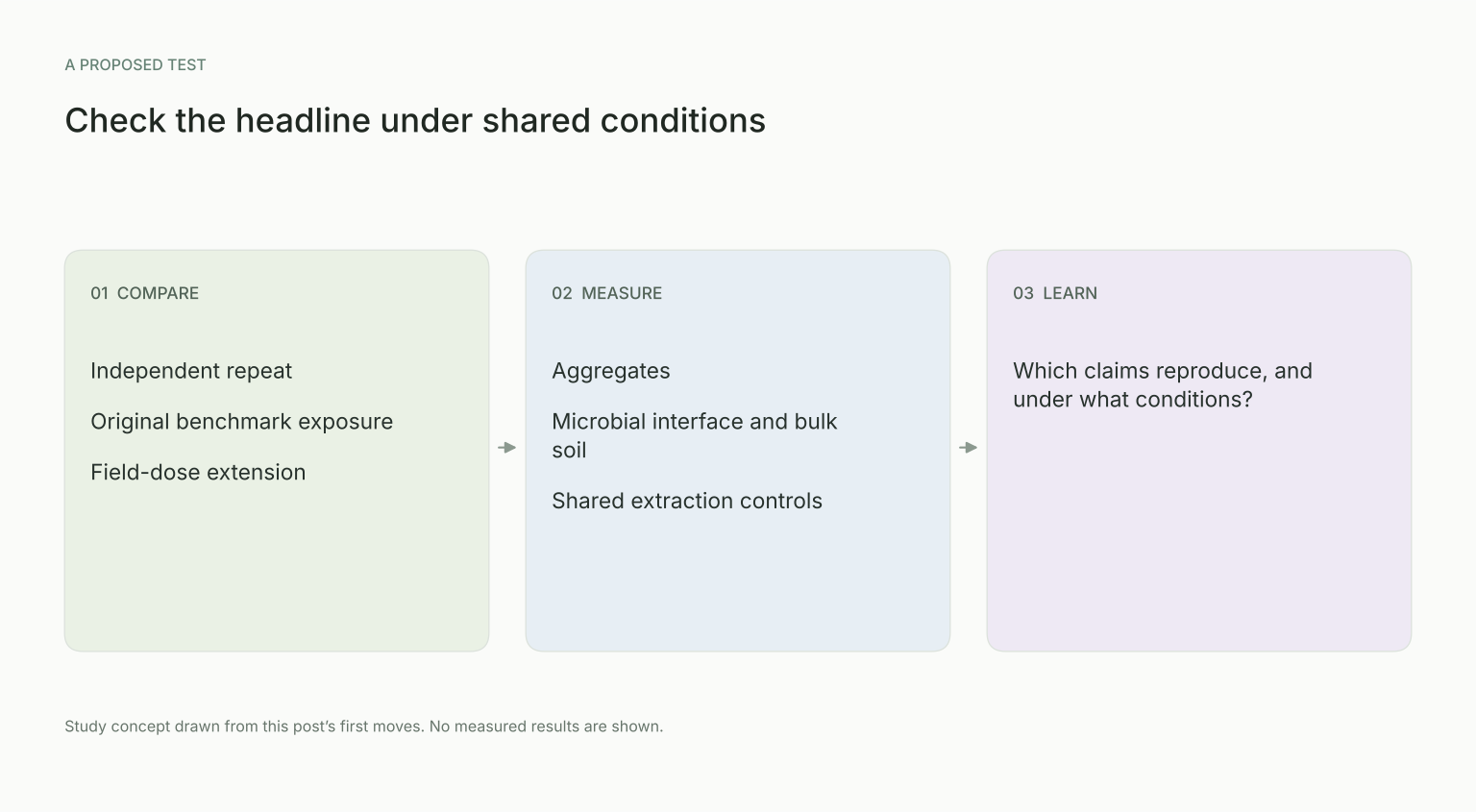
Take Han's design, regular and biodegradable plastic at 0.5% in a silty loam, and repeat it in a second, independent lab with the single goal of checking whether the crumb shift shows up again. Publish the effect size whether it repeats or not.
- 2
Drop the dose to what soil sees
Run the same structural and microbial measurements at field-realistic amounts rather than the high loads the reviews flag. That tells us whether the effect is real at the exposures soils actually get, not only at the exposures that are easy to detect.
- 3
Fix the method before comparing
Organize a small round-robin where several labs process splits of one shared soil using a single agreed sampling and extraction protocol. That attacks the no-standard-method problem so future replication attempts are actually comparable.
Where I land
Where I land: this corner has grown on primary work that few people have gone back to check, and the most useful thing anyone could do now is take an old result and run it again, carefully. My guess is that the loudest results soften at realistic doses, while the basic crumb shift probably survives. What bothers me most is Han's biodegradable-is-just-as-bad conclusion, because it is close to policy and rests on a single experiment.
An invitation
My read is that occurrence and spatial distribution has grown fast on primary work that few people have gone back to confirm, and that the most useful thing anyone could do right now is an old result, run again. I am a student mapping this from the outside, and the people who have actually pipetted plastic into soil know things I cannot see from the papers. So here is the one I keep turning over: if a result has been quoted a thousand times and tested exactly once, do we really know it at all?
Questions about this gap
Why repeat structural and microbial results together?
They are often used to describe the same soil-plastic problem, but they measure different outcomes. A shared repeat can test which responses travel beyond the original setup.
Why separate a faithful repeat from a field-dose test?
The faithful repeat checks the original conditions. The field-dose test asks a new question about exposure relevance; combining the two steps can obscure why a result changed.
What does the abstract-only label mean?
Nyssa’s reading notes identify a source accessed at abstract level. It flags a limit on the available methodological detail, rather than a judgment that the paper is weak.
What can a shared reference soil establish?
It can reveal whether laboratories recover comparable particle counts from the same material. That makes later comparisons of biological effects easier to interpret.
Are these proposals evidence that the cited effects are false?
No. They identify a need for confirmation and clearer limits. A proposed replication should allow for either agreement or disagreement with the original result.