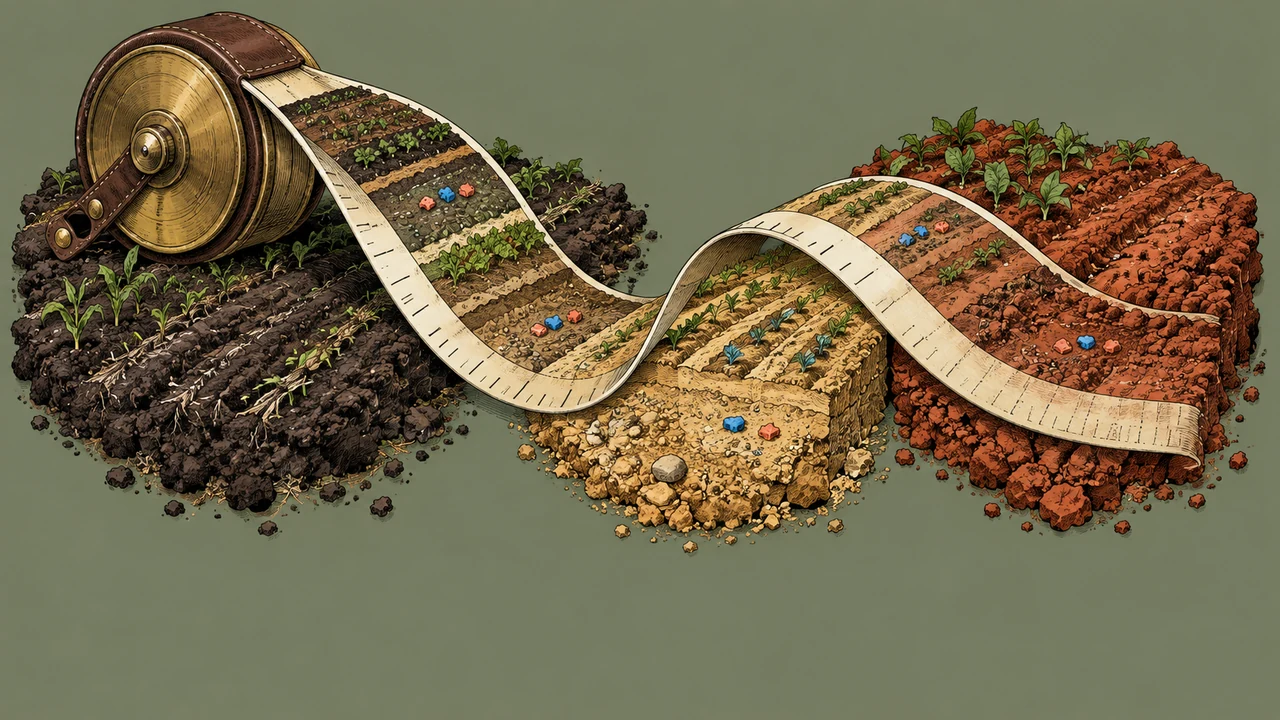
Some of the most-cited numbers about how microplastics move through and build up in farm soil come from a handful of studies. When I follow the citations, I keep landing on the same few original measurements, quoted with confidence and rarely repeated.
Start with the sturdiest-looking number I found. In eastern Spain, van den Berg and colleagues tracked plastic buildup in farmland that had taken sewage sludge. Each round of sludge added roughly 280 light and 430 heavy particles per kilogram, with sludged soils holding about 2,130 light and 3,060 heavy versus roughly 930 and 1,100 in soils that never got any. The more sludge you spread, the more plastic stacks up, in near-proportion. It's a clean, believable dose-response. It also comes from one region, four treatment plants, and 16 fields. Nobody, as far as I've found, has re-run that exact accounting in another country's soils to see if the per-application step holds.
The same pattern shows up in how plastic reshapes soil structure. Han and colleagues mixed polyethylene and biodegradable PLA into a silty loam and found the small-crumb fraction rose from 17% to 29-35% while large crumbs fell from 84% to 65-71%, dropping average crumb size from 1.4 mm to about 1.0 mm, largely regardless of plastic type or size. Even the biodegradable kind did comparable damage. That squares with the broad reviews saying microplastics change porosity, bulk density, and water-holding (Sajjad et al., 2022; Guo et al., 2020). But it's one greenhouse, one soil, one rice-and-wheat year, at a 0.5% dose. A repeat in a different soil could either confirm it or quietly overturn it.
Here's what makes me uneasy, and it comes straight from the reviewers. Aralappanavar and colleagues note that most of the evidence is short-term, high-dose lab jars, and they ask outright for long-term field studies at realistic amounts. That's a field admitting its own base is thin. It sits against the confident tone of the primary papers. Han explains a striking 54% of the shift in bacteria from plastic addition, while the reviews say the whole literature leans on doses far above what real fields see.
When the synthesis papers are asking for confirmation instead of delivering it, that's the sign the primary work here has been cited faster than it has been checked.
- Type
- Replication, under-confirmed
- Field
- Soil physics and transport
- Comparative basis
- Primary results vs. independent repeats
- Methods
- Field sampling, greenhouse dosing, round-robin tests
Why this is answerable now
The reviewers are asking
The most recent synthesis openly says the evidence is short-term, high-dose, and lab-bound, and calls for long-term field work at realistic amounts (Aralappanavar et al., 2024). That's a field naming its own replication gap out loud.
Sludge keeps going down
Sewage sludge is a live, ongoing input, and the Spanish fields showed the count climbing with each application (van den Berg et al., 2020). Every season it spreads is another chance to confirm or break the dose-response.
The 'safe' swap isn't confirmed
Biodegradable PLA harmed soil structure about as much as regular polyethylene in one greenhouse (Han et al., 2024). Policy is already nudging toward bioplastics, so whether that single result reproduces matters right now.
No shared method yet
There's still no standard way to sample and extract microplastics from soil (Sajjad et al., 2022). The window to build replication and a shared method together, instead of retrofitting later, is open now.

Sources cited
Papers I read for this question. These notes distinguish reviews from primary studies and identify the limits of my access.
Frames the gap; as a review it inherits whatever the primary studies got right.
Admits the base is short, high-dose lab work and asks for confirmation.
No standard extraction method, which is the mechanical reason replication is hard.
04Microplastics alter soil structure and microbial community
Primary experimentA strong, specific greenhouse result begging to be reproduced in other soils.
The cleanest dose-response in the set, from a single region.
What’s missing — the gap
If the headline transport-and-leaching numbers, the per-application sludge increment, the crumb-breakdown percentages, and the 54% of microbial variance, were re-measured across several soils, climates, and independent labs using a shared method, would they reproduce within a reasonable margin, or are they single-site measurements the field has been citing as settled?
These figures get quoted like constants. Underneath, each is one study, in one place, once. Van den Berg's dose-response is one region. Han's crumb result is one greenhouse and one soil. The reviews that lean on them admit the base is thin and ask for confirmation. Until someone re-runs these in a different soil under a shared method, we can't tell whether the numbers describe soil microplastics or describe one field in Spain and one pot in a greenhouse.
First moves
- 1
Repeat the sludge accounting outside Spain
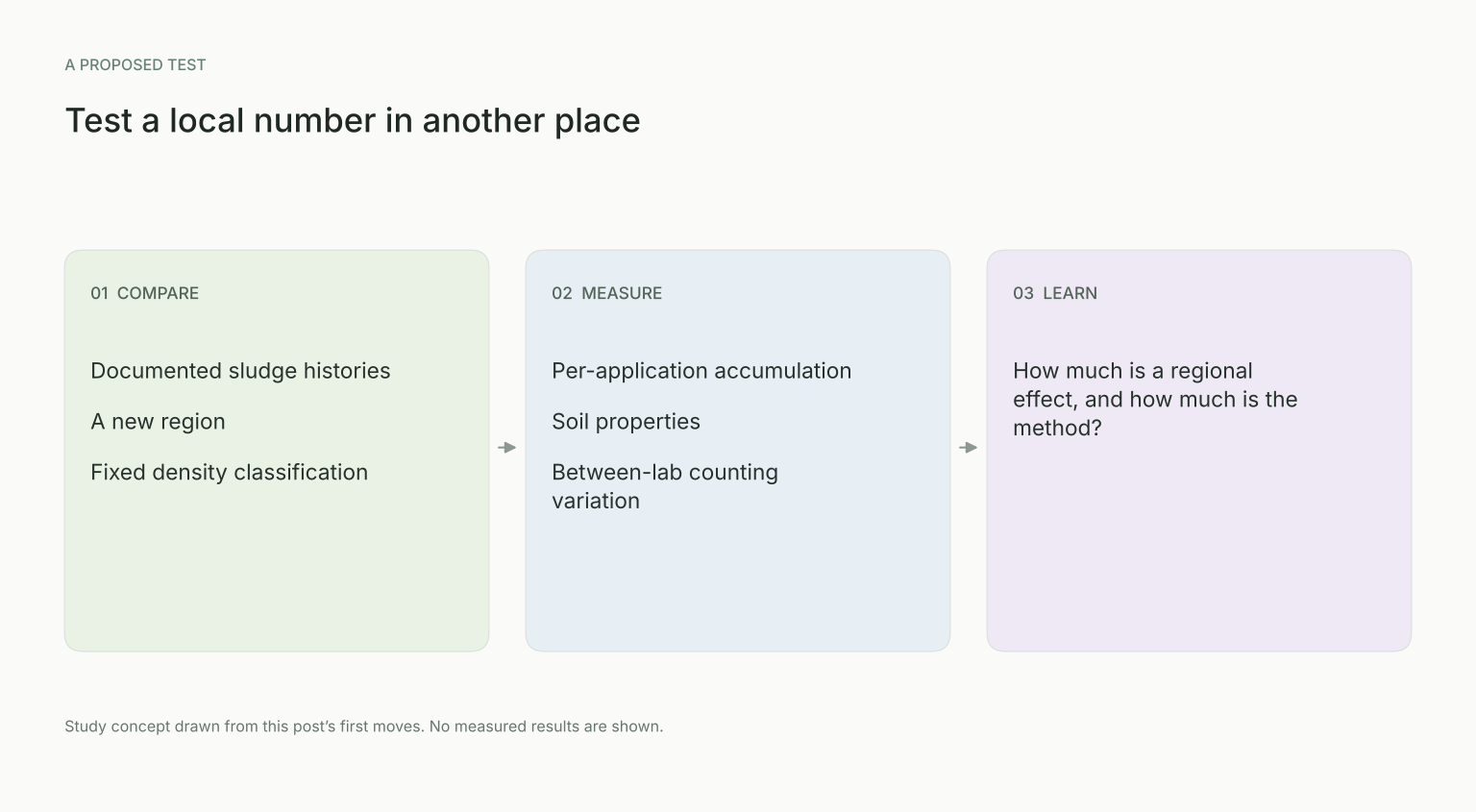
Take van den Berg's design, fields with a known count of past sludge applications, particles split by density, a fitted per-application step, and run it in another country's soils and sludge stream. If the roughly 280-light and 430-heavy slope reappears, it graduates from a local finding to a real dose-response.
- 2
Re-run the crumb test at realistic doses
Han used 0.5% in a greenhouse; the reviews say real fields see far less. Redo the crumb-size and average-size measurements across a dose gradient down to realistic amounts, in more than one soil texture, to test whether the 17%-to-29-35% shift survives outside one silty loam.
- 3
Do a round-robin on one soil
Since there's no standard extraction method (Sajjad et al., 2022), split one homogenized, plastic-spiked soil among several labs and have each count it their own way. That measures how much of the between-study spread is real versus method noise, which any honest replication here needs first.
Where I land
Where I land: I'd bet van den Berg's sludge dose-response mostly holds, because it's a simple accounting of what goes in, but I'd expect the exact per-application number to drift a lot with soil and sludge type. Han's 54% figure worries me more. A signal that clean from one greenhouse is the kind that shrinks the moment a second lab tries it in a different soil. What I'm most sure of is the boring fix: without a shared extraction method, none of these can be checked properly, so that method is the first thing to build.
An invitation
This is the corner I keep circling: a set of confident, widely quoted numbers about how plastic moves and builds up in soil, resting on studies almost no one has repeated, and reviews that, read closely, are quietly asking for that confirmation. If you run a soils lab, or you have fields with a known sludge history sitting right there, you're holding the tools to turn one of these one-off results into something the field can stand on. So which of these numbers would you bet reproduces, and which one do you quietly suspect wouldn't?
Questions about this gap
Why should a per-application accumulation rate be checked elsewhere?
Sludge composition, soil, management, and measurement can differ between regions. An increment observed in one setting should not automatically be treated as a universal constant.
Do aggregate measurements directly measure transport?
No. They describe a possible influence on transport. Particle movement or leaching needs a direct measurement if the study is to establish that connection.
What should remain fixed in a regional repeat?
The particle classification, extraction workflow, and reporting units should be documented and comparable, while regional conditions are recorded as potential explanations for differences.
Why run a methods round-robin first?
It estimates variation caused by processing and counting the same soil. Without that information, a regional difference could be mistaken for a biological or environmental one.
How should disagreement be reported?
Report the estimated effect and uncertainty alongside differences in soil and method. A useful repeat explains the conditions under which the figures agree or diverge.