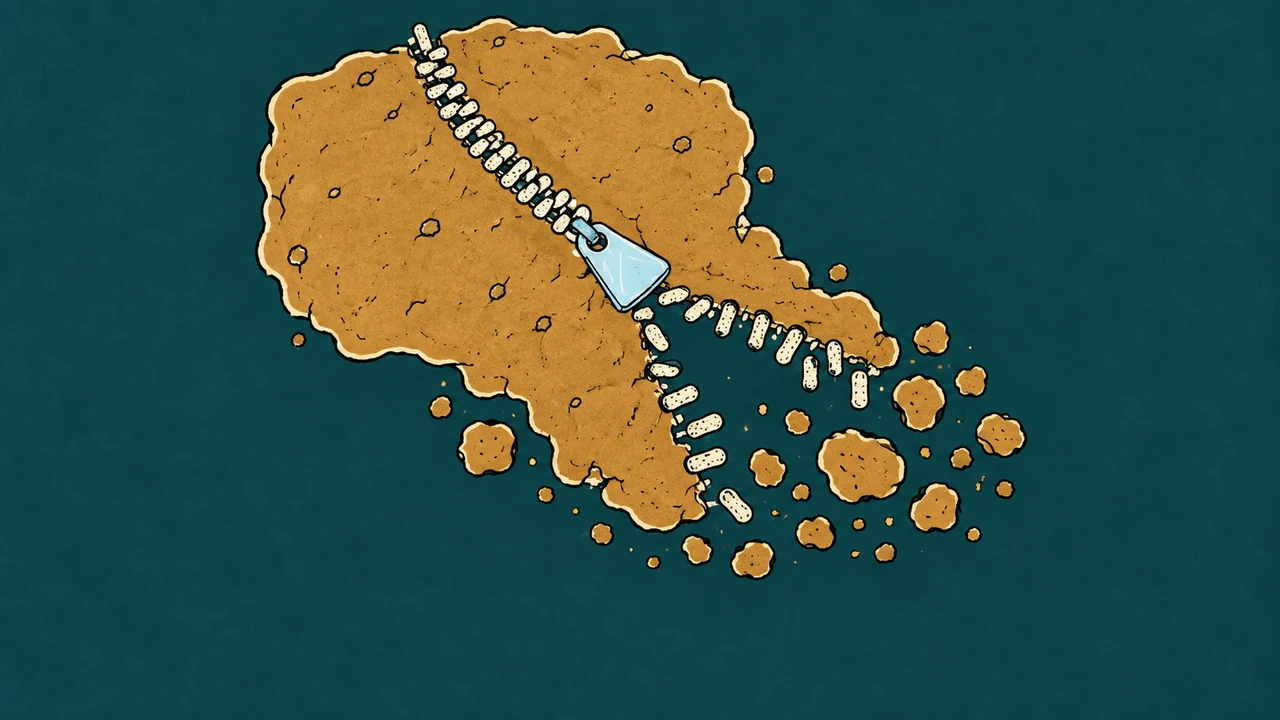
Two things happen on a buried scrap of plastic in farm soil, and they get studied almost entirely apart. Microbes colonize the plastic surface and build a biofilm, the plastisphere. That same plastic reshapes how the soil clumps into crumbs. Each is a busy field on its own. Where the two meet is where the map goes blank.
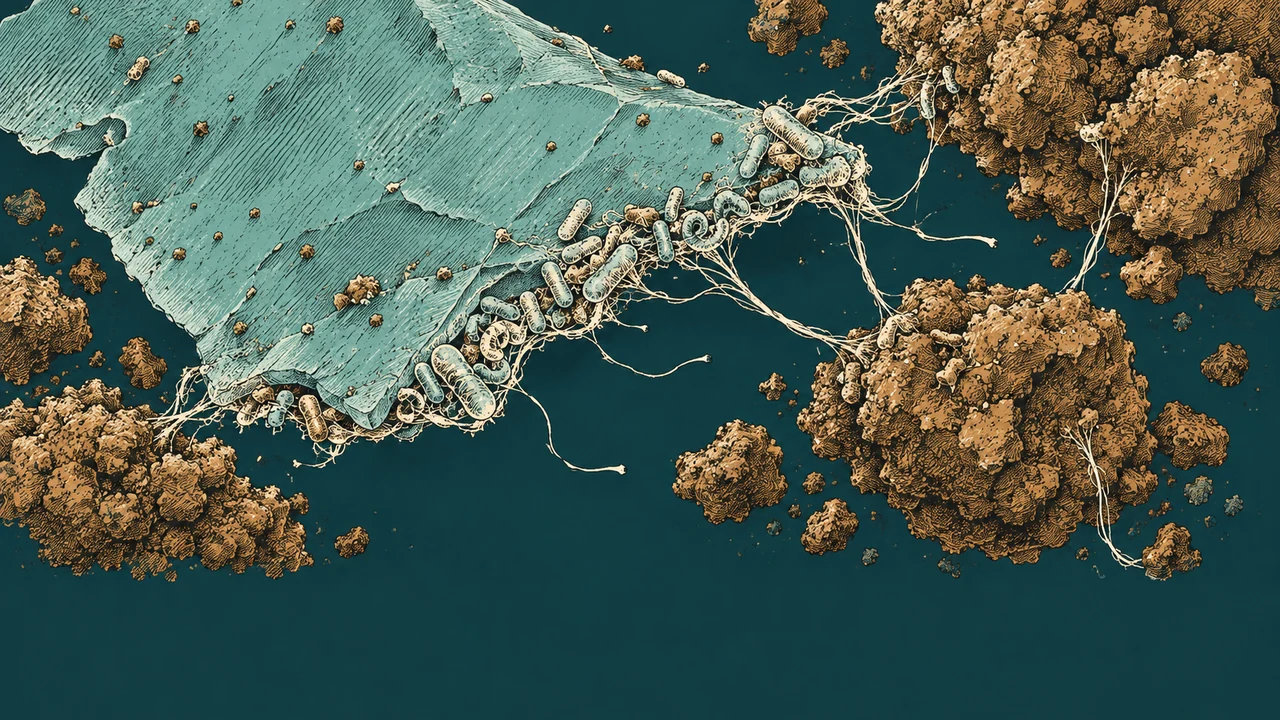
Start with the biofilm side. A 2024 review reports that both the plastisphere and plastic-contaminated soils carry distinct communities with lower diversity than clean soil, enriched in plastic-degraders like Actinobacteria, Proteobacteria, Bacteroidetes, and Ascomycota (Aralappanavar et al., 2024). A piece of plastic becomes a surface that selects for one crowd of microbes and shuts out others. A primary experiment on the microplastisphere, the thin zone right at the soil-plastic interface, pushes this further: a biodegradable plastic, PHBV, was eaten as a carbon source and turned that interface into a spot of faster microbial growth and higher enzyme activity than the surrounding soil (Zhou et al., 2021).
Now the structure side. A 2024 greenhouse study mixed regular and biodegradable plastic into a silty loam at 0.5% and, after a rice-wheat rotation, sieved the soil into aggregate sizes (Han et al., 2024). Both plastics pushed the soil toward more microaggregates, from 17% up to 29-35%, and fewer of the larger macroaggregates, from 84% down to 65-71%, lowering the mean weight diameter from 1.4 mm to about 1.0-1.1 mm. The two sides quietly touch here: the authors tie part of that structural loss to reduced microbial byproducts and binding agents. The substances that hold soil crumbs together are largely made by microbes, so a change in the microbial community is also a change in soil structure. The same study found plastic explained about 54% of the variance in bacteria, and the microaggregate communities were the most sensitive of all.
So the pieces are almost holding together, and the fields stay separate. Han measured aggregates and community shifts in the same soil but read the microbes mainly as a cause of structure, not as biofilms in their own right. Zhou described the microplastisphere biofilm in fine detail but did not track what it did to aggregate structure.
This squares with the older reviews, which record that plastic alters soil structure, porosity, and water-holding while also acting as microbial habitat and carrier for other pollutants (Sajjad et al., 2022; Guo et al., 2020). Those two roles are catalogued side by side, rarely connected. The biofilm on the plastic and the crumb structure of the soil are driven by one and the same surface, and almost no one has measured them as one system.
- Type
- Interaction, studied apart
- Field
- Soil microbial ecology and structure
- Comparative basis
- Biofilm studies vs. aggregation studies
- Methods
- 16S sequencing, zymography, aggregate sieving
Why this is answerable now
Plastic is already there
The reviews put near 700,000 tonnes of plastic reaching farmland each year in Europe and North America, with up to 90% of Swiss floodplain soils polluted (Sajjad et al., 2022). The interface we are asking about already exists in real farm soil at scale.
Biodegradable is not safe
Han found biodegradable plastic damaged soil structure about as much as regular plastic, and Zhou found biodegradable plastic actively feeds and reshapes the microbes. The green swap is being made now, before we understand its combined effects.
The methods now overlap
One team already pairs 16S sequencing with aggregate sieving (Han et al., 2024), another pairs zymography with the microplastisphere (Zhou et al., 2021). The tools to study biofilm and aggregation together exist. They just have not been aimed at the same soil.
Mostly short, high-dose evidence
The 2024 review notes most findings come from short, high-dose lab jars and calls for long-term field studies at realistic amounts (Aralappanavar et al., 2024). A coupled biofilm-and-aggregation study done right could answer that call and close two gaps at once.

Sources cited
Papers I read for this question. These notes distinguish reviews from primary studies and identify the limits of my access.
The 2020 review that said soil was ignored next to the ocean.
The plastisphere carries distinct, lower-diversity microbial communities.
Plastic hits both structure and biology, catalogued separately.
04Microplastics alter soil structure and microbial community
Primary experimentTies the crumb collapse partly to lost microbial binding agents.
The biofilm in fine detail, but never checks soil structure. Abstract only.
What’s missing — the gap
When a microplastic surface becomes a plastisphere biofilm in soil, does that biofilm drive the shift toward smaller aggregates and lower mean weight diameter, measurably, in the same soil, through the binding agents its microbes make? Or are the biofilm and the structural change two independent effects of the plastic that happen to sit next to each other?
Han invokes reduced microbial binding agents to explain the crumb collapse, and Zhou shows the biofilm at the interface running hotter and more active. Those look like two views of the same process, but no single study has measured the biofilm and the aggregate structure on the same samples. Until one does, the mechanism stays inferred rather than observed.
First moves
- 1
One soil, both readouts
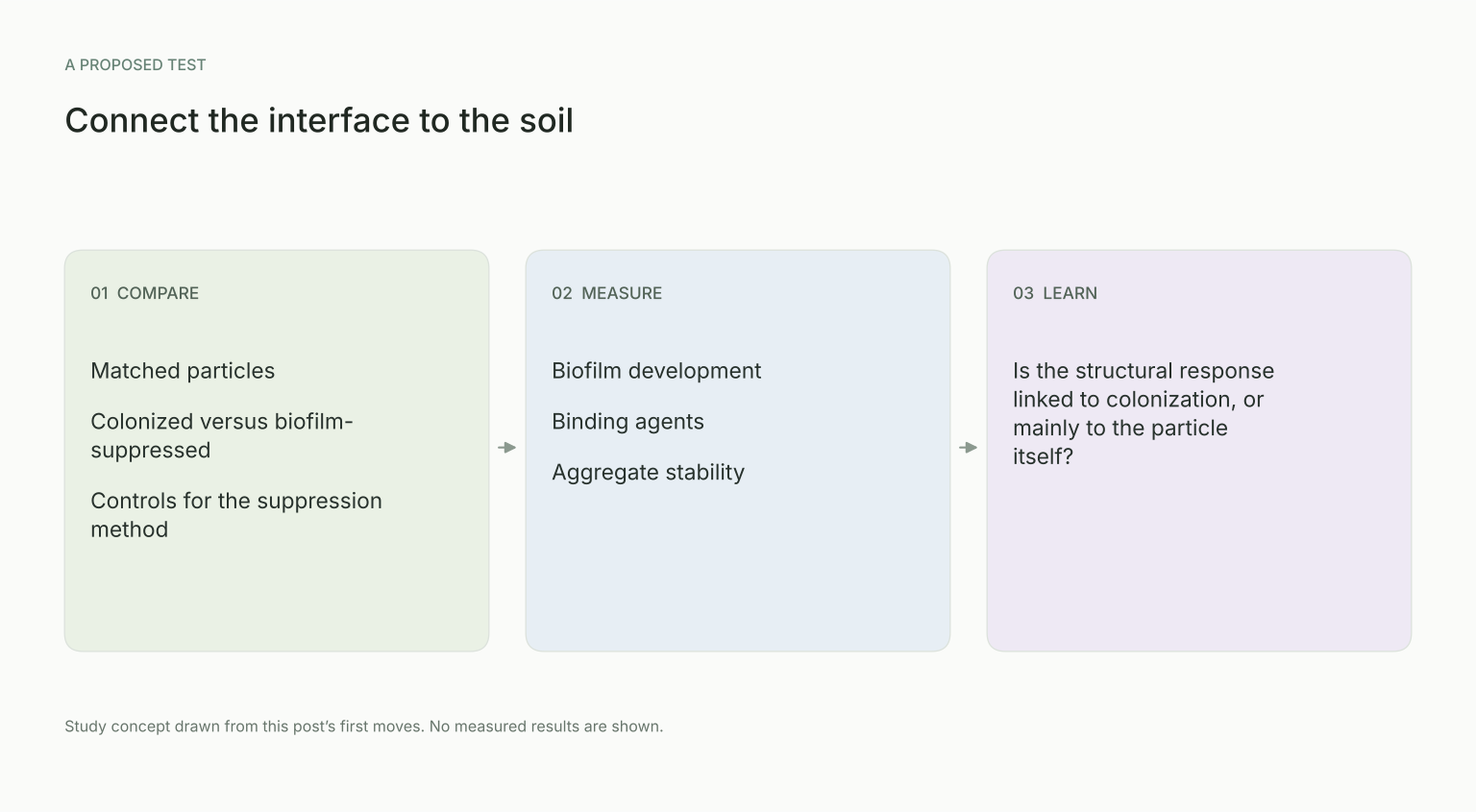
Run Han's design, regular and biodegradable plastic at a realistic dose, but on the same samples pair aggregate sieving and mean weight diameter with plastisphere characterisation, 16S plus zymography. The point is one experiment where biofilm and structure are measured together, not stitched from two studies.
- 2
Suppress the biofilm, keep the plastic
Compare plastic that microbes have colonized against sterilized or biofilm-suppressed plastic of the same type and size. If aggregation collapses only where the biofilm forms, that separates the biofilm's effect from the bare particle's physical effect.
- 3
Track the binding agents
Measure the microbial binding agents Han invokes, such as glomalin-related proteins and extracellular polymeric substances, across the microplastisphere versus bulk soil over time. Then the proposed mechanism is observed rather than assumed.
Where I land
Where I land: the reduced binding agents Han invokes and the active biofilm Zhou describes are probably the same process seen from two sides. My guess is that the biofilm helps drive the crumb collapse. The way to find out is one experiment that measures aggregates and the plastisphere on the same samples. Right now those two readouts almost never get taken together, and that is the whole problem.
An invitation
If you already sieve soil for aggregates, or already sequence the plastisphere, you are one shared sample away from answering this. The two halves of the experiment mostly exist, they have just never been run on the same soil. I would love to know from the people who do this work daily: is there a good reason these two readouts are almost never taken together, or has it simply not been anyone's job yet?
Questions about this gap
What is a biofilm in this question?
It is the microbial community and associated material attached to a plastic surface. The post asks whether that interface helps explain changes in nearby soil aggregates.
Why is measuring both changes not enough to prove causation?
Biofilms and aggregate breakdown could share another cause. A stronger test changes colonization while keeping the particle’s physical properties as comparable as possible.
What is the purpose of a biofilm-suppressed treatment?
It provides a comparison with colonized particles. Any suppression method also needs controls for its own effects on soil, or the comparison could be misleading.
Why measure microbial binding agents?
They offer a possible connection between microbial activity and aggregation. Measuring them alongside structural changes would test that mechanism rather than infer it from community composition alone.
Could the two responses turn out to be independent?
Yes. The proposed study is useful precisely because it can distinguish coupled changes from parallel responses to the same plastic exposure.