
Microplastics change how carbon and nitrogen move through soil. That claim gets cited everywhere now. When I go looking for the confirmation, I keep hitting the same wall: has it been reproduced at doses and timescales that look like a real field?
The primary work is there, and it is careful. Zhao, Lozano and Rillig mixed 12 plastics into a loamy sandy soil and watched pH, respiration, and 4 enzymes for about a month. Shape and polymer both mattered. Foams and fragments pushed soil pH up, and most enzyme activities, the tools microbes use to break down carbon and nitrogen compounds, were held back. The plastic changed the soil's chemistry and slowed the machinery that recycles nutrients, and how much depended on whether it was a fiber, a film, a foam, or a fragment.
Set that next to Zhou and colleagues and the studies start to argue. Zhou's team added a biodegradable plastic, PHBV, and got almost the opposite result. Microbes ate the plastic as carbon, grew faster, and turned the soil-plastic interface into a spot of higher enzyme activity, not lower. So one study says plastic dampens the nutrient cycle and another says it can speed it up.
Both can be true, because they used different plastics for different reasons: a conventional one versus a biodegradable one microbes will actually feed on. That is the problem. The direction of the effect flips with the material, so a single headline result does not travel.
The reviews already spotted this. Aralappanavar and colleagues report that plastic tends to raise nitrogen-fixers while lowering nitrifiers and ammonia oxidizers, so even within nitrogen cycling the plastic pushes different steps in opposite directions, and the effects on nitrogen, phosphorus, and greenhouse gases depend on dose, type, and soil.
Their sharpest line is the one that made me start this map: most of the evidence comes from short, high-dose lab jars, and they ask outright for long field studies at realistic amounts. The mechanisms are plausible and seen again and again. Seen repeatedly in a beaker at a heavy dose is not the same as confirmed in a field at the doses soil actually gets.
- Type
- Replication, under-confirmed
- Field
- Soil biogeochemistry, microbial ecology
- Comparative basis
- Lab-jar results vs. field confirmation
- Methods
- Incubations, enzyme assays, field trials
Why this is answerable now
Loud claim, thin proof
That plastic reshapes soil carbon and nitrogen is now treated as settled, yet the review itself flags that most of it rests on short, high-dose lab jars. The confidence has outrun the confirmation.
The effect keeps flipping
One study finds enzymes suppressed, another finds them enhanced, and reviews report nitrogen-fixers up while nitrifiers go down. When direction depends on shape, polymer, and dose, matched replication is the only way to tell signal from setup.
Soil is still catching up
Two reviews here note soil and groundwater stay understudied next to marine and freshwater systems. The primary work is arriving faster than the synthesis that would confirm it.
Real doses are testable
The field names its own gap out loud: long-term studies at field-realistic amounts. The confirming experiment is defined and waiting, not blocked on new methods.

Sources cited
Papers I read for this question. These notes distinguish reviews from primary studies and identify the limits of my access.
The framing review: soil is a real, distinct plastic sink, understudied next to the ocean.
Says most evidence is short high-dose jars and asks for long field studies.
Microbes ate biodegradable PHBV and turnover rose. Abstract only.
04Microplastics increase soil pH and decrease microbial activities
Primary experimentConventional plastics mostly slowed enzymes down. Shape and polymer drive it.
05Microplastic pollution in soil and groundwater: a review
Abstract onlyA second review agreeing the soil compartment lags behind. Abstract only.
What’s missing — the gap
With so many primary studies reporting that microplastics reshape soil carbon and nitrogen cycling, do those effects still hold, in the same direction and size, when the same plastic type and shape is tested at realistic concentrations in field soil over a full season?
The mechanisms are plausible and observed many times, but almost always in short, high-dose jars. The two clearest primary studies point in opposite directions because they used different plastics. Nobody has taken a well-cited result, held the method fixed, and asked whether the actual figure survives a realistic dose and a real field. The reviews name that missing experiment themselves.
First moves
- 1
Rerun one result at a real dose
Take a single well-cited jar finding, like enzyme suppression under a given polymer and shape, and repeat it exactly while stepping the dose down toward field-realistic levels. If the effect vanishes at a real dose, that is the whole story.
- 2
Test the sign-flip head to head
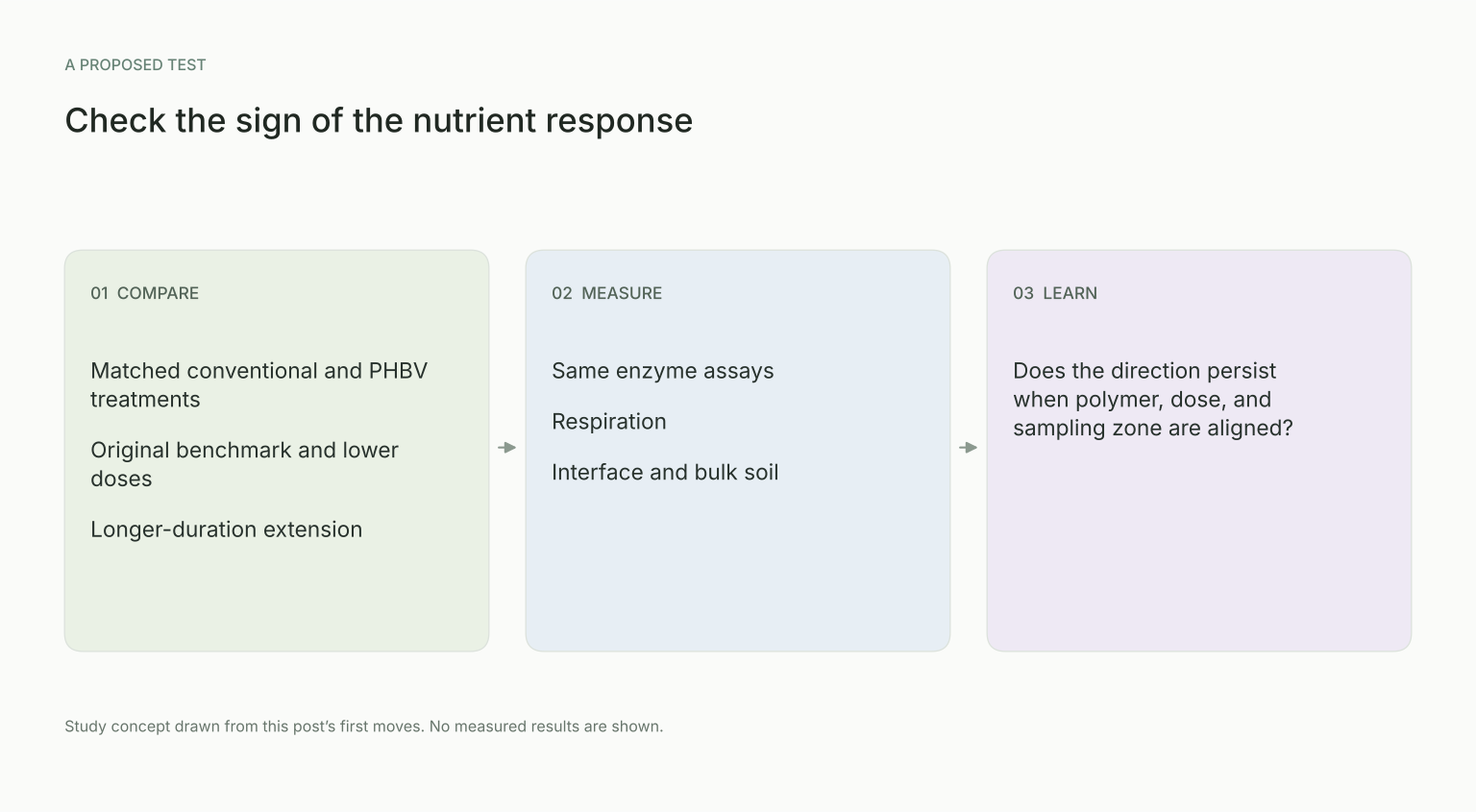
Put a conventional plastic and a biodegradable one like PHBV in the same soil, same experiment, same enzymes. Zhou saw enhancement, Zhao saw suppression. A matched design shows whether the direction is set by whether microbes can eat the plastic.
- 3
Move one jar into the field
Take a jar protocol that produced a clear carbon or nitrogen result and run it as a field plot across a full season. The reviews name long-term field work at realistic amounts as the missing piece. This is the smallest honest version.
Where I land
Where I land: the direction of these effects is probably real, and the exact numbers are probably not confirmed. I would bet that enzyme suppression under conventional plastic and acceleration under an edible biodegradable one both survive replication, but a lot of the loud magnitudes shrink at field doses. The uncomfortable part is that policy and remediation could get built on figures no one has re-run. One matched replication would tell us more than the next ten new-effect papers.
An invitation
If you run soil incubations, you are the person who could settle this, not by finding a new effect but by taking one everyone already cites and seeing whether it survives a realistic dose, a different polymer, or a real field. I have laid out the tensions the way I read them, but I am a student mapping this from the outside, and the people at the bench know things the abstracts do not say. Where would you push back?
Questions about this gap
What needs to be repeated: the direction or the magnitude?
Both matter. A repeat should specify the endpoint and report an effect estimate with uncertainty, rather than checking only whether it is statistically significant.
Why test conventional plastic and PHBV together?
The reading notes describe different responses in separate settings. A matched comparison helps test whether material, sampling zone, or method explains the difference.
Does increased enzyme activity mean better soil health?
Not necessarily. It describes an activity, not an overall benefit. Nutrient availability, losses, and plant responses need separate interpretation.
Why lower the dose in a replication program?
It tests exposure relevance after the benchmark has been checked. A high-dose repeat alone cannot establish what happens at a measured field load.
What does a field plot add to an incubation?
It introduces changing weather, roots, and soil conditions. The comparison tests whether the laboratory endpoint persists in that wider setting.