
We have gotten good at counting the plastic in soil. We are still guessing at what it does to the chemistry underneath.
One line of work is about finding and measuring microplastics in soil: where they come from, what shape they are, how many, how they move. Chia and colleagues reviewed plastic in soil and groundwater and said this area is studied less than the ocean and lakes, then laid out the counting side plainly. Littering is the main source in topsoils worldwide, and fibers and pellets are the common shapes. Guo and colleagues did the same for soil overall, listing inputs like mulch film, sludge, irrigation, and dust from the air, and tracking how particles sink and spread through the ground.
That counting half is well built. We can increasingly say how much plastic is where.
The other half is what all that plastic does to carbon and nitrogen cycling, the microbe-run work that decides how soil breathes and feeds plants. That half is thinner and messier. Aralappanavar and colleagues reviewed it and found that soils with plastic hold different microbes than clean soil, with less variety. The plastic favors bugs that break plastic down, raises the ones that pull nitrogen from the air, and cuts the ones that turn that nitrogen into a form plants can use. So the plastic changes which microbes are in charge of the nitrogen ledger.
The same review is honest that almost all of this comes from short lab runs in jars, at plastic levels much higher than a real field. It says the effects depend on the dose, the plastic type, and the soil. That is the opposite of a settled number.
The process studies do not even agree on the direction. Zhou and colleagues added a biodegradable plastic called PHBV and watched microbes eat it as food. The thin layer of soil against the particle grew more active, with higher beta-glucosidase and leucine aminopeptidase, the enzymes that break down carbon and nitrogen compounds. So there the plastic sped turnover up. Zhao, Lozano and Rillig tested 12 conventional plastics across 4 shapes and 8 polymer types and mostly saw the reverse. Most enzyme activities dropped, respiration fell faster with plastic present, and foams and fragments nudged the soil pH up.
So one paper's plastic is food that speeds microbes up, and the other's plastic slows their enzymes down. Both fit Aralappanavar's it-depends verdict, and both cut against any single story. I keep coming back to how confidently we can now count the particles, and how unsettled we still are on what those particles do to the soil's carbon and nitrogen.
- Type
- Coverage imbalance
- Field
- Soil microplastics, biogeochemistry
- Comparative basis
- Counting methods vs. cycling processes
- Methods
- Enzyme assays, respiration, density separation
Why this is answerable now
The counting is maturing
Methods for measuring how much plastic is in a soil are far enough along that reviews treat that side as the developed one. The open questions have moved to what the plastic does.
Labs admit the field gap
The 2024 cycling review says plainly that most evidence is short, high-dose jar work. It asks for long field studies at realistic amounts. That is a direct invitation.
The results contradict
Biodegradable PHBV sped microbes up. A panel of conventional plastics slowed their enzymes down. When the direction flips with the material, someone has to map the conditions.
Farms are the site
Mulch film, sludge, and irrigation put plastic into the soils that grow food. Carbon and nitrogen decide yields, so this is a practical question now.

Sources cited
Papers I read for this question. These notes distinguish reviews from primary studies and identify the limits of my access.
The review arguing soil is studied less than the ocean. The counting-and-origin backbone.
The clearest map of the cycling side. Says most evidence is short jar work.
Microbes ate biodegradable PHBV and sped carbon and nitrogen enzymes up. Abstract only.
04Microplastics increase soil pH and decrease microbial activities
Primary experimentTwelve conventional plastics mostly slowed the soil's enzymes down. Shape and polymer matter.
05Microplastic pollution in soil and groundwater: a review
Abstract onlyStrong on where plastic comes from, light on carbon and nitrogen. Abstract only.
What’s missing — the gap
At the plastic levels a real field actually sees, over a real length of time, do common farm microplastics shift soil carbon and nitrogen enzyme activity in a predictable direction, or does the effect stay stuck to the shape, polymer, and soil?
We can increasingly say to the milligram how much plastic is buried in a field. We still cannot say whether it is feeding that soil or starving it. Almost every process study is a few weeks in a jar at a heavy dose, and the two clearest ones point in opposite directions. Until someone runs the cycling side at field doses for long enough to matter, the counting will keep outrunning the meaning.
First moves
- 1
Run one soil at field dose, long enough
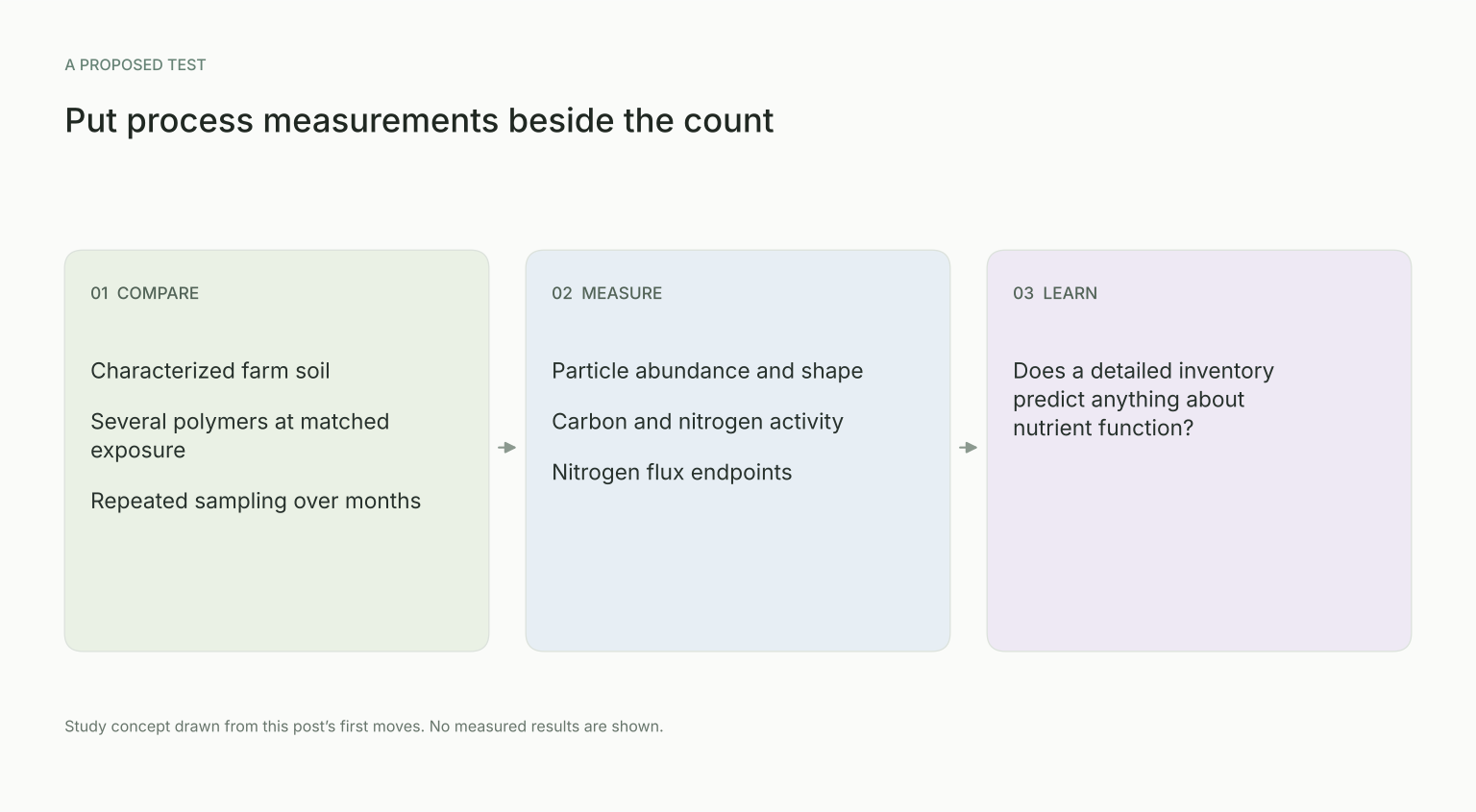
Take one well-described farm soil and incubate it at realistic plastic levels, not the heavy jar dose the 2024 review flags. Track carbon and nitrogen enzymes and respiration over months so the answer is not a three-week artifact.
- 2
Put both plastics in one experiment
Zhou's PHBV sped turnover up and Zhao's conventional panel slowed it down, but never in one design. Test PHBV beside PE, PS, and PET in the same soil and dose, so any difference is the material and the contradiction can be settled.
- 3
Measure counting and cycling together
Where a study already counts particle abundance and shape, add the nitrogen-process measurements on those exact samples: nitrifier abundance and nitrous oxide flux. That closes the imbalance instead of leaving it in separate papers.
Where I land
Where I land: the counting side has earned its confidence, and the cycling side has not. My guess is that at field doses the loud jar effects will shrink, but the split nitrogen response stays real, with more nitrogen-fixers and fewer nitrifiers even in honest soil. What bothers me is that we can map the particles to the milligram and still cannot tell a farmer whether the plastic in their field speeds the soil up or slows it down. One careful long study on real ground would move this more than another jar.
An invitation
If you work on soil plastics, I keep wondering which side you live on: the people who can say how much plastic is in a field, or the people who can say what it does to the carbon and nitrogen underneath. Those two conversations still rarely happen on the same soil. If we can say to the milligram how much plastic is buried in a field, how is it that we still cannot say whether it is feeding that soil or starving it?
Questions about this gap
What is the coverage imbalance in this post?
The question contrasts increasingly detailed particle measurements with more limited information about nutrient processes at comparable field exposures and durations.
Why measure nitrifiers and nitrous oxide together?
Organism abundance and a nitrogen flux describe different parts of the cycle. Their relationship needs to be measured rather than assuming one predicts the other.
Can a particle inventory show whether soil is gaining useful nutrients?
No. Counting describes exposure. Nutrient transformations, losses, and availability require process measurements on the same soil.
Why use months rather than one short incubation?
A longer series can reveal whether an early response persists or changes. It still needs to be interpreted within the limits of the tested soil and conditions.
What would a predictable response look like?
Similar direction and magnitude across defined material and soil conditions would support prediction. Context-dependent results would instead help identify which conditions need separate models.