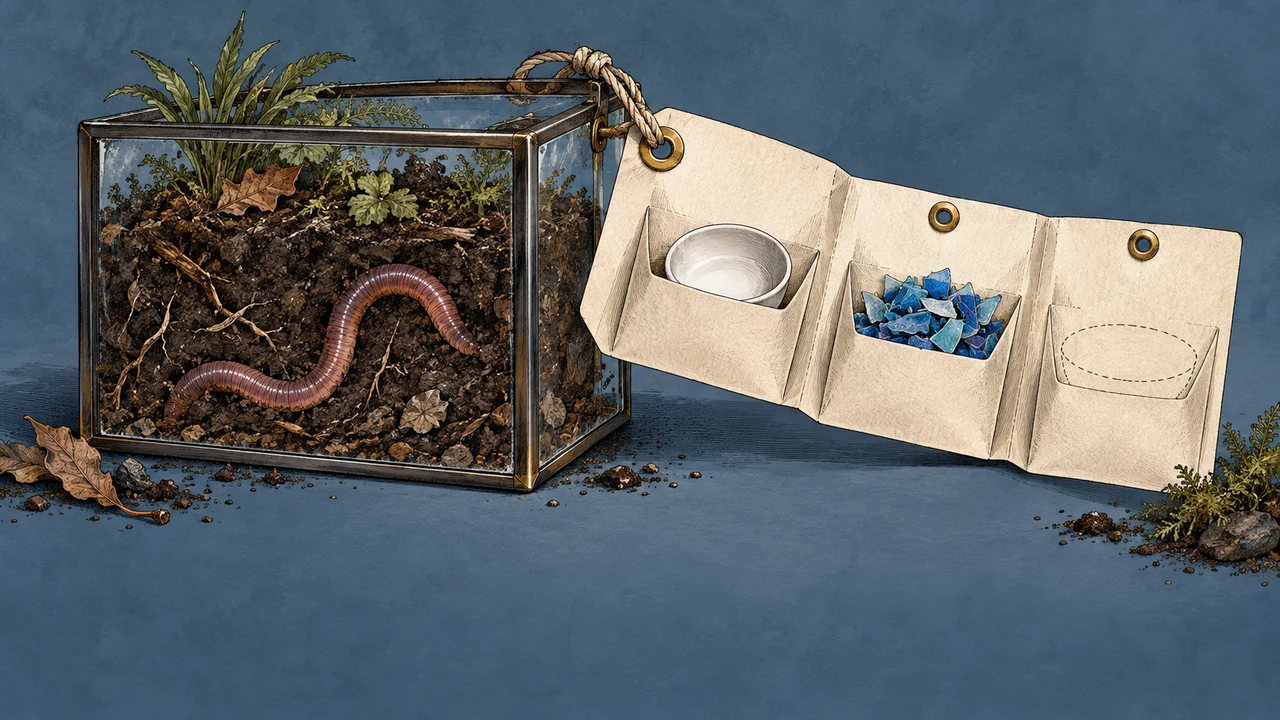
The soil-fauna corner of microplastics research has a quiet problem. Everyone measures the same thing a slightly different way, and almost nobody writes down whether their measurement was clean. So when two earthworm studies disagree, you can't tell whether the soil disagreed or the methods did.
Start with the plainest fact in the pile. Sajjad and colleagues walk through sources, sampling, extraction and effects on fauna, and then say the quiet part out loud: no standard soil microplastic sampling or extraction method exists. There is no agreed recipe for getting the plastic out of the dirt and counting it.
Every lab pulls, sieves and separates its particles its own way, so every number comes out measured on its own private scale. With no shared method, and no shared habit of reporting blanks or recovery rates, two labs can study the same worm and report results that can't be laid side by side.
The same field is careful about everything except the counting. On the community side the reporting is detailed. Han and colleagues mixed polyethylene and biodegradable PLA into silty loam, dry-sieved the soil into aggregate classes, profiled the bacteria by 16S sequencing, and could say plastic explained about 54% of the shift in the bacterial community.
Zhou and colleagues used zymography to map enzyme hotspots at the plastic surface and reported beta-glucosidase and leucine aminopeptidase running 0.6 to 5.0 times higher there than in the rhizosphere. We can pin down what the microbes do to a fine grain, while the fauna work rests on an extraction step no one has pinned down.
The fauna stakes are real, which is what makes the missing quality control nag at me. Sajjad's review reports dose-dependent harm to earthworms, nematodes and collembolans, with roughly 1 to 2% plastic by weight causing death. Aralappanavar and colleagues add a second worry: most of what we know comes from short, high-dose lab jars, and they call for field studies at realistic concentrations.
Line those up and the problem sharpens. We are asking whether field-realistic doses hurt soil animals, using an extraction method that isn't standardized and a reporting habit that rarely mentions blanks or recovery. I keep wondering how much of the scatter in the fauna literature is real biology and how much is measurement noise that never got flagged.
- Type
- Methods and reporting
- Field
- Soil fauna ecotoxicology
- Comparative basis
- Community-side rigor vs. fauna-side QC
- Methods
- Extraction blanks, recovery rates, dose reporting
Why this is answerable now
Fauna harm is dose-dependent
Sajjad and colleagues report earthworms, nematodes and collembolans dying at roughly 1-2% plastic by weight. If the dose-response line matters, the number underneath it has to be trustworthy first.
The field wants realistic doses
Aralappanavar and colleagues say most evidence is short, high-dose lab jars and call for field work at realistic concentrations, and realistic concentrations are exactly where recovery and blanks decide whether you found anything at all.
No shared recipe yet
Sajjad and colleagues state plainly that no standard soil microplastic sampling or extraction method exists. That is a gap you can close with reporting norms now, before the fauna literature hardens around incomparable numbers.
The community side proves it
Han and colleagues and Zhou and colleagues report their methods in fine detail. The rigor already exists in the same field. It just hasn't reached the extraction-and-counting step the fauna work depends on.

Sources cited
Papers I read for this question. These notes distinguish reviews from primary studies and identify the limits of my access.
Frames why soil fauna deserve attention; measurement reliability unresolved.
Warns current numbers may not survive field-realistic soil.
Real fauna harm, no agreed extraction method behind the numbers.
04Microplastics alter soil structure and microbial community
Primary experimentA model of method transparency the fauna work has not reached.
Fine-grained community-side precision. Abstract only.
What’s missing — the gap
In the soil-fauna microplastics literature, does whether a study reports extraction blanks and recovery rates predict how comparable and reproducible its fauna results are? Or are we stacking dose-response numbers built on measurement steps too unstandardized to compare?
The fauna number that gets cited, 1-2% by weight causing death, rests on an extraction step no one has standardized and a reporting habit that rarely names blanks or recovery. Until we know how often the field even reports those checks, we can't tell whether a dose-response curve drawn across labs is biology or a curve of methods.
First moves
- 1
Audit the QC reporting that exists
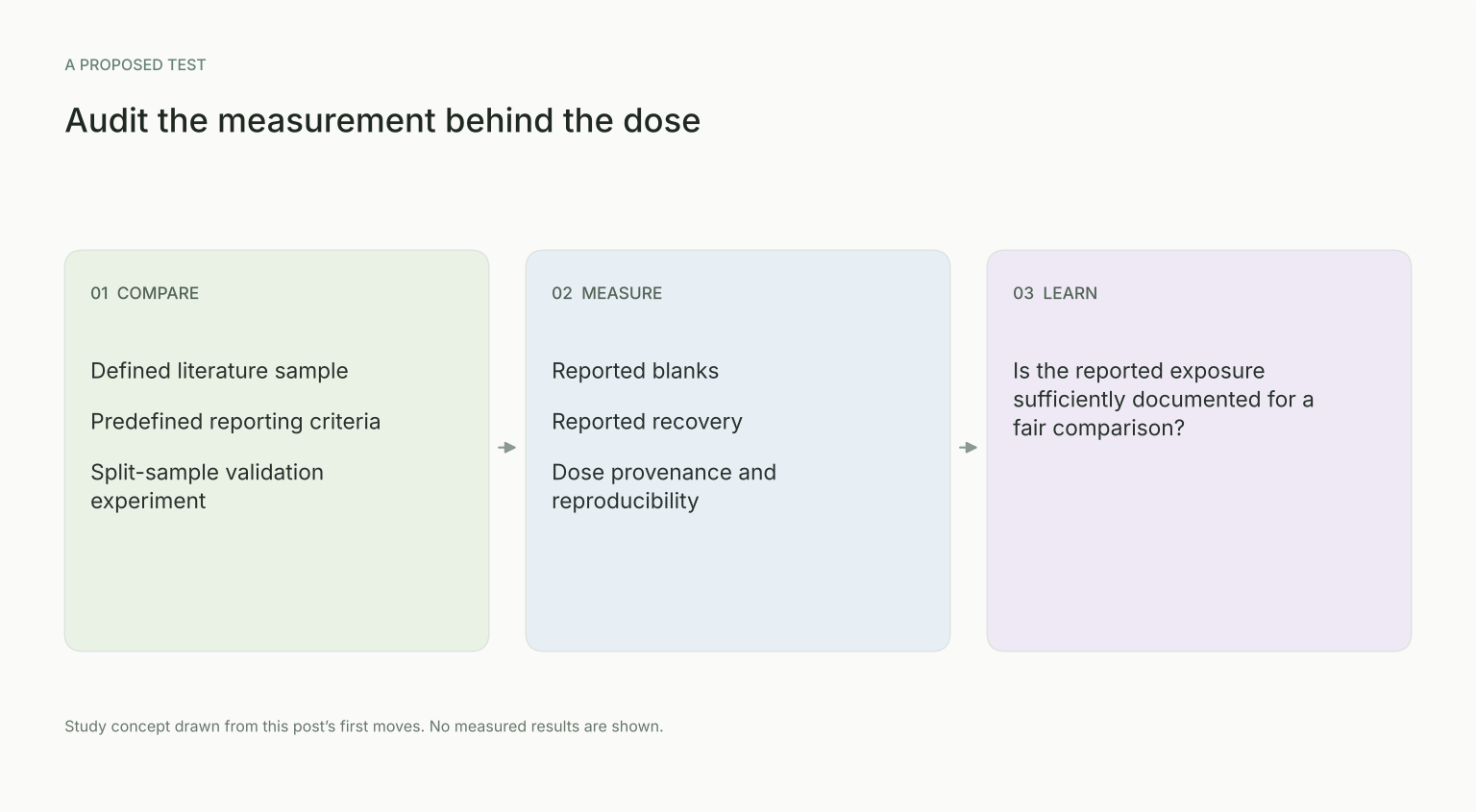
Take the soil-fauna microplastic papers and code each one for whether it reports procedural blanks and recovery rates at all. The smallest honest first step is measuring how often the field even mentions the checks, before arguing about which is best.
- 2
One worm, two extractions, side by side
Spike a single soil at a field-realistic dose, split it, and process it through two common extraction protocols with blanks and recovery quantified for both. This tests directly whether method choice, not biology, drives the scatter.
- 3
Borrow the community side's transparency
Draft a minimal fauna-study reporting checklist, blanks, recovery, dose provenance, modeled on what the microbial work already does routinely, so the same field can hold its counting step to the standard it holds its sequencing step.
Where I land
Where I land: I think a real share of the scatter in the fauna literature is measurement noise that never got flagged, not biology, and a simple audit of who reports blanks and recovery would start to show it. The community side of this same field already reports its methods in fine detail. The counting step the fauna work depends on should be held to that standard before more dose-response numbers pile up.
An invitation
If you work on earthworms, nematodes, or collembolans in plastic-laden soil, I would love to know whether the numbers in this corner feel comparable to you from the inside, whether a dose-response curve drawn across labs means what it looks like it means, or whether the unstandardized extraction underneath quietly makes it a curve of methods rather than of biology. What am I missing here?
Questions about this gap
Why audit reporting before proposing a new checklist?
An audit establishes which quality-control details are actually present or missing. It turns a general concern into a documented pattern in the selected literature.
Are blanks and recovery tests the same?
No. Blanks test contamination introduced by the procedure; recovery tests measure how much of a known particle input is retrieved. Both affect confidence in the exposure estimate.
Does missing reporting prove poor laboratory practice?
No. It means the reader cannot verify the practice from the report. The audit should distinguish unreported information from an explicitly omitted control.
Why use two extractions on the same soil?
It tests method-related differences without changing the biological material. That helps separate measurement variation from a real difference in the animal response.
What belongs in a minimal reporting checklist?
The proposal highlights blanks, recovery, and dose provenance, alongside a reproducible extraction and fauna measurement protocol. The checklist would support comparison, not substitute for validation.