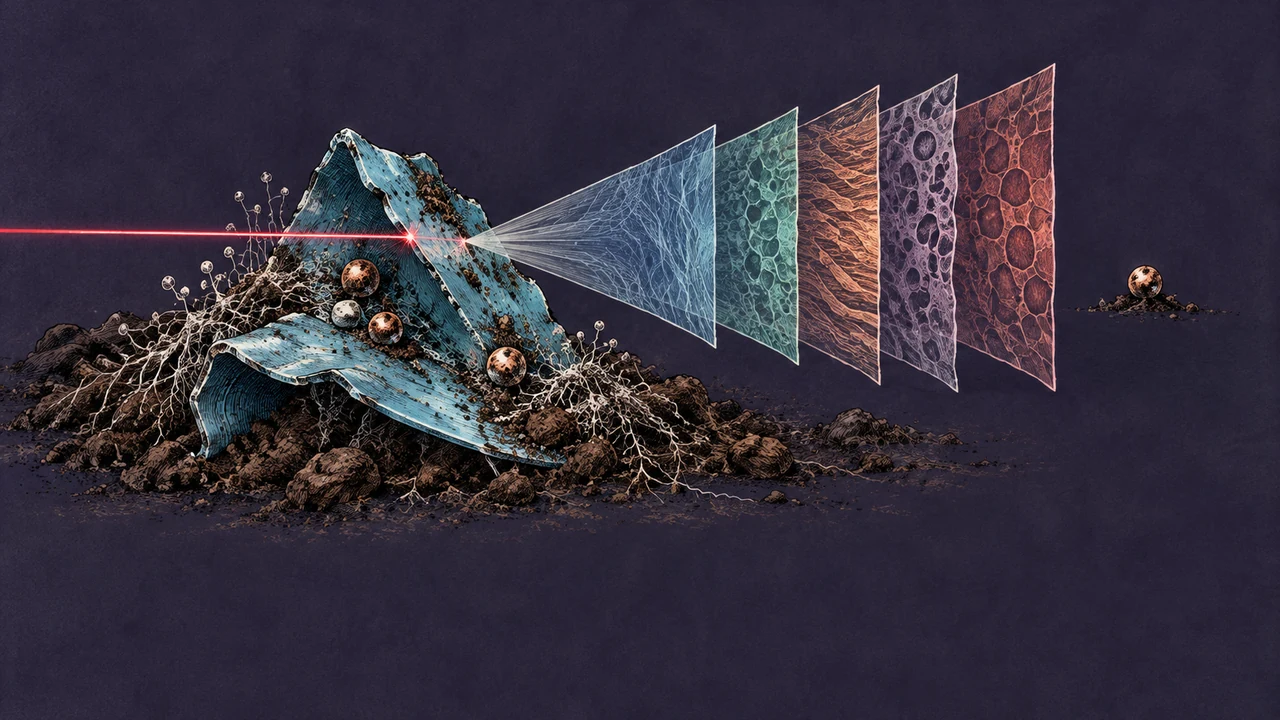
A tool works well in one corner of this field and has never been pointed at the corner next to it. Raman spectroscopy is standard for identifying polymers: shine a laser at a particle and read back what plastic it is. In the study of how soil microplastics bind pollutants, that instrument is nowhere. The two questions seem made for each other.
Start with why sorption matters at all. Sajjad and colleagues are blunt: soil microplastics act as carriers for co-contaminants, binding phthalates, antibiotics, potentially toxic elements, PAHs and PCBs. A fragment of plastic can hold other poisons on its surface and move them through the soil.
The same review sets the scale. Plastic film mulch is the largest source, and roughly 700,000 tonnes of plastic reach farmland in Europe and North America each year, with up to 90% of Swiss floodplain soils already polluted. The surfaces doing the binding are being added to farm soil constantly.
Now look at how we find these particles today, because this is where the missing tool shows up. Cusworth and colleagues rebuilt a microplastic record from the Broadbalk wheat experiment using archived soil back to 1846: they digested, separated and stained the particles with Nile Red, then counted them under fluorescence. That method answers how many and how big, and it showed concentrations climbing from 1966 on. Staining tells you a particle is there. It does not tell you what polymer it is or what has bound to its surface.
The broader reviews add that no standard method for detecting soil microplastics exists at all. So the field is counting particles carefully while staying largely blind to their chemistry.
Sorption is a chemistry question. Whether a phthalate or an antibiotic clings to a fragment depends on what the fragment is made of. Aralappanavar and colleagues tie the microbial story to this too, noting that plastic-degrading communities and their toxicity effects shift with polymer type.
This is the part I find strange. The instrument that reads polymer identity from a laser is routine in the spectroscopy corner, and I have not found published work using it to ask which polymers in real soil carry which pollutants. The reviews agree the risk is real and the methods are unstandardized. None of them reach for the tool one bench over.
- Type
- Method transfer
- Field
- Soil microplastic analysis
- Comparative basis
- Polymer ID vs. sorption studies
- Methods
- Raman spectroscopy, Nile Red fluorescence
Why this is answerable now
The surfaces are piling up
The problem scales with how much plastic is in the ground, roughly 700,000 tonnes reaching farmland in Europe and North America each year, with concentrations rising steadily since 1966. The sorbing surfaces are added faster than we can characterise them.
The risk is chemistry
Microplastics are documented carriers of phthalates, antibiotics, potentially toxic elements, PAHs and PCBs. What sticks depends on polymer identity, so a method that reads polymer chemistry is aimed straight at the mechanism.
The toolkit's blind spot
Fluorescence staining counts particles well but cannot name the polymer or its bound load, and reviews agree no standard soil-microplastic detection method exists yet. There is an open slot to fill, not an entrenched standard to displace.
Proven one bench over
Raman spectroscopy is well established for polymer identification. Transferring it is borrowing a mature tool, not inventing one, which is the cheapest kind of progress a young sub-field can make.

Sources cited
Papers I read for this question. These notes distinguish reviews from primary studies and identify the limits of my access.
Soil understudied next to marine work; deserves its own methods.
Microbial and toxicity effects shift with polymer type. Mostly lab jars.
Carrier stakes and the method vacuum stated on the same page.
04Microplastics as pollutants in agricultural soils
Abstract onlyNo standardized detection for soil microplastics. Abstract only.
Counts and dates particles by staining; cannot name the polymer.
What’s missing — the gap
Would running Raman spectroscopy on field-extracted soil microplastics resolve which polymers are carrying which sorbed pollutants, the polymer-specific sorption that fluorescence counting cannot see?
Raman identifies polymers reliably in the spectroscopy corner, and sorption depends on what the polymer is. No published work I found points it at real, weathered soil particles to read their bound load. The smallest honest first step is proving the identification even transfers to messy field fragments.
First moves
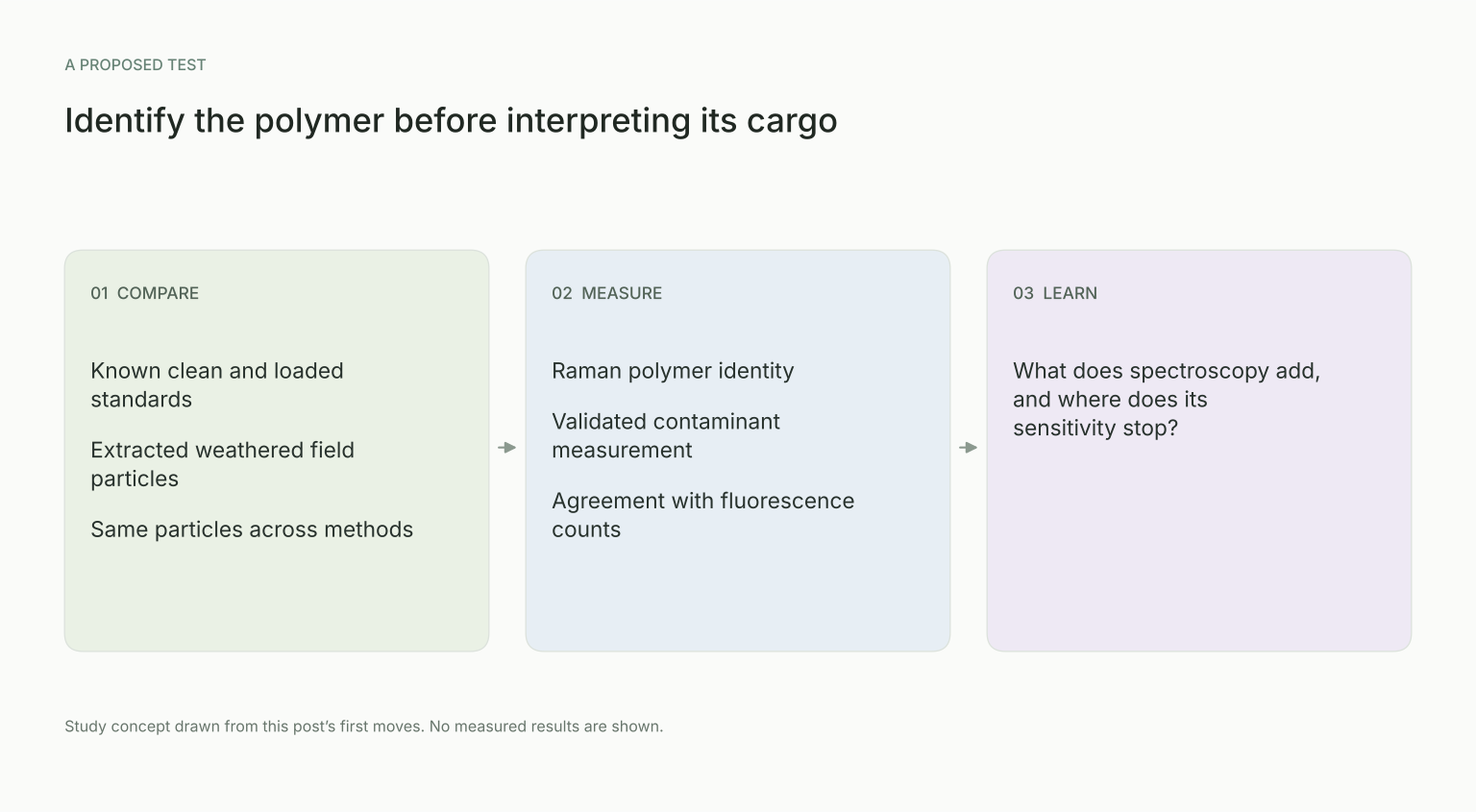
- 1
Point Raman at extracted particles
Take microplastics separated by an established digestion-and-density workflow like the one used on the Broadbalk soils, then run Raman on the same particles to name the polymer instead of only counting it.
- 2
Build a polymer-versus-pollutant panel
Expose known polymers to individual documented co-contaminants such as a PAH or an antibiotic, then ask whether Raman can tell loaded surfaces from clean ones, before anyone trusts it on messy field samples.
- 3
Cross-check against the count
Run both methods on one set of soil samples so the Nile Red counts and the Raman polymer identities describe the same material. That shows exactly what the transferred tool adds, and where the two disagree.
Where I land
Where I land: I think the transfer is worth trying and probably harder than it looks. Real soil particles are weathered, coated in microbes, and mixed with organic matter, all of which muddy a Raman read. But the upside is a polymer-level map of what carries what, which counting alone can never give. I would rather see one honest attempt that fails cleanly than another paper that counts particles and stops.
An invitation
If you work in polymer spectroscopy, you already own the instrument this question needs. If you study sorption in soil, you already own the samples and the stakes. What I cannot tell from the published work is whether the two sides have simply never been in the same room, or whether someone tried the transfer, found it harder than it looks, and never wrote it up. Is there a real reason Raman has stayed on the polymer side, or is this just a bench nobody has walked around yet?
Questions about this gap
What would Raman add to an extracted particle count?
It can contribute polymer identification for individual particles. That identity can then be paired with a separate, validated measurement of associated pollutants.
Can a Raman spectrum automatically quantify every sorbed chemical?
No. Polymer identification does not guarantee sensitive contaminant detection. The proposed clean-versus-loaded standards would test what the method can actually resolve.
Why start with known materials?
Known polymers and controlled contaminant loading provide a reference before interpreting complex, weathered field particles with soil residues or mixed signals.
Why analyze the same particles by two methods?
It connects a counting signal with an identification result, revealing where the methods agree and what each one misses on the same material.
What would an unsuccessful transfer still teach us?
It would define the limits of the approach on real soil extracts and indicate where complementary chemical analysis or sample preparation is needed.