
A finding can get cited so often it starts to feel like settled fact: farm soils are filling up with plastic. Cited is not the same as confirmed. If you ran these studies again, in another country, with another method, would the numbers hold?
Line the primary studies up and at first they sound like a chorus. In a Chinese field mulched for 32 years, Li and colleagues found polyethylene film had broken down and worked through the whole soil profile, with fertilised plots carrying about twice the film microplastics of unfertilised ones. In eastern Spain, van den Berg and colleagues watched microplastics climb in step with how many sewage-sludge applications a field had received. In the UK, Cusworth and colleagues pulled soil from an archive going back to 1846 and saw microplastics appear only after modern plastics were invented, then rise sharply from the 1960s.
Three countries, different inputs, three teams reaching the same verdict: farming loads soil with plastic, and it stays. That independent agreement is what replication is supposed to look like.
Then look at how each number was made and the chorus falls out of tune. Li's team reported film microplastics in the millions of particles per kilogram. Van den Berg's counted in the low thousands. Cusworth's stained particles with a fluorescent dye and counted them by eye under a microscope. These are orders of magnitude apart. The studies agree that plastic goes up. They disagree on the amount, and the amount is the part everyone quotes.
Sajjad and colleagues put a name to why. Their review states flatly that no standard method exists for sampling and extracting microplastics from soil. Every lab isolates its particles a little differently, so two honest studies can land on very different numbers for reasons that have nothing to do with the dirt. Some of the counting is being done by the method.
So is the soil different, or is the method different? Right now I do not think anyone can say. Guo and colleagues argue soil has been badly neglected next to the ocean and rivers, so the primary studies are still young and scattered, rarely measured against each other head to head. Even the strongest single piece, Cusworth's deep-time record from Rothamsted, comes with the authors' own caveats: one dye, one analyst counting, one site.
I read that as the shape of the whole problem. We have a growing pile of careful, independent measurements that mostly point the same way, and almost no work that has re-run one of them, held the method fixed, and asked whether the actual figure survives.
- Type
- Replication, under-confirmed
- Field
- Agricultural soil plastics, nanoplastics
- Comparative basis
- Cross-study numbers vs. shared method
- Methods
- Density separation, staining, archived soils
Why this is answerable now
Enough to check itself
The primary base has finally grown large enough, mulch, sludge, fertiliser, across several continents, that the studies can be tested against each other instead of just added up. Confirmation is the missing move, not more one-off measurements.
No shared method yet
Sajjad and colleagues note there is still no standard way to sample and extract soil microplastics. That is a closing window: agree on a protocol now, before another decade of numbers no one can compare locks in the confusion.
Decisions ride on it
Li's and Cusworth's work frame this as a near-permanent legacy that migrates deep and barely reverses. If policy gets built on numbers no one has reproduced, being an order of magnitude wrong is paid in the soil for a long time.
The samples exist
Rothamsted's archived soils go back to 1846, and long field trials like the 32-year Chinese mulch plots are still standing. The material needed to re-test these claims is sitting in freezers and fields right now.

Sources cited
Papers I read for this question. These notes distinguish reviews from primary studies and identify the limits of my access.
Soil neglected next to the ocean, so primary studies stay young and scattered.
States flatly that no standard soil sampling and extraction method exists.
Film microplastics in the millions per kilogram. One site, one crop history.
A straight-line dose response: counts rose with each sludge application.
Deep-time record from 1846. One dye, one analyst, one site.
What’s missing — the gap
If the mulch, sludge, and fertiliser findings were re-measured at fresh sites using one shared extraction and counting protocol, would the reported concentrations converge within an order of magnitude, or has each study's number been decided as much by its method as by its soil?
The direction is reproduced across three countries and three inputs. The magnitude is not, and the magnitude is what gets quoted. No standard method exists, so the counts differ by orders of magnitude for reasons that may have nothing to do with the soil. Nobody has taken one of these studies, held the method fixed, and asked whether the actual figure survives a new site. The archived soils and standing trials to do it already exist.
First moves
- 1
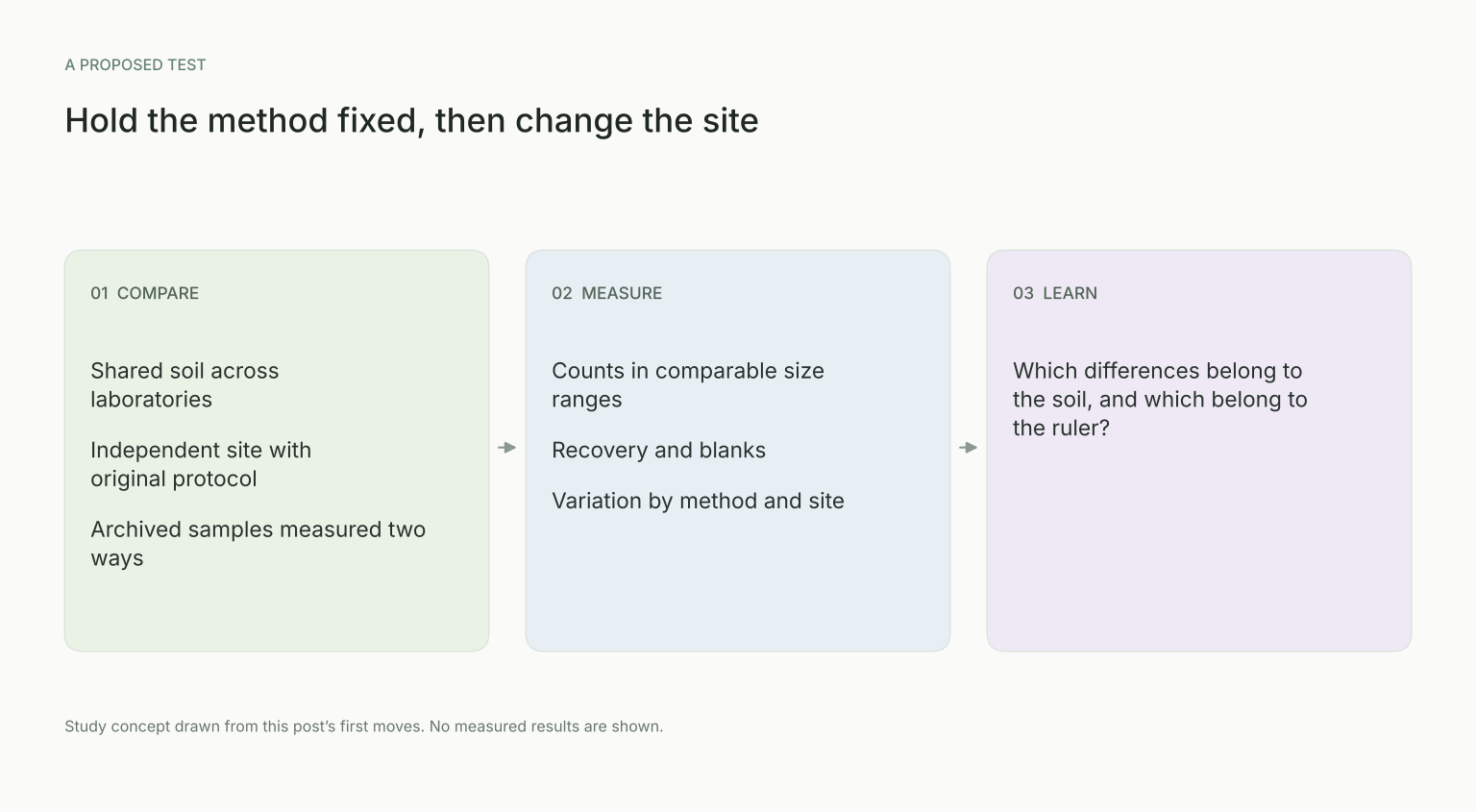
Split one soil across the methods
Take a single well-mixed soil, divide it, and send identical portions to labs using the different published extraction and counting approaches. If the counts come back orders of magnitude apart on the same dirt, we have measured the method, and we will know how much of the disagreement is method.
- 2
Re-run one study, method held fixed
Pick one study, the sludge dose-response is a clean target, and repeat it at an independent set of fields using the original protocol unchanged. The point is a direct answer to whether the first result reproduces when only the site varies.
- 3
Two methods, one set of samples
Apply two different extraction protocols to the very same archived samples, ideally from a long record like Rothamsted's. Running both on one soil separates the method effect from the real change over time, so the trend can be reported in a way another lab could match.
Where I land
Where I land: the direction is reproduced and the magnitude is not. I would stake a lot on the claim that farming loads soil with plastic and it stays, and very little on any single particles-per-kilogram figure until a shared method has been run twice. The uncomfortable part is that remediation and policy are being framed around numbers that could be an order of magnitude off. The samples to check this are sitting in freezers. The missing move is not another measurement, it is running one twice.
An invitation
If you work on soil plastics, I would love to know which of these numbers you would stake a decision on, and which you quietly suspect is really a measurement of the method that made it. My honest read is that the direction is reproduced and the magnitude is not, but I am a student turning this over from the outside, and the people who ran these extractions know things the papers do not print. Where would you push back, is the agreement as solid as it looks, or am I right to find the missing replication a little unnerving?
Questions about this gap
What scale do the cited accumulation studies actually establish?
They report particles within their own detection ranges, primarily at the micro or macro scale. They do not automatically validate an unmeasured nanoplastic abundance.
Why split the same soil between methods?
It isolates part of the measurement variation. A large difference on identical material cannot be explained solely by differences between field sites.
Why repeat one study with its method held fixed?
It tests transfer to a new site without simultaneously changing the measurement. That makes the reason for agreement or disagreement easier to investigate.
Does agreement within an order of magnitude prove accuracy?
No. It is a possible comparison criterion, not a validation standard by itself. Recovery, specificity, blanks, and uncertainty still matter.
What can archived samples add?
Applying two protocols to the same dated samples can distinguish method differences from changes through time, provided storage and sample comparability are accounted for.