
The counts get cited everywhere: so many microplastic particles per kilogram of soil, this much of a jump after sludge, that much shift in the microbes. When I go looking for the same number confirmed by a second lab, in a second field, with a second method, I mostly can't find it. The honest question is not how much plastic is in our soil. It is whether the striking numbers we keep repeating have been reproduced, or whether we quote single measurements as settled facts.
Start with the field study that gives the cleanest numbers. In eastern Spain, van den Berg and colleagues found sludge-treated plots held about 2,130 light and 3,060 heavy particles per kilogram, against roughly 930 and 1,100 in soils that never got sludge, with each application adding about 280 light and 430 heavy per kilogram. Put plainly: the more sludge a field gets, the more plastic piles up, close to a straight line. That is a lovely quantified result. It is also one study, in one region, using one flotation-and-filtration method.
This is where the review literature tells me to be careful. Sajjad and colleagues note there is no standard way to sample or extract microplastics from soil at all. A count that precise is only as reproducible as the extraction recipe behind it, and there is no shared recipe.
The pattern repeats in what plastic does to soil, not just how much is there. Han and colleagues ran a greenhouse rice-wheat rotation and reported that polyethylene or PLA at 0.5% by weight pushed small clumps up from about 17% to as high as 35%, dropped big clumps from 84% to about 65%, and explained roughly 54% of the shift in the microbes. The plastic broke the soil's crumb structure into finer bits whether it was the persistent kind or the compostable kind. That cuts against the comfortable assumption that switching to biodegradable plastic solves the problem. It is again a single greenhouse experiment, three replicates, one dose.
The broader review by Aralappanavar and colleagues says almost the same thing from the other direction: most of what we know comes from short, high-dose lab jars, and the effects on nutrients and greenhouse gases depend on dose, plastic type, and soil. A result that changes with dose and soil is exactly the kind that needs running again somewhere else before anyone trusts the exact figure.
So here is the tension I keep circling. The reviews agree on the big shape of the story. Guo and colleagues frame soil plastic as a genuine emerging pollutant arriving through mulch film, sludge, irrigation, and the air, then moving down through the soil. Sajjad adds the scale, about 700,000 tonnes reaching farmland in Europe and North America each year. That shared shape is well confirmed. The layer of specific quantities underneath it is not. The particles-per-kilogram, the percent-structure-change, the percent-of-variance all come from lone primary studies the reviews summarize but no one has repeated.
- Type
- Under-confirmed, unreplicated
- Field
- Soil microplastic measurement
- Comparative basis
- Single studies vs. independent repeats
- Methods
- Flotation-filtration, 16S sequencing, aggregate assays
Why this is answerable now
Cheap enough to repeat
The flotation-and-filtration extraction van den Berg used and the sieving plus 16S sequencing Han used are established, affordable bench methods. Re-running one of these numbers in a new soil is a first-year project, not a moonshot.
The reviews already ask
Aralappanavar's review calls for long field studies at realistic amounts, and Sajjad's flags the missing standard method. The field is openly saying which numbers it does not yet trust.
Policy leans on the counts
If sludge-to-farmland rules get written around particles-per-kilogram figures, we should know whether those figures hold outside eastern Spain before they harden into regulation.
Biodegradable sold as the fix
Han's finding that PLA behaves much like polyethylene will steer buying and policy if it holds up, and mislead if it doesn't. That makes confirming it urgent.

Sources cited
Papers I read for this question. These notes distinguish reviews from primary studies and identify the limits of my access.
Confirms the big picture, gives no reproduced single quantity.
Reviewers flag the replication problem: mostly short, high-dose lab jars.
No standard method, so counts aren't cleanly comparable across labs.
04Microplastics alter soil structure and microbial community composition
Primary experimentOne greenhouse study, three replicates, one dose. Worth repeating.
The cleanest counts, from one region and one method. Abstract only.
What’s missing — the gap
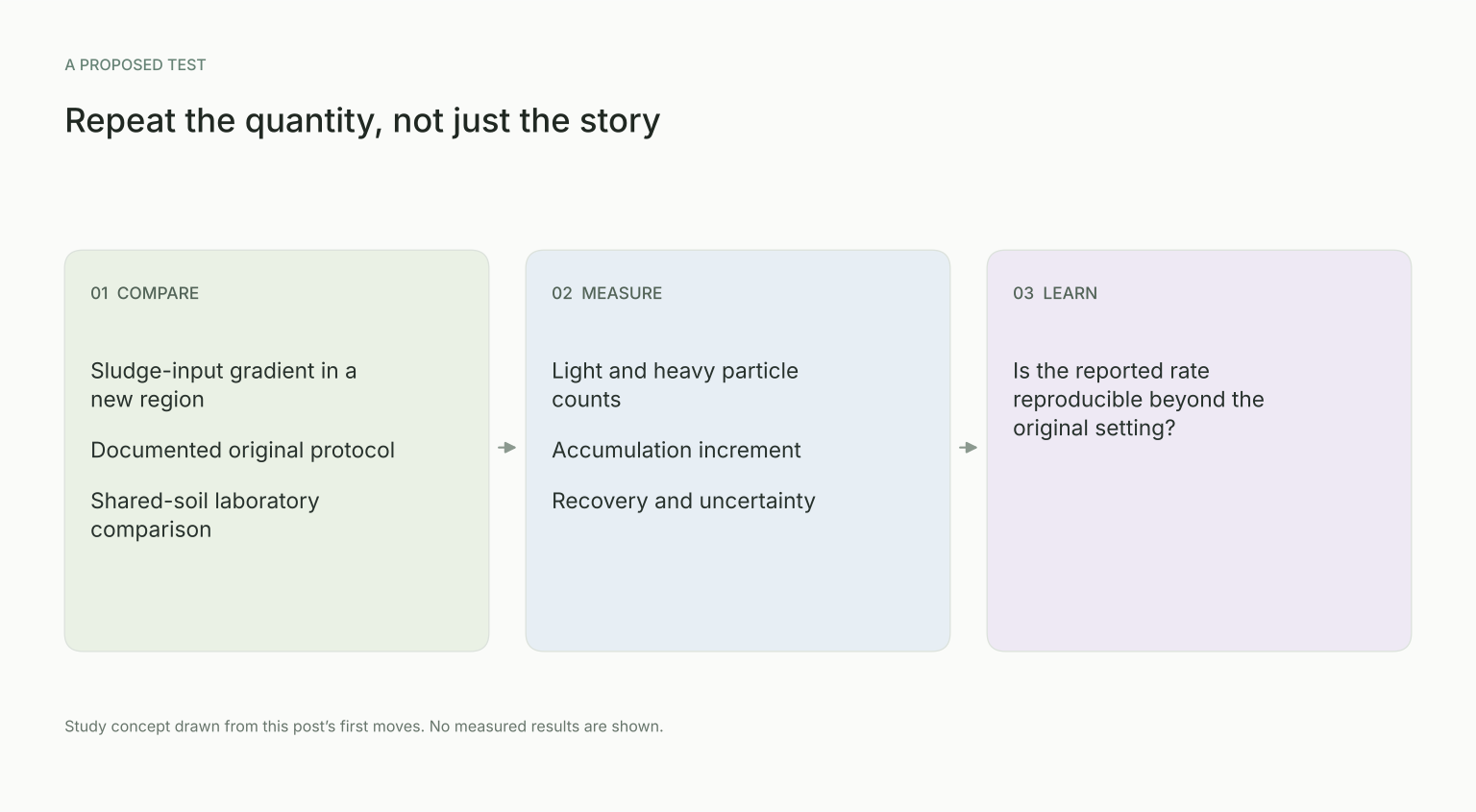
If a second lab, in a second region, used a documented extraction method to re-measure the headline counts we cite most, van den Berg's per-application accumulation rate and Han's aggregate and community shifts, would the numbers hold within a reasonable margin, or do our most-quoted figures rest on single unrepeated studies?
The reviews confirm the overall story: soil plastic is real, widespread, and arriving through several inputs. The exact quantities underneath that story are a different matter. Each one traces back to a single primary study that no one seems to have independently run again. Until someone repeats one of these numbers in another soil with a documented method, we can't tell a general rate from a local one.
First moves
- 1
Re-run one accumulation number
Take van den Berg's sludge-to-soil design and repeat it in a different region with a fully documented flotation-and-filtration protocol. One faithful repeat tells us whether about 280 light and 430 heavy particles per kilogram per application is a general rate or a local one.
- 2
Repeat the biodegradable result
Repeat Han's polyethylene-versus-PLA comparison at 0.5% by weight in a soil that is not silty loam, measuring clump sizes and 16S community. If PLA again tracks polyethylene, that conclusion moves from striking to trustworthy.
- 3
Pin the method before the number
Run a small round-robin where several labs extract plastic from splits of the same soil using their own protocols, then compare counts. That shows how much of the between-study variation Sajjad warns about is real signal versus method.
Where I land
Where I land: the big story about soil plastic is well confirmed, and the exact numbers we quote from it mostly are not. I think several headline figures will hold up, and a few will move once someone repeats them. This corner is thick with results that got cited before anyone ran them twice, and I'd trust one honest repeat over the next new effect.
An invitation
If you work in a soil lab and one of these numbers is close to your bench, I'd love to know whether you have tried to reproduce it, or quietly assumed someone else already did. I'm a student mapping where confirmed knowledge ends and repeated-but-unchecked knowledge begins, and this corner looks thick with the second kind. Am I wrong to find it strange that we cite these counts so confidently before anyone has run them twice?
Questions about this gap
What makes a count reproducible?
Another team must be able to follow the documented sampling and extraction steps and obtain a comparable estimate, with uncertainty and recovery reported.
Why revisit the sludge accumulation increment?
It is a concrete quantity that can be tested in another region. The comparison asks whether the increment travels beyond the original soils and sludge stream.
Is counting agreement sufficient for an effects claim?
No. Agreement in exposure measurement supports the comparison, but structural or microbial effects must still be measured independently.
What does a laboratory round-robin contribute?
It reveals how much variation appears when different teams process matched material. That provides context for interpreting differences between published field counts.
Why report both density classes?
Keeping the original classification makes a repeat more comparable and can reveal whether a method recovers light and heavy particles differently.