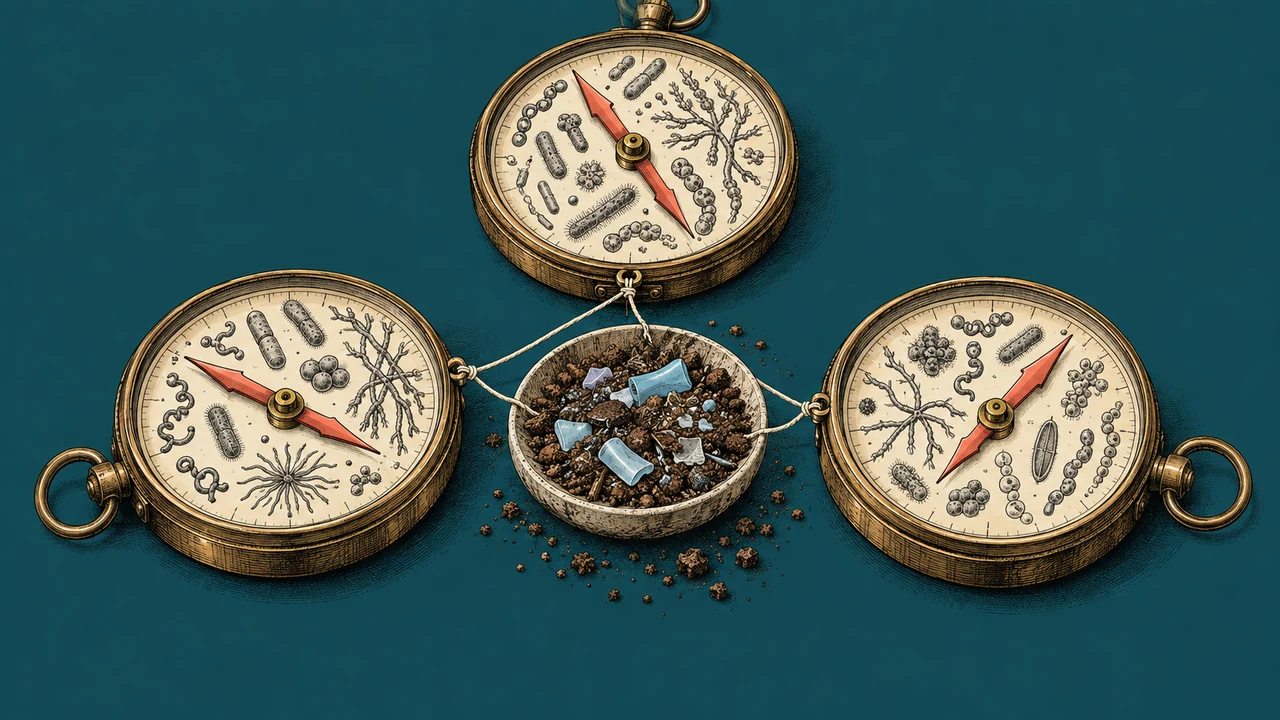
Dozens of papers say microplastics reshape the community of microbes in soil, and that claim gets cited everywhere. When I line the actual experiments up, the harder question is whether the specific result has ever been reproduced.
Start with what the reviews assert. Aralappanavar and colleagues, reading across the field, conclude that both the plastic surface and contaminated soil hold communities with less variety than clean soil, enriched in plastic-degraders like Actinobacteria, Proteobacteria, Bacteroidetes, and Ascomycota, while nitrogen and phosphorus specialists shift, more nitrogen-fixers and phosphorus-freers, fewer nitrifiers. It's a clean, quotable summary. The trouble is what sits underneath it.
Look at two primary experiments and the story stops rhyming. Han and colleagues mixed polyethylene and PLA into a silty loam over a rice-and-wheat rotation and found plastic explained about 54% of the shift in bacteria, a huge fingerprint. But in their soil Proteobacteria dropped while Actinobacteria and Chloroflexi rose. Zhou and colleagues, adding a PHBV biopolymer and watching the thin soil skin right against the plastic, instead saw variety go up, with Acidobacteria and Verrucomicrobia rising.
So one review says variety falls and Proteobacteria are enriched. One field-style experiment says Proteobacteria fall. One surface study says variety climbs. Everyone agrees the community moves. Almost no two agree on which way.
Some of that scatter is real biology, and the reviews say so. Aralappanavar's team stresses that effects on nutrients and gases depend on dose, plastic type, and soil, and that most evidence comes from short, high-dose lab jars. Sajjad and colleagues add the part that makes me nervous about the whole pile: there's still no standard way to sample and extract microplastics from soil. So when two studies disagree, I can't tell whether the microbes responded differently or the two teams measured different things. That's the definition of a result cited more than it's been confirmed.
- Type
- Replication, under-confirmed
- Field
- Soil microbial ecology
- Comparative basis
- Review consensus vs. primary results
- Methods
- 16S sequencing, ring tests, shared extraction protocol
Why this is answerable now
Cited ahead of confirmation
The reviews already treat 'microplastics restructure soil microbes' as settled, but the primary experiments underneath disagree on direction. This is the moment to test the claim before it hardens into a citation everyone repeats and no one rechecks.
No shared measuring stick
Sajjad and colleagues note there's still no standard soil microplastic sampling and extraction method. Until one exists, disagreement between labs can't be read. Building it now is low-glamour, high-value work.
The evidence is lab-shaped
Aralappanavar and colleagues flag that most data come from short, high-dose jars and ask for long-term field studies at realistic amounts. Replication at field doses is exactly the gap they name.
Biodegradable sold as the fix
Han and colleagues found PLA harmed soil structure about as much as polyethylene. If 'switch to biodegradable' is becoming policy, we need reproduced community results before the switch scales, not after.

Sources cited
Papers I read for this question. These notes distinguish reviews from primary studies and identify the limits of my access.
A call to look at soil, not a confirmation of any specific microbe shift.
The consensus summary, and an honest admission the base is thin.
No standard method, which is why lab disagreements can't be read.
04Microplastics alter soil structure and microbial community
Primary experimentBig effect, but Proteobacteria fell, against the review's direction.
Variety climbed at the plastic surface, against the consensus. Abstract only.
What’s missing — the gap
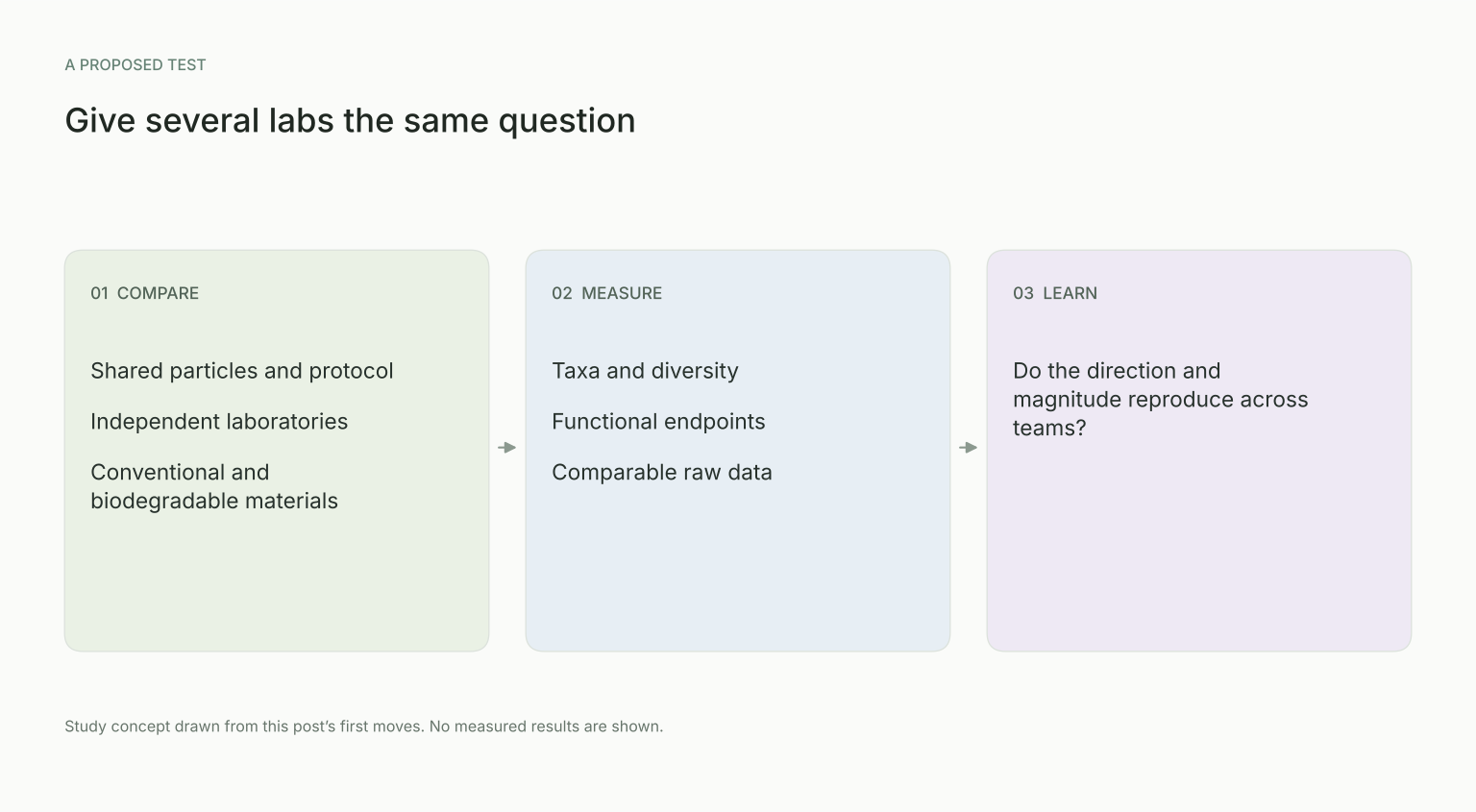
If independent labs applied the same microplastic type, dose, and soil under one shared sampling-and-extraction protocol, would they reproduce the same directional shifts in microbial variety and dominant taxa, or do the field's disagreements about which taxa rise and whether diversity climbs reflect method drift rather than real biology?
Microbe-community effects are cited as one of the most established consequences of soil microplastics. Yet no one has taken a single well-described plastic-and-soil combination and had several labs run it under one protocol. Right now the review says variety falls, Han says Proteobacteria fall, Zhou says variety climbs. Without a shared method I can't tell whether those are three real biologies or three ways of measuring. That's the precise thing a coordinated test would resolve.
First moves
- 1
Run one ring test
Pick a single, fully specified combination: one polymer, one particle size, one field-realistic dose, one well-described soil. Ship identical samples to three or four labs using one shared extraction and 16S protocol. The first honest question is whether two labs even get the same answer, before we ask what the plastic does to microbes.
- 2
Test the direction conflict head-on
Han saw Proteobacteria fall; the reviews say they're enriched. Design one experiment that varies only plastic type, an inert polyethylene against a readily eaten biopolymer like PHBV in the same soil, to see whether the variety direction flips with biodegradability. That would reconcile Zhou with the consensus, or rule it out.
- 3
Publish the null and the method
Since there's no standard extraction method, the most useful early paper may be an unglamorous one: a shared protocol plus every raw community result, including the runs where nothing moved, so the field can separate real biology from measurement noise.
Where I land
Where I land: I think a lot of this disagreement is method drift, not biology, and a ring test would show it. My guess is that the size of the effect reproduces, since even a rough measurement catches a 54% signal, but the specific taxa, whether Proteobacteria rise or fall, won't survive a shared protocol. I'd also bet the variety split between Han and Zhou is partly real, driven by whether the plastic is inert or edible. What frustrates me is that a claim this widely cited has been reproduced this little, and the fix, a shared method and a ring test, is cheap and boring and nobody's doing it.
An invitation
If you run soil microbiome work, I'd love to know whether you think the disagreements across these studies are real ecology or mostly method drift, and whether a ring test on one plastic-soil pair is the cheapest way to find out. It seems strange to me that a result this widely cited has been reproduced this little. Am I wrong to find that odd?
Questions about this gap
What exactly needs reproducing?
The direction and size of microbial changes under a specified plastic treatment need to be checked. A general statement that microbes respond is less precise than a repeatable endpoint.
Why use a shared sequencing workflow?
Differences in sampling, extraction, sequencing, and analysis can alter reported communities. Holding the workflow consistent helps make a biological comparison interpretable.
Why distinguish conventional and biodegradable polymers?
They need not offer microbes the same substrate or create the same local conditions. A shared experiment can test that difference without pooling unlike treatments.
What is a ring test?
Several laboratories analyze shared or closely matched material under a defined plan. It helps reveal how much variation comes from the measurement process itself.
Why publish raw data and null findings?
They let other researchers check the analysis and compare endpoints. Reporting only striking changes would give an incomplete picture of reproducibility.