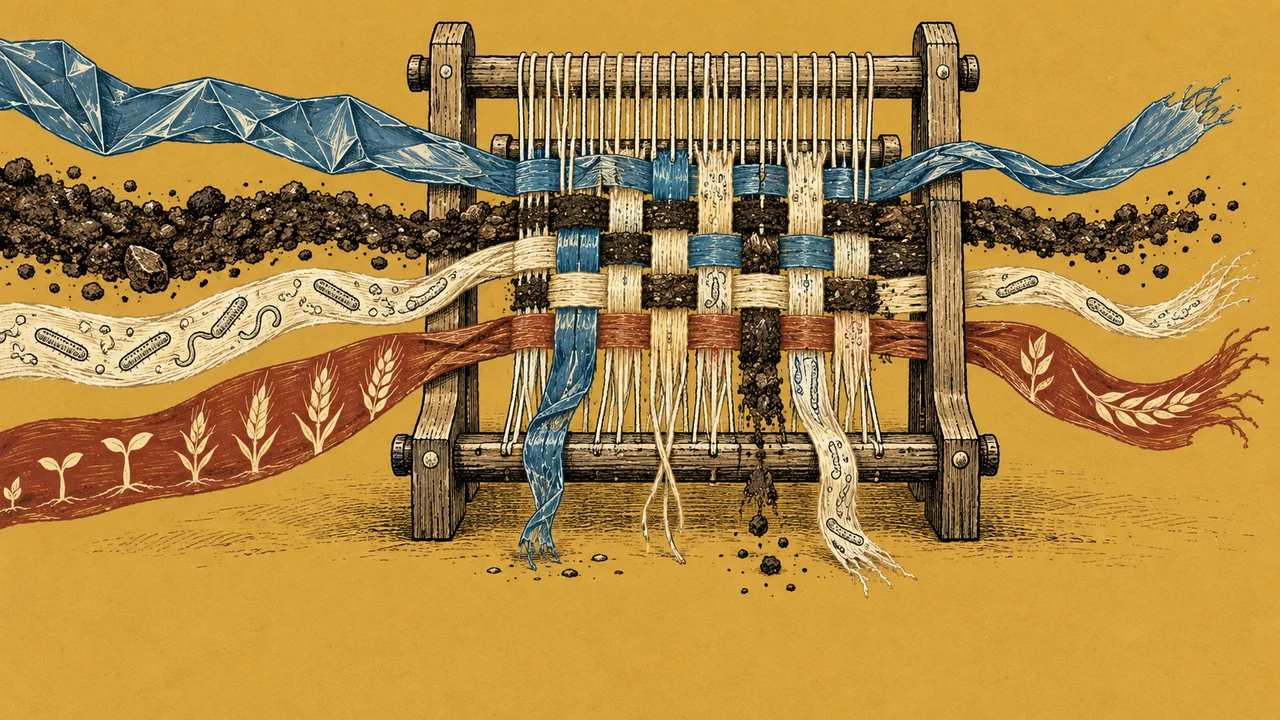
We study what microplastics do to soil, and we study how soil weathers and breaks those plastics down. Both are busy fields. What almost nobody does is watch the two happen together, in the same handful of dirt, over the time a real crop actually grows.
Start with what a single plastic does on its own. Han and colleagues buried polyethylene and biodegradable polylactic-acid microplastics in a silty loam and ran it through a full rice-wheat rotation, then took the soil apart by clump size. Both plastics shifted the soil from big crumbs to fine ones. Macroaggregates fell from 84 to 65-71 percent while microaggregates climbed from 17 to 29-35 percent, and mean weight diameter dropped from 1.4 mm to about 1.0 mm.
So the soil lost its larger, well-glued clumps and turned more powdery, and it barely mattered whether the plastic was the conventional kind or the compostable kind. That is the surprise worth sitting with. The biodegradable option was supposed to be the safer swap, and here it was not.
Now let the plastic and the microbes talk to each other. In Han's rotation, adding microplastic explained about 54 percent of the variance in the bacterial community: Proteobacteria fell while Actinobacteria and Chloroflexi rose, and the co-occurrence networks grew more competitive, an effect stronger for the more persistent PE than for PLA. Zhou and colleagues zoomed all the way in on the microplastisphere, the thin film of soil hugging each plastic particle, and found the opposite mood: microbes ate the PHBV biopolymer as a carbon source and grew faster and more active than in bulk soil, with beta-glucosidase and leucine aminopeptidase running 0.6 to 5.0 times higher.
One study sees plastic making microbial life more cutthroat and another sees it feeding a boom. The difference seems to hinge on which plastic, at what dose, in which soil. The studies are describing different rooms of the same house.
The reviews say the same thing from above. Aralappanavar and colleagues, surveying microplastic effects on microbial nutrient cycling, conclude that impacts on nitrogen, phosphorus, and greenhouse gases are dose-, type-, and soil-dependent, and that almost all of the evidence comes from short-term, high-dose lab microcosms rather than long field seasons. Sajjad and colleagues add that microplastics also carry co-contaminants like phthalates, antibiotics, and PAHs, and that no standard sampling or extraction method exists yet. Every one of those depends-on clauses is an interaction nobody has pinned down. We have measured the variables one at a time. The crosses between them stay dark.
- Type
- Under-studied interaction
- Field
- Degradation and weathering
- Comparative basis
- Single variables vs. their crosses
- Methods
- Rotation trials, 16S networks, zymography
Why this is answerable now
The safe swap isn't safe
Biodegradable plastics are pushed as the fix for conventional mulch films, but Han and colleagues found PLA damaged soil structure about as much as PE. If substitution does not reduce harm, that decision needs the interaction data before more of it goes in the ground.
Realistic conditions are missing
Aralappanavar and colleagues flag that the field runs on short-term, high-dose microcosms. The honest next step is long seasons at field-realistic concentrations, exactly the design that would expose how these effects combine over time.
Co-contaminants are wide open
Sajjad and colleagues show microplastics carry phthalates, antibiotics, and heavy metals along with them. Almost nobody studies plastic plus its passenger together, which is the interaction most likely to matter for food and health.
The tools are ready
Zhou and colleagues paired zymography with growth-respiration to map enzyme hotspots at the particle scale, and Han and colleagues used 16S sequencing with network analysis. The methods to catch interactions exist. They have not been aimed at the crosses.

Sources cited
Papers I read for this question. These notes distinguish reviews from primary studies and identify the limits of my access.
Makes the case that soil is understudied and plastic is a real soil contaminant.
Effects are dose-, type-, and soil-dependent, and mostly from short high-dose microcosms.
Mulch film is the top source. Plastics carry co-contaminants. No standard method yet.
04Microplastics alter soil structure and microbial community composition
Primary experimentBoth PE and biodegradable PLA broke down soil clumps about equally over a rotation.
Microbes fed on PHBV and sped up at the particle surface. Abstract only.
What’s missing — the gap
Does a single soil's structural, microbial, and nutrient-cycling response to microplastics depend on plastic type, dose, co-contaminant load, and time in ways that persist under field-realistic conditions across a full growing season, or do the single-variable lab effects wash out once the variables are allowed to interact?
The map is thick with single variables and nearly empty where they meet. Every depends-on clause in the reviews, plastic by dose, plastic by soil, plastic by co-contaminant, plastic by time, is an interaction nobody has run on purpose. Until someone does, we cannot tell whether the striking lab effects add up, cancel out, or fade in real ground.
First moves
- 1
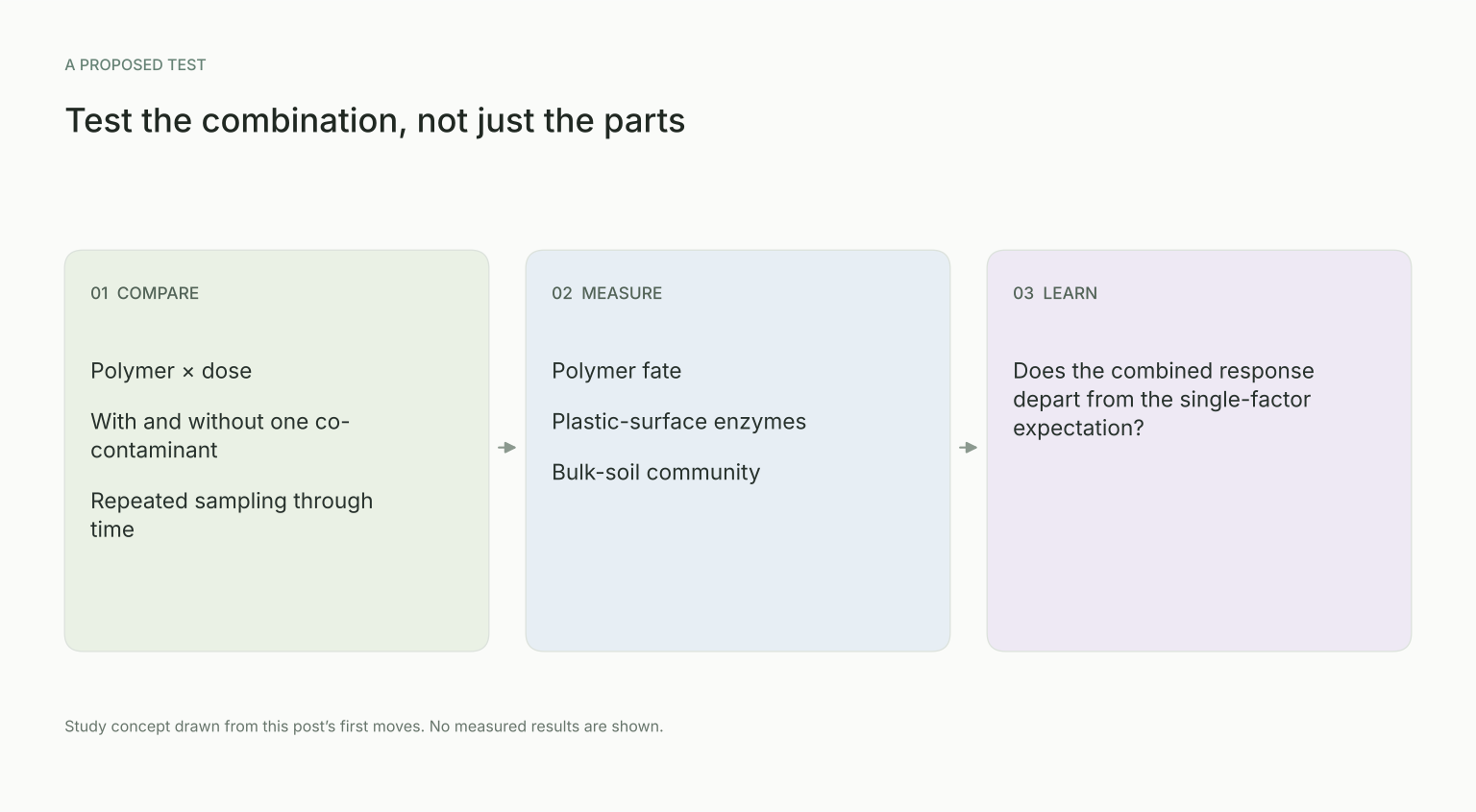
Cross plastic type against dose over a season
Take Han's rotation design but add a realistic-dose arm alongside the high-dose one, for both PE and a biodegradable polymer. It is the smallest honest test of whether type matters survives when dose and time are allowed to move too.
- 2
Pair the particle scale with the bulk scale
Run Zhou's microplastisphere zymography and Han's bulk 16S plus network analysis on the same soil cores, so the hotspot-at-the-particle reading and the whole-sample competition reading can be compared directly instead of across separate studies.
- 3
Add one co-contaminant on purpose
Sajjad flags plastics as carriers of phthalates and antibiotics, yet they are rarely dosed together. Introduce a single, quantified co-contaminant with the microplastic and measure whether the microbial and structural effects add up, cancel, or amplify.
Where I land
Where I land: the single-variable work is strong, and the crosses between the variables are where the real answers hide. My honest guess is that plastic type, dose, and time interact enough that some loud lab effects soften in real ground while others hold, and I would not bet on the biodegradable swap being safe until someone runs the season-long cross. The tools are here. What is missing is the design that lets the variables collide.
An invitation
If you work on soil structure, plastisphere microbiology, or nutrient cycling, this is a call to run one of these crosses, because the map is thick with single variables and nearly empty where they meet. I have tried to read the pieces honestly, but I am a student turning this over, not the person with the microcosms. When you look at how these plastics, doses, soils, and co-contaminants actually collide in the ground, what am I missing?
Questions about this gap
What is the interaction being proposed?
The question is whether polymer, dose, co-contaminants, and time change one another’s effects on breakdown and soil function, rather than contributing independently.
Why measure the plastic surface and surrounding soil separately?
Microbes attached to plastic may behave differently from the broader soil community. Sampling both makes that difference visible within one experiment.
Does fragmentation mean the plastic has biodegraded?
No. Smaller fragments can remain plastic. A breakdown study needs measurements that distinguish physical fragmentation from biological transformation or loss of polymer mass.
Why start with one co-contaminant?
A defined, measured co-contaminant makes the comparison interpretable. Adding many substances immediately would make it harder to identify which combination changed the response.
What result would support an interaction?
A combined treatment that departs from the response predicted by the separate treatments would support an interaction under those tested conditions. Its direction is still an open question.