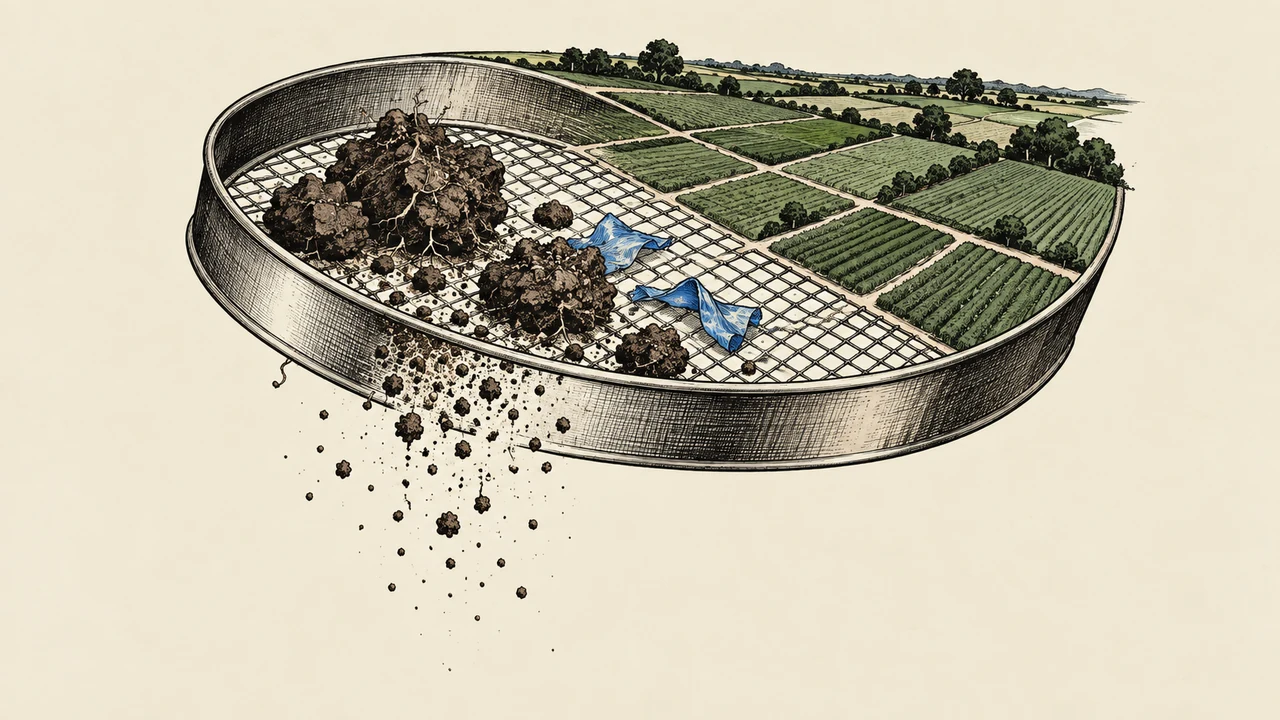
I’d like to know whether plastic changes how soil behaves when it rains. In a greenhouse study by Han and colleagues, soil with added plastic had smaller clumps. That makes me wonder whether it would also absorb water differently.
These clumps, called aggregates, are groups of soil particles held together. Their arrangement helps shape the spaces that water, air and roots move through. In this experiment, a measure of average clump size was about 1.0–1.1 millimetres in the plastic treatments, compared with 1.4 in the control, which had no added plastic.
The team grew rice and wheat over a year in silty loam, comparing ordinary polyethylene with biodegradable PLA. The two plastics generally produced similar changes in aggregation. I’d want to test both in a field, rather than assume the biodegradable one would have less effect.
The researchers measured the clumps by sorting dried soil through sieves. That tells me about their sizes, but I still want to know how well they hold together when wet. Smaller clumps might affect how water enters the soil, but I’d need to measure that too.
The experiment used 0.5% plastic by weight, or 5 grams per kilogram of soil. Before using that amount in a field test, I’d check how much plastic is already in the field and what kinds are present.
I’d like to find out whether the clumps are still smaller at those plastic levels, whether the change lasts across seasons, and whether it affects water movement. Those results would help me understand what the greenhouse finding means for a farm.
- Type
- Emerging, not settled
- Field
- Soil structure and water
- Comparative basis
- Greenhouse measurements and field conditions
- Methods
- Soil sieving, wetting tests, water infiltration, repeated field sampling
Why this is answerable now
We can measure changes in clump size
I’d use the same method to compare aggregate sizes in soil with different amounts of plastic. Repeating the measurements would show whether the differences last.
We can test different amounts of plastic
Testing several amounts would help me find out whether a lower dose has a smaller effect, no detectable effect, or a different effect altogether.
We can check what happens when the soil gets wet
I’d measure how well the clumps hold together during wetting, as well as how quickly water enters the soil. That would let me compare size changes with changes in water movement.
The reviews help plan a field comparison
Aralappanavar’s review calls for longer field work at relevant plastic levels. Guo, Sajjad and Kumar describe how plastic reaches soil and the difficulties of measuring it. I’d use that information to decide what to measure before starting a field test.

Sources cited
Papers I read for this question. These notes distinguish reviews from primary studies and identify the limits of my access.
Reviews where soil microplastics come from, how they move and their possible effects. Useful background for deciding which plastic exposures to investigate.
Reviews microbial responses and nutrient cycling, and calls for longer field studies. Relevant to deciding how long to follow changes in the soil.
Reviews effects on physical soil properties, including water behaviour, and the difficulties of comparing plastic measurements between studies.
04Microplastics alter soil structure and microbial community
Primary experimentThe greenhouse experiment discussed here. The researchers used dry sieving and mean weight diameter to compare aggregates after adding PE and PLA.
Reviews agricultural sources of plastic, its behaviour in soil and the challenges of detecting and measuring it.
What’s missing — the gap
At plastic levels measured in a particular field, do changes in aggregate size persist across growing seasons, and do they go along with changes in how the soil handles water?
I want to know whether smaller dry aggregates also fall apart more easily when wet. If they don’t, or if water movement stays much the same, I’d need to reconsider how much the size difference tells me about the soil.
First moves
- 1
Measure the plastic already in the field
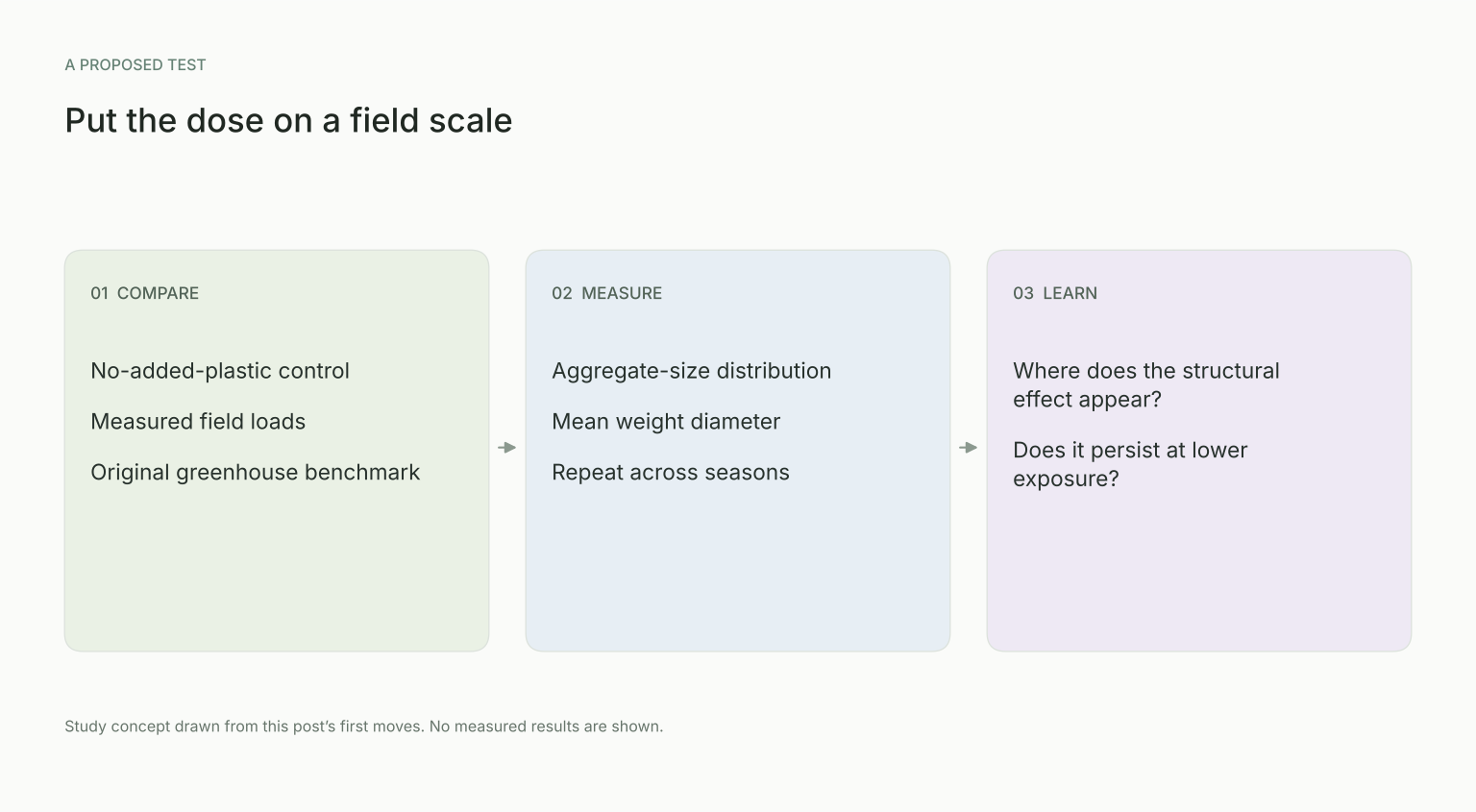
I’d measure the plastic already present in a chosen field, including its material, size, shape and amount. I’d use those measurements to choose the amounts to test, alongside a no-added-plastic control and the 0.5% greenhouse treatment for comparison. I’d record particle counts and weight separately.
- 2
Sample the same plots across seasons
I’d use several plots for each treatment and sample before the additions, then at consistent stages over several growing seasons. Polyethylene and PLA would get separate treatments, with particle sizes and shapes matched as closely as possible. I’d record rainfall, soil moisture and farming operations alongside the samples.
- 3
Test how the clumps respond to water
I’d use the same dry-sieving method across samples and calculate mean weight diameter. Then I’d test how well the aggregates hold together during controlled wetting and measure how quickly water enters the soil in each plot. This would let me check whether a change in clump size is accompanied by a change in water movement.
Where I land
My hunch is that some of the greenhouse effects will be harder to detect at lower plastic levels in a field. But I wouldn’t assume that half the plastic produces half the change. I’d test several amounts to see what actually happens.
I’m especially curious about what it would mean if the clumps got smaller but water still moved through the soil at much the same rate. I’d have to rethink my assumption that the size change would affect water movement. That’s why I want to measure both.
An invitation
If you’ve measured soil structure in a field, I’d love to hear which measurements you found useful and why. If you grow plants, what changes in the soil do you pay attention to after rain? I’m interested in how those observations compare with what a soil test can tell us.
Questions about this gap
Is crumbly soil always a bad thing?
Not necessarily. I’d want to know how large the clumps are, how well they hold together when wet, and whether water moves through the soil differently. Describing soil as “crumbly” doesn’t tell me all of that.
What does “mean weight diameter” actually mean?
It is a summary of aggregate size that gives more influence to size groups containing more of the sample’s mass. It isn’t the diameter of every clump, and it doesn’t show that each individual clump shrank by the same amount.
Why can’t I compare all plastic percentages directly?
A percentage by weight and a percentage by volume describe different things. A particle count is different again. I’d check the units, sampling depth and material before deciding that one field has more plastic than another.
Could the size change without hurting the crop?
Yes. A structural measurement alone doesn’t establish crop damage. To connect it to plant growth or yield, I’d need to measure those outcomes too. This proposal starts with soil structure and water.
Have I done this field experiment?
No. This is an experiment I’d like to try, based on the papers discussed here. The greenhouse measurements are from Han and colleagues. I haven’t carried out the field comparison or water tests I’m proposing.