
Microplastics break up soil crumbs and reshuffle the microbes on them. That claim is cited all over the soil-plastics literature. When I chase the primary experiments behind it, I find striking single studies, a stack of reviews repeating them, and little independent work that ran the same test again and got the same answer.
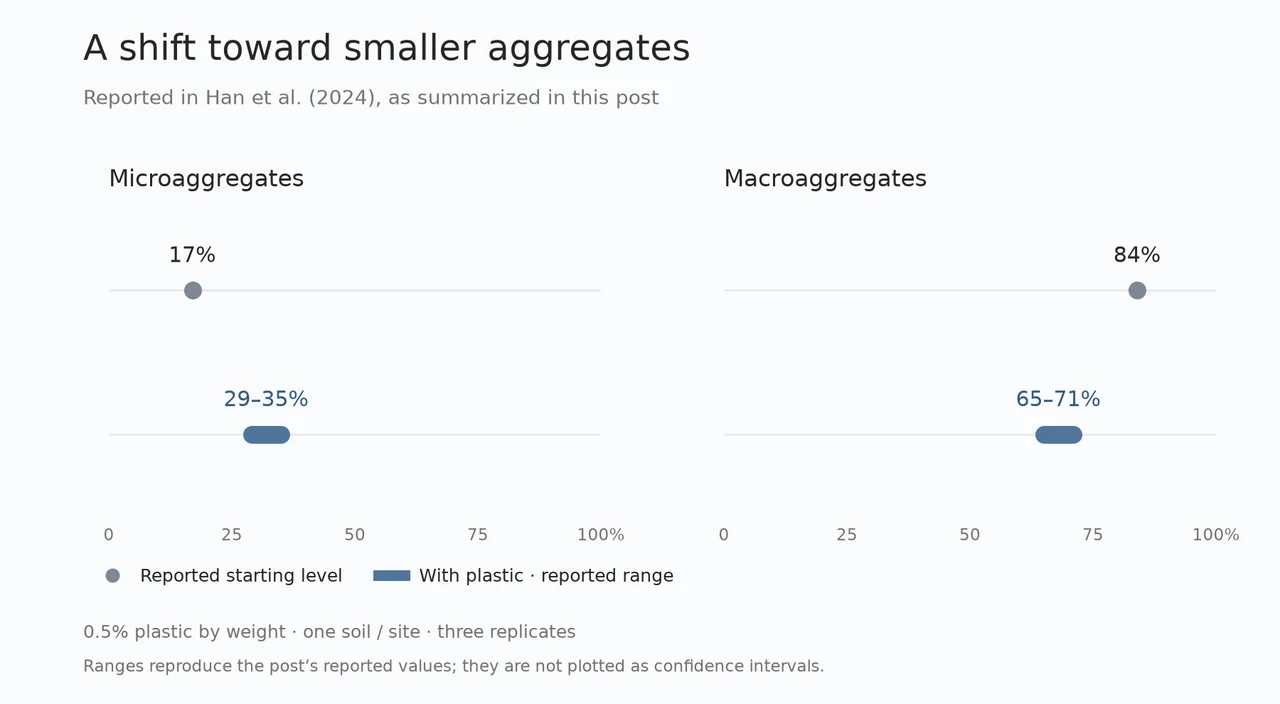
Start with what the primary work shows. In a one-year rice-wheat rotation, Han and colleagues mixed regular and biodegradable plastic into a silty loam at 0.5% by weight and watched the structure come apart: microaggregates rose from 17% to 29-35%, macroaggregates fell from 84% to 65-71%, and the mean weight diameter dropped from 1.4 mm to about 1.0-1.1 mm (Han et al., 2024). The soil went from holding together in big clumps to crumbling into fine bits. They tie this to the plastic acting as fracture points and to a drop in the microbial byproducts and sticky proteins that normally bind crumbs together, and plastic alone explained about 54% of the variance in the bacteria. The structural damage and the biological shake-up show up in the same experiment.
Set that next to Zhou and colleagues, who looked at the microplastisphere, the thin film of soil and life clinging to the plastic surface, using a biodegradable PHBV polymer (Zhou et al., 2021). There the plastic was not an inert fracture point. Microbes ate it as a carbon source, and the interface ran hotter than the surrounding soil, with enzyme activity 0.6-5.0 times higher than the rhizosphere. The two papers start to talk to each other, and not in full agreement. Han reports biodegradable plastic doing damage on par with regular plastic, so swapping to greener plastic buys little. Zhou shows a biodegradable polymer becoming a feeding spot that lifts diversity.
Soil structure breaks down
Microaggregates after plastic addition
A microbial hotspot
Enzyme activity relative to the rhizosphere
Different experiments, not a controlled head-to-head comparison. The open question is whether either result survives an independent repeat.
That tension sharpens against the reviews. Aralappanavar and colleagues sum the field up as plastic soils holding lower-diversity communities that favor a few plastic-degraders (Aralappanavar et al., 2024), the opposite direction from Zhou's rise in diversity. So a primary result and the settled summary point different ways, and nobody has run the deciding repeat.
The reviews are doing a lot of work. Guo and colleagues frame soil microplastics as an understudied contaminant next to the ocean (Guo et al., 2020). Sajjad and colleagues catalog how plastic alters porosity, bulk density, and water-holding, while noting there is still no standard way to even sample soil microplastics (Sajjad et al., 2022). These syntheses lean on a thin base of primary aggregation-and-biofilm experiments, then get cited as settled. The confident summary sentences outnumber the independent replications under them.
- Type
- Under-confirmed, rarely repeated
- Field
- Soil microbial ecology and structure
- Comparative basis
- Primary results vs. replication
- Methods
- 16S sequencing, zymography, aggregate sieving
Why this is answerable now
The papers are recent
The primary work driving this corner is from 2021 to 2024, early enough that the field is still deciding which effects are real and repeatable. It is not yet locked into textbook fact, which is the moment to check it.
Biodegradable sold as the fix
Han finds biodegradable plastic roughly as harmful as regular, while Zhou finds a biodegradable polymer feeding microbes. Getting the repeat right now, before compostable plastic scales onto farmland, changes what we recommend.
No shared method
Sajjad notes there is still no standard way to sample or extract soil microplastics, so two labs testing the same effect may not measure the same thing. Replication has to be built deliberately, not assumed.
The dose gap is fixable
Most of the strong results come from short, high-dose lab jars, and reviewers keep asking for long-term field studies at realistic amounts. That is a concrete, doable target rather than a vague wish.

Sources cited
Papers I read for this question. These notes distinguish reviews from primary studies and identify the limits of my access.
The framing review: soil is a neglected sink next to the ocean.
Sums up lower diversity, which runs opposite to Zhou's result.
No standard sampling method, so clean replication is hard.
04Microplastics alter soil structure and microbial community
Primary experimentStrongest aggregation result, but one site and three replicates.
Found diversity rising, against the review consensus. Abstract only.
What's missing — the gap
For a category with this much confident review language, very few of the headline biofilm-and-aggregation results have actually been run again. Does independent replication at field-realistic doses reproduce the core findings, plastic shifting soil from large to small aggregates and reshaping the plastisphere community, or do the effects, especially the biodegradable-equals-regular claim, weaken or reverse when a second lab repeats them?
The pieces are all here in the primary work. What is thin is the second time anyone checked. Han's aggregate result and biodegradable-equals-regular conclusion rest on one site and three replicates. Zhou's diversity-up result is available only as an abstract and runs against the review consensus. Both are decision-relevant, and both are waiting for an independent repeat at a dose the field actually sees.
First moves
- 1
Repeat Han's test in a second soil
Rerun the regular-versus-biodegradable aggregate breakdown in a different soil texture and climate, holding the 0.5% dose and the sieving protocol constant. Report whether the large-to-small crumb shift and the biodegradable-equals-regular result survive a change of site.
- 2
Dose it down to the field
Take the same endpoints, aggregate size classes and community composition, and test them at the low, field-realistic amounts the reviews keep asking for. That shows whether high-dose jar effects hold when the plastic load matches actual farmland.
- 3
Settle the diversity direction
Run one experiment that measures the plastisphere and the surrounding bulk soil side by side with a shared extraction method, aimed at the Zhou-versus-review disagreement: does plastic raise or lower microbial diversity when both are measured the same way?
Where I land
Where I land: this corner has more confident review sentences than repeated experiments. The biodegradable-equals-regular claim is the one I most want checked, because it is close to policy and rests on a single site. My guess is that the basic large-to-small crumb shift survives an independent repeat, while the diversity direction stays open until someone measures the plastisphere and bulk soil the same way. The most useful next study is an old result, run again.
An invitation
If you work on soil aggregation, the plastisphere, or biodegradable polymers, I would love to know which of these results you would bet on repeating and which you quietly doubt, especially the claim that switching to biodegradable plastic buys the soil nothing. The pieces are all here in the primary work. What is thin is the second time anyone checked. So before this hardens into something everyone just cites: which of these effects do you actually expect to reproduce, and where would you push back?
Questions about this gap
What is the research gap?
The post asks whether influential results on soil aggregation and microbial changes survive an independent repeat. A result being cited often does not establish that another team has reproduced it.
What would a useful repeat test?
Repeat the core experiment across different soils and at field-relevant doses, while measuring soil structure and microbial responses together. The post also calls for agreed sampling methods so results can be compared.
Why compare regular and biodegradable plastic?
The studies discussed here suggest different responses to biodegradable polymers: structural damage in one experiment and an active microbial interface in another. Their conditions differ, so they do not settle whether switching materials protects soil.
Do the studies prove the same thing?
No. Han examines aggregation and microbial changes in a particular soil experiment. Zhou examines the microplastisphere around PHBV. They inform the same question but are not a controlled head-to-head comparison.
Were all five papers read in full?
No. The reading notes explicitly identify Zhou et al. (2021) as abstract-only. Its findings should be interpreted with that access limitation in mind.
What does a gap score of 7.9 mean?
It is Nyssa’s assessment using five dimensions: whitespace, timeliness, evidence readiness, significance, and tractability. It is a prioritization aid, not a measurement of effect size or a scientific certainty rating.