A corner of soil science is quietly picking up speed. Microplastics are starting to look less like inert litter and more like surfaces that bind other pollutants and move them through the ground. The work is rising, but no one has pulled it into a clear picture yet.
Start with the binding, because it is what makes plastic in soil more than an eyesore. Sajjad and colleagues reviewed soil microplastics and reported that the particles act as carriers for other contaminants, listing phthalates, antibiotics, potentially toxic elements, PAHs and PCBs among what sticks to them. So a plastic fragment can pick up other toxic chemicals and move them down through the soil.
Aralappanavar and colleagues went into the biology of that. Soils with microplastics hold less varied microbes than clean soils, and the mix shifts toward the bugs that break plastic down. The plastic raises the microbes that pull nitrogen from the air and cuts the ones that turn that nitrogen into a form plants can use.
Here is where the studies start talking to each other. Aralappanavar's team is honest that most of their evidence comes from short, high-dose lab jars, and they ask for long-term field studies at realistic amounts. Cusworth and colleagues did the long, real-world version. They read a microplastic record out of archived soil from the Broadbalk wheat experiment at Rothamsted, sampled at 18 points between 1846 and 2022.
They found none before 1914, a rise across every plot from 1966 to 2022, and fertiliser-treated plots sitting well above the untreated one. So fertiliser is adding plastic above the baseline. The field record confirms the buildup the lab work predicted. The sorption question, what those particles are binding and carrying, is the part that long record never measured.
Guo and colleagues had already placed soil microplastics as an emerging contaminant, understudied next to the ocean, with particles that move down, sideways, and up the food chain. Kumar and colleagues said the same about farm soils and flagged standardized methods as a future need. Everyone names sorption of co-contaminants as important. Almost no one has followed it from the archive into the food chain.
- Type
- Emerging, not consolidated
- Field
- Soil contaminant chemistry
- Comparative basis
- Lab vector claim vs. field record
- Methods
- Density separation, Nile Red, sorption assays
Why this is answerable now
A small base, climbing
Work on sorption in soil is rising off a modest base. That is the cheap moment to shape a field, before its habits set and the interesting questions get crowded out.
The long record exists
Cusworth and colleagues showed you can pull a dated microplastic series out of archived farm soil. They counted the particles. No one has asked that same archive what those particles carried.
Fertiliser is a named source
The Rothamsted plots treated with fertiliser held more plastic than the untreated plot. That points at a specific farming practice, which makes the sorption question something you can act on.
The carrier claim is untested
Review after review lists microplastics as carriers of phthalates, antibiotics, PAHs and PCBs. The evidence behind it is mostly short, high-dose lab jars. At field scale it has barely been checked.

Sources cited
Papers I read for this question. These notes distinguish reviews from primary studies and identify the limits of my access.
Says soil was ignored next to the ocean; plastic moves and matters.
How plastic changes soil microbes and nutrients. Calls for field studies.
Plastic carries phthalates, antibiotics, PAHs, PCBs. No standard measure yet.
04Microplastics as pollutants in agricultural soils
Abstract onlyFarm soils understudied next to water. Standard methods missing. Abstract only.
Archived soil back to 1846: plastic rising since 1966, fertiliser adds more.
What’s missing — the gap
In long-term archived farm soil, did the pollutants bound to microplastic particles, such as PAHs, PCBs or antibiotics, rise over time along with the number of particles, or not?
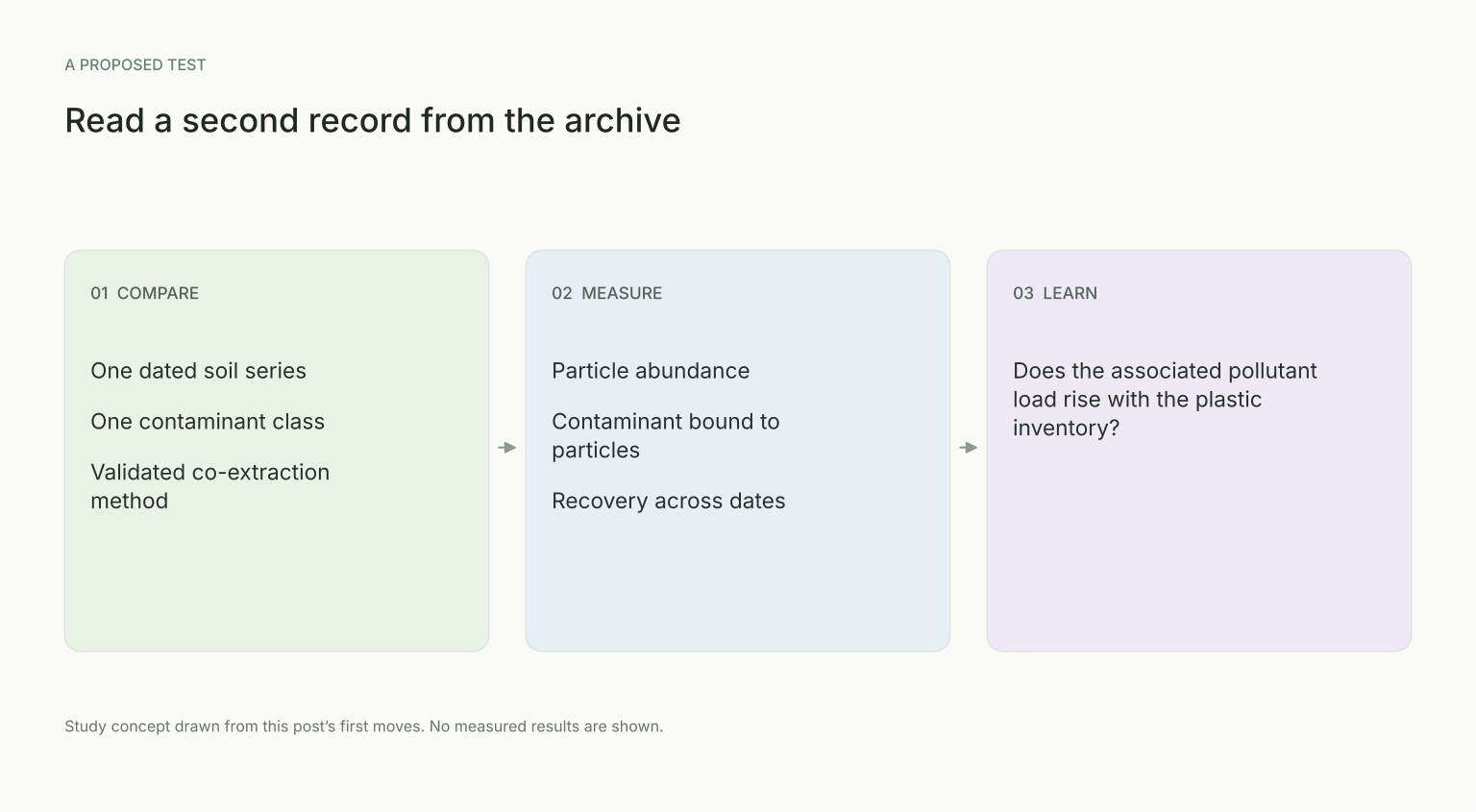
We can now read a dated plastic record out of old farm soil, and every review calls these particles carriers of other pollutants. No one has put those two together and measured the sorbed load across the same time series. The smallest honest test is one contaminant class on one archived plot, to see if the bound load tracks the particle rise.
First moves
- 1
Point the archive at sorption
Take the kind of archived long-term soil the Rothamsted study used and, instead of only counting particles, extract the microplastics and measure the co-contaminants bound to them across the time series.
- 2
Pair a field gradient with the claim
The carrier role is asserted mostly from high-dose lab jars. Sample real soils along a fertiliser-input gradient and test whether sorbed loads scale with microplastic concentration at realistic field levels.
- 3
Settle one extraction method first
Since no standard soil microplastic extraction method exists, run a small methods comparison for co-extracting particles and their sorbed pollutants, so future sorption numbers can be compared across labs.
Where I land
Where I land: my guess is the sorbed load did rise with the particles, at least for the stickier pollutants, because the plastic surface has been accumulating for decades and barely reverses. But that is a guess. What bothers me is that we can date the plastic to the year and still can't say what it was carrying. One archived plot, one contaminant class, measured properly, would settle more than another lab jar.
An invitation
If you work on soil microplastics, plastisphere microbes, or contaminant sorption, this is the corner I would love to see someone push into. The archives exist, the carrier claim is everywhere, and the thread connecting them is still loose. I am a student mapping this from the outside. Where would you push back?
Questions about this gap
What does sorbed mean?
It describes a substance associated with a surface or material. Here the question concerns contaminants bound to extracted plastic particles, rather than only their concentration in whole soil.
Why use archived soil?
A dated archive can support comparisons through time. Storage history and extraction effects must be considered before treating the recovered contaminants as an unchanged historical record.
Would more plastic necessarily mean more bound pollutant?
No. Polymer properties, weathering, and contaminant availability can change the relationship. That uncertainty is the central question of the proposed time series.
Why start with one contaminant class?
It keeps the analytical method and interpretation manageable. A clear result for one class is more informative than an poorly resolved mixture of many chemicals.
What needs validating before the archive is interpreted?
The method should recover both particles and their associated contaminants without creating an artificial difference between samples or stripping away the material being measured.