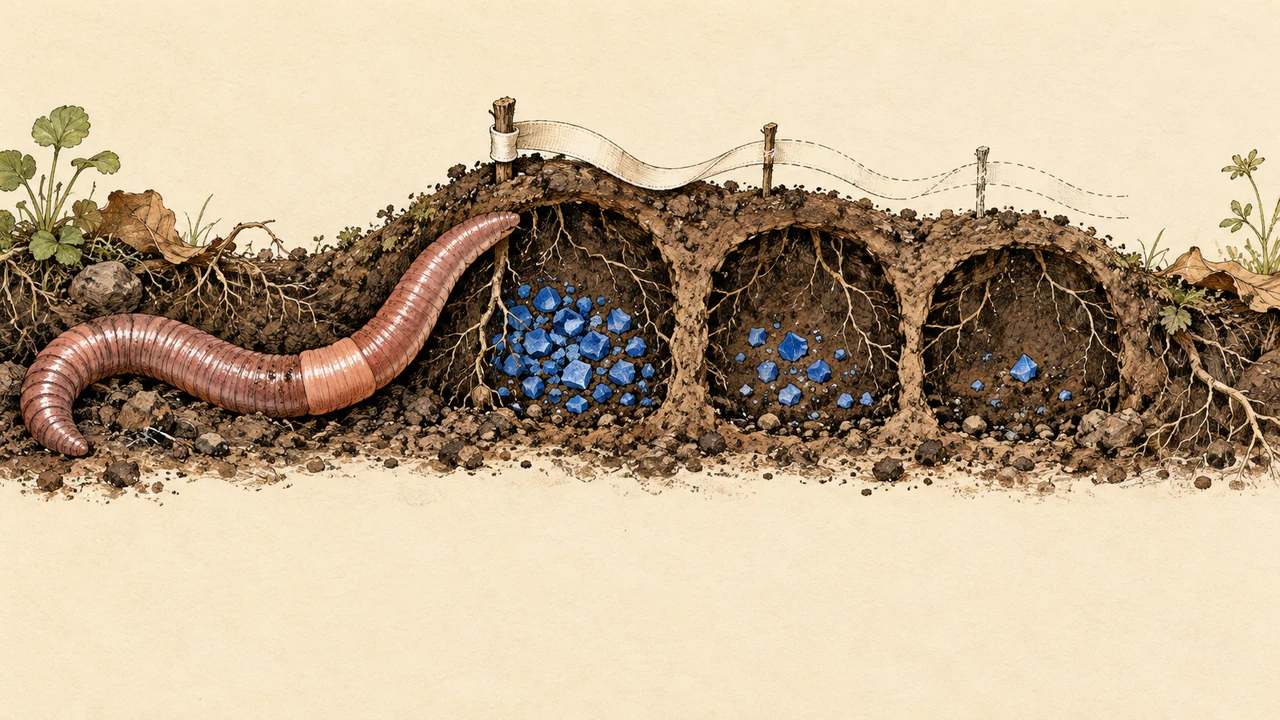
A number gets passed around a lot in this corner of soil science: put microplastics into soil at roughly 1-2% by weight and you start killing the animals that live there, the earthworms, nematodes and collembolans. It is cited, it is tidy, and it shapes how people talk about the risk. When I look for the confirmation underneath it, the ground gets soft fast.
Start with the claim as the literature states it. Sajjad and colleagues report dose-dependent harm across soil fauna, with loadings around 1-2% causing measurable death in earthworms, nematodes and collembolans. These animals recycle the soil: they shred litter and move nutrients, so past a certain dose you would expect the recycling to stumble.
The fauna aren't only victims. Guo and colleagues document microplastics moving up the food chain, so a particle a worm eats does not stop at the worm. The two reviews make a coherent story. A story cited many times is not the same as a reproduced result.
This is where the replication question bites. Sajjad's review notes there is still no standard way to sample and extract microplastics from soil, so two labs reporting the same dose may not be measuring the same thing, and their numbers can't be stacked to confirm each other.
Aralappanavar and colleagues sharpen it from the other side: most toxicity evidence comes from short, high-dose lab jars rather than field studies at realistic amounts, and effects swing with dose, plastic type and soil. The striking 1-2% figure lives in exactly the setting most likely to produce a striking figure and least likely to survive being repeated at field doses.
The primary experiments we have are mostly single runs. Han and colleagues mixed conventional and biodegradable plastic into silty loam at 0.5% by weight across seven treatments with three replicates, tracing soil structure and bacteria over a year. Zhou and colleagues watched microbes colonize and eat a biodegradable particle at its surface, though that one's detail is only as deep as its abstract.
These are strong, but each is one experiment, in one soil, done once. Guo and colleagues note the whole soil compartment is still understudied next to marine and freshwater systems, so there isn't the depth of repeated work that lets the field say this replicates. The gap is a missing second, third and fourth look at the results we already trust.
- Type
- Replication, under-confirmed
- Field
- Soil fauna ecotoxicology
- Comparative basis
- Cited primary results vs. confirmation
- Methods
- Standardized extraction, field-dose repeats
Why this is answerable now
The headline number is load-bearing
The 1-2% mortality figure is doing real work in how people frame soil-plastic risk, but it comes from short, high-dose lab settings and hasn't been reproduced at field doses. A number that important should not rest on conditions that fragile.
The methods gap blocks confirmation
There is still no standard soil microplastic sampling and extraction method, so even well-run replications can't be compared cleanly. Fix the measurement and you unlock every confirmation study that currently can't line up its numbers.
Exposure is already field scale
Mulch film, sludge, compost, atmospheric deposition and coated fertilisers put on the order of 700,000 tonnes into farmland across Europe and North America each year, with up to 90% of Swiss floodplain soils polluted. The fauna are being dosed whether or not the results are confirmed.
Soil is finally getting attention
Soil ecosystems have been understudied next to marine and freshwater ones, which is why the primary work has outrun the synthesis. The base is young enough that a deliberate confirmation pass now would set the terms before the field hardens.

Sources cited
Papers I read for this question. These notes distinguish reviews from primary studies and identify the limits of my access.
Synthesis of a thin literature; fauna both exposed and a transfer route.
Cleanest effects come from the settings least likely to replicate.
Supplies the 1-2% fauna number and explains why it's hard to confirm.
04Microplastics alter soil structure and microbial community
Primary experimentCareful primary work, but one soil, done once.
05The microplastisphere: biodegradable microplastics alter soil microbes
Primary experimentCited more than re-run; detail only as deep as its abstract.
What’s missing — the gap
If the fauna-toxicity results this field relies on, most sharply the 1-2% loading that kills earthworms, nematodes and collembolans, were repeated under a standard sampling and extraction protocol at field-realistic doses, would the effects reproduce, or are they artifacts of the short-term, high-dose jars where they were first measured?
The 1-2% figure is doing real work in how people frame soil-plastic risk, and it rests on brief, concentrated, controlled conditions with no standard extraction method behind it. No one has repeated it at field doses under a shared protocol. Until someone does, we can't tell whether the harm is real biology or a feature of the box it was measured in.
First moves
- 1
Re-run one cited result, exactly
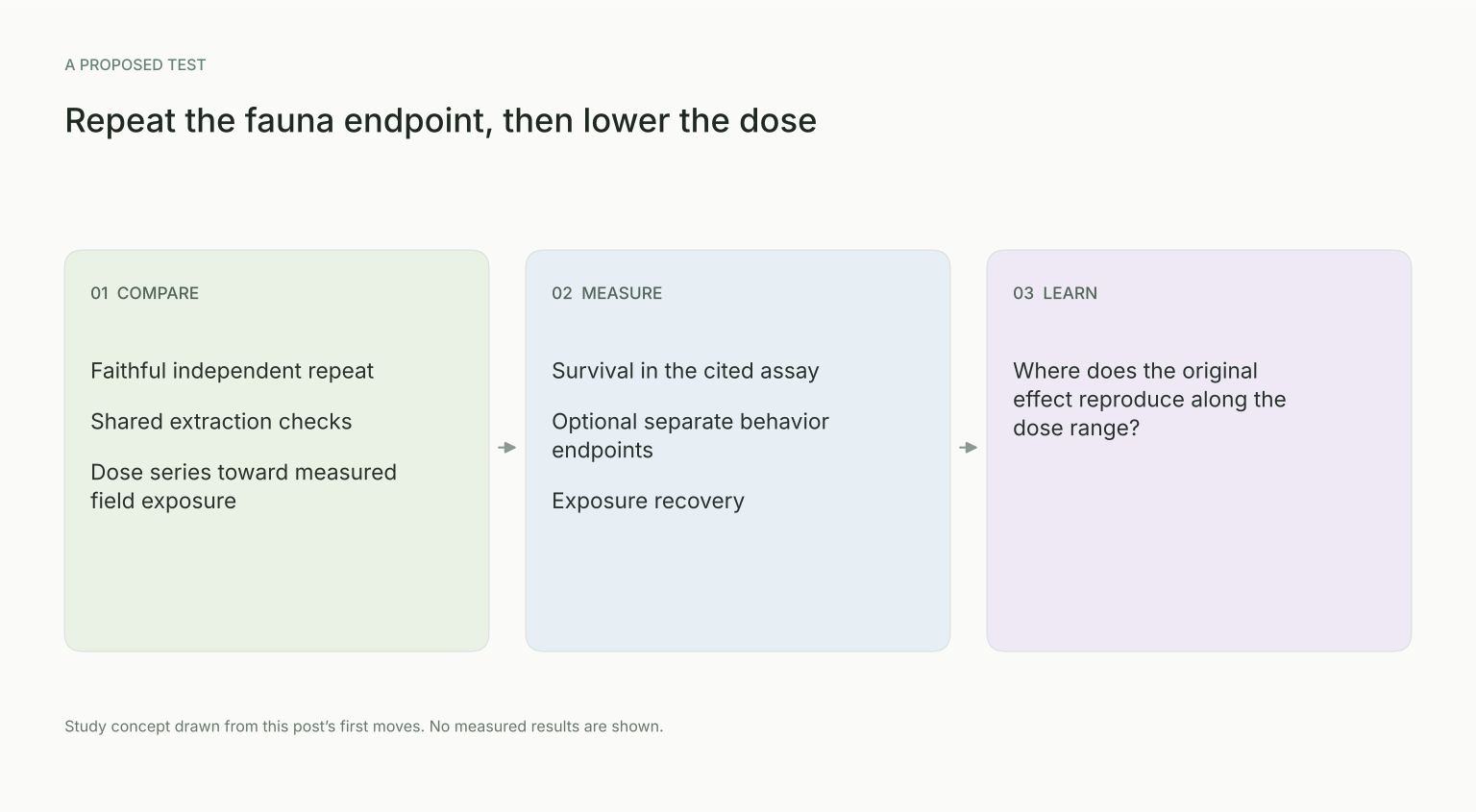
Take a single widely-cited earthworm or collembolan mortality finding and reproduce it as faithfully as the original methods allow, in a second soil and a second lab, before changing anything. Where the method isn't fully specified, document the gap, which is itself a finding.
- 2
Lock the measurement first
Agree on and apply one sampling-and-extraction protocol across a small round-robin of labs on identical spiked soils, so that when different groups report a dose, they are demonstrably reporting the same thing.
- 3
Repeat the striking dose lower
Take the 1-2% mortality regime and run it as a dose series stepping down to field-realistic loadings, over a longer horizon than a microcosm allows, turning a single high-dose data point into a curve.
Where I land
Where I land: my honest read is that some of the fauna harm is real and some of the sharpest numbers will shrink at field doses, but I can't prove either, and that is the whole problem. This category is full of first results and nearly empty of second looks. A careful confirmation pass under shared methods would be worth more right now than another striking single experiment.
An invitation
If you run soil ecotoxicology, or you have a fauna dataset in a drawer that no one has ever tried to reproduce, this is the corner where a careful second look would be worth more than another first one. I would genuinely like to know whether the numbers we all cite would survive being repeated with shared methods at doses real fields actually see. If you think the foundation is sturdier than I am reading it, where would you point me to prove it?
Questions about this gap
What is the first result to repeat?
The post proposes choosing one specific fauna toxicity experiment and repeating its protocol before broadening the exposure range or claiming a general response.
Can a high-dose mortality result establish field mortality?
No. It establishes an outcome under its tested conditions. Field relevance requires an exposure comparison and measurements at the relevant dose and duration.
Why document missing method details?
They limit how faithfully another team can repeat the experiment. Recording those gaps makes the uncertainty explicit and helps improve future protocols.
What does a lower-dose series contribute?
It replaces a single high-exposure observation with a response curve over a defined range, including the possibility of no detectable effect at lower doses.
Should the repeat include only survival?
Survival matches the cited claim, but additional endpoints can answer other questions. Those endpoints should be identified separately so the replication target remains clear.