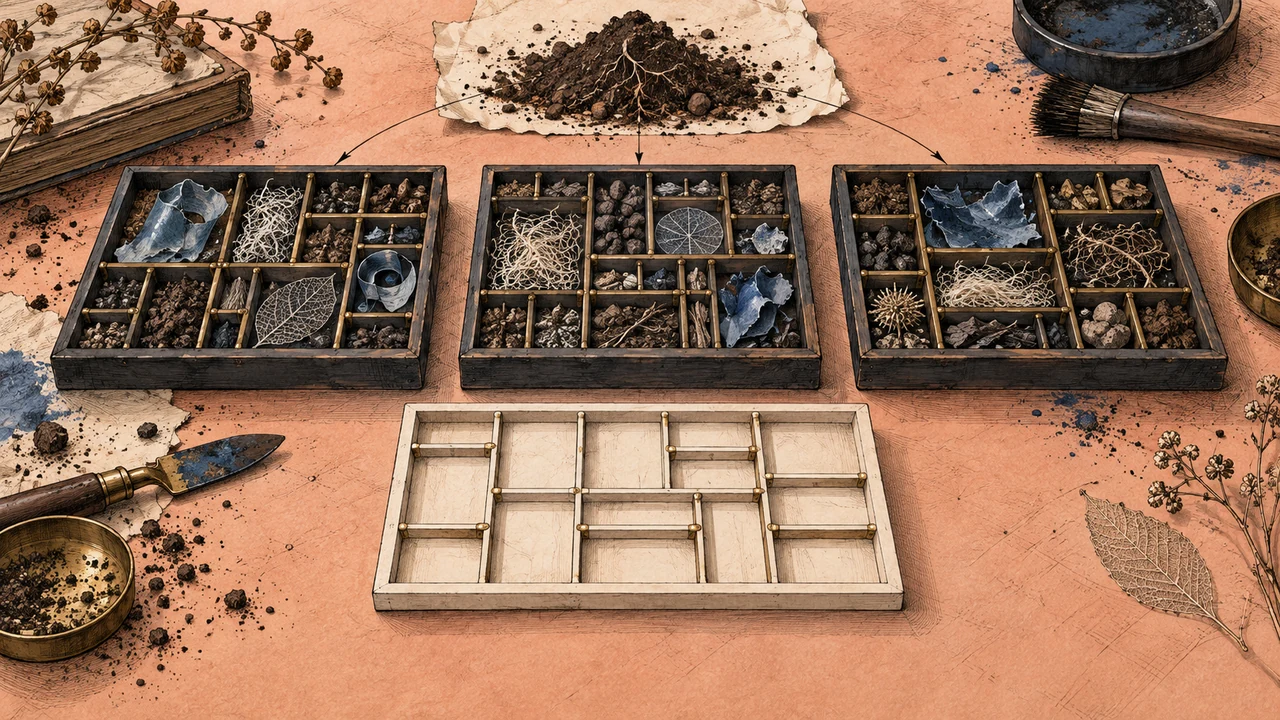
Everyone in this corner measures soil microplastics differently, so we cannot compare the numbers we already have. Each group used its own sampling, extraction, and counting, and their answers were never built to line up.
Two separate reviews say the quiet part out loud. Sajjad and colleagues, surveying plastics under 5 mm across the soil environment, conclude flatly that no standard soil microplastic sampling or extraction method exists. Kumar and colleagues, looking at plastics as pollutants in farmland, land in the same place: no standard detection and quantification technique exists, and they list standard methods as a future need in the same breath as toxic effects on humans and animals. Two reviews, two literatures, one missing tool. Before we argue about how much plastic is in the food chain, we have to agree how to count it, and we have not.
This matters because the plastic will not behave like one clean variable, so sloppy methods get amplified. Zhao, Lozano and Rillig mixed twelve microplastics, four shapes and eight polymers, into one loamy sandy soil at 0.4% by weight and watched pH, respiration, and four enzymes over 31 days. Shape, polymer, and exposure time all changed the outcome, with foams and fragments raising pH while different enzymes were knocked down by different shapes. A microplastic is dozens of things that each do something different. A method that lumps them together, or catches some shapes and misses others, will hand you a different answer than the next lab's, and neither of you will know why.
That sits uneasily next to Aralappanavar and colleagues, who reviewed plastic's effects on soil microbes and carbon and nutrient cycling and found the effects depend on dose, type, and soil, drawn mostly from short, high-dose lab jars rather than real fields. If the effect already swings with conditions, and the methods that measure it are not shared, the field is stacking numbers that were never comparable.
So I keep circling the same worry. Effects hinge on shape and polymer and dose. Most of what we know comes from high-dose lab jars, not real fields. And there is still no agreed way to pull plastic out of a soil sample and count it. The human-exposure numbers we would most want to trust are being built on measurements that were never meant to be compared.
Guo and colleagues already argue that soil deserves its own dedicated study, understudied next to the ocean. Dedicated study needs a shared ruler, and right now every lab brought its own. So how much of what we think we know about plastic in our food is really a story about whose ruler we happened to pick?
- Type
- Un-harmonized methods
- Field
- Food-chain transfer and human exposure
- Comparative basis
- Competing measurement protocols
- Methods
- Sampling, extraction, particle counting
Why this is answerable now
The reviews now agree
Two independent reviews, in 2020 and 2022, reach the same verdict: no standard soil microplastic detection or extraction method exists. The field is naming its own missing tool out loud.
We know why it bites
Zhao and colleagues showed in 2021 that shape, polymer, and exposure time each swing the result. The lack of a common method is not cosmetic. It changes the number you get.
Food-chain stakes are explicit
Kumar and colleagues list biomagnification and toxic effects on humans and animals as open needs right beside standard methods. The exposure question and the measurement question are the same question.
The evidence is lab-heavy
Aralappanavar and colleagues note most findings come from short, high-dose jars and ask for field studies at realistic amounts. A shared method is what would let those field numbers finally be pooled.

Sources cited
Papers I read for this question. These notes distinguish reviews from primary studies and identify the limits of my access.
Says soil deserves its own study, which needs a shared ruler.
Context-bound numbers that cannot be pooled without a common protocol.
States flatly that no standard soil sampling or extraction method exists.
Lists standard methods and human exposure as needs on one list.
05Microplastics change soil pH and microbial activity by shape and polymer
Primary experimentAnswer depends on which shapes you caught, so methods must match.
What’s missing — the gap
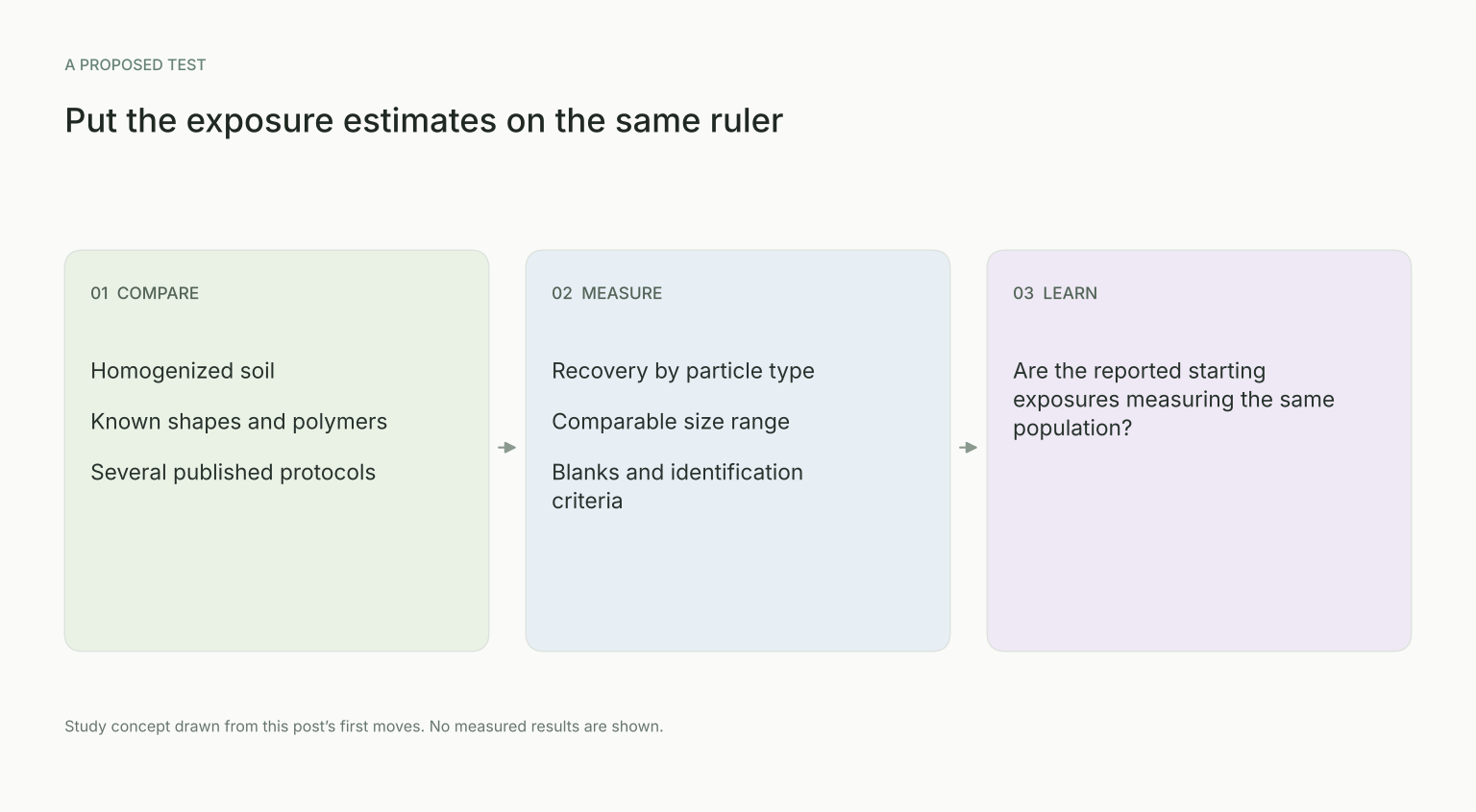
If several published soil-microplastic protocols were run on the same soil, would they return counts you cannot tell apart, or would the method alone move the number, enough to prove that current food-chain and exposure estimates are not measuring the same quantity?
Two reviews openly say there is no standard sampling, extraction, or counting method, and a primary study shows the answer swings with shape and polymer. Nobody has put the competing methods head-to-head on one shared soil to see how far their estimates diverge. Until that test is run, every cross-study comparison of plastic in the food chain is trusting that the methods agree, when the evidence says they probably do not.
First moves
- 1
Run a split-sample round-robin
Take one homogenized agricultural soil, split it, and hand identical portions to labs using different published extraction and counting protocols. If the counts diverge, you have measured how much of the signal in the literature is really just method.
- 2
Spike with known shapes and polymers
Add a known mix of shapes and polymers, the very variables Zhao showed matter, at a known dose, then test which methods recover which particles. That turns no standard method from a complaint into a recovery table.
- 3
Bridge lab dose to field dose
Aralappanavar flags that most evidence is high-dose lab jars. Take one harmonized method and run it across both a spiked microcosm and a real field soil at realistic amounts, so the field number and the lab number sit on the same ruler.
Where I land
Where I land: I think the counting is the real bottleneck, and the exposure question cannot be answered honestly until it is fixed. My guess is that if you ran the leading protocols on one shared soil, the counts would split apart, and a lot of what looks like real variation between studies is method. That makes me cautious about every headline number for plastic in the food chain. The unglamorous fix, one shared reference soil and a recovery rate on every count, would do more for the field than another new exposure estimate built on an un-shared ruler.
An invitation
If you work on soil microplastics or on how they reach the food chain, I would like to know whether a shared measurement protocol feels overdue or premature, whether the field is ready to compare one soil across many methods, or whether the plastic is still too many things at once to pin down. I have laid out why I think the counting is the bottleneck before the exposure question can even be asked, and I could be wrong.
Questions about this gap
Why do soil counting methods matter for exposure estimates?
They define the starting exposure measurement. If methods count different particle populations, later comparisons can inherit that mismatch.
Does a shared soil protocol solve tissue analysis too?
No. Plant or animal tissue is a different matrix and needs its own recovery, contamination, and identification validation.
Why spike several shapes and polymers?
A method may recover one material or form better than another. A varied reference reveals those biases before counts are used in a comparison.
Can a laboratory spike stand in for every field sample?
It is a validation tool, not a complete substitute. Weathering, soil matrix, and particle mixtures can differ from the reference material.
What would make cross-study estimates more comparable?
Shared size ranges, clear units, identification criteria, blanks, recovery information, and uncertainty would make the measured quantities easier to align.