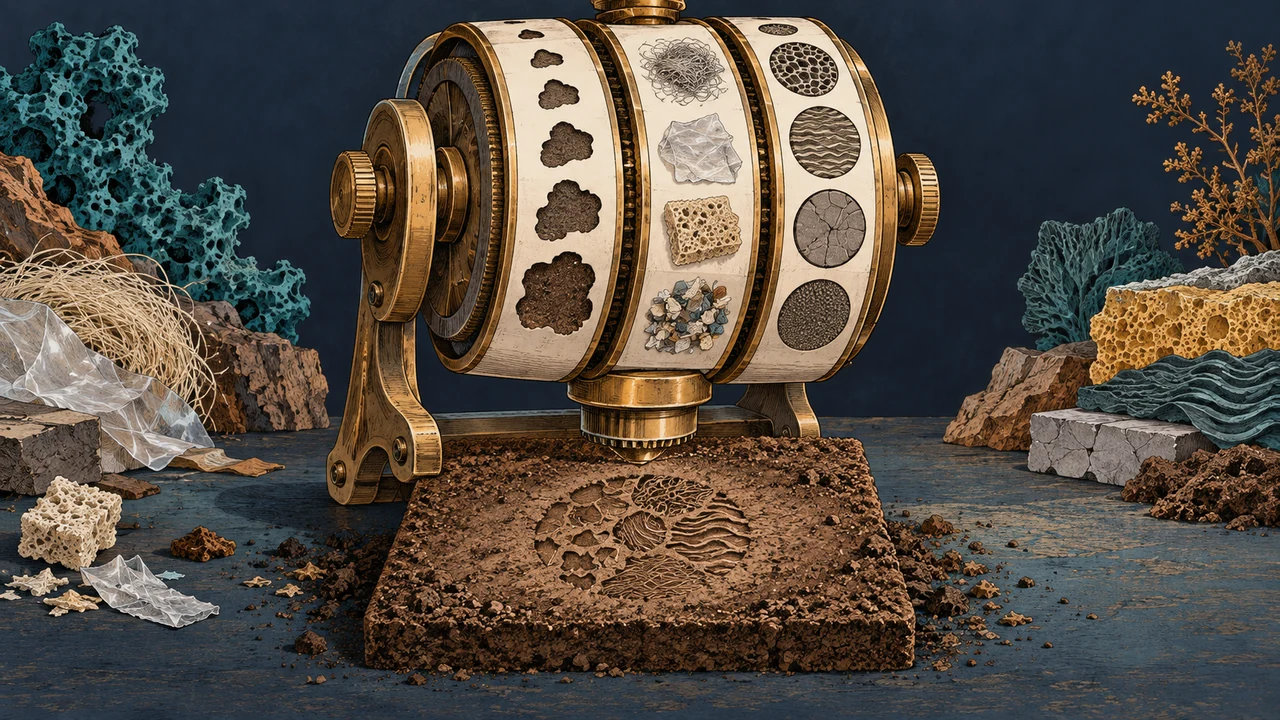
Size, shape, polymer type, exposure time: soil-microplastics research measures each of these constantly. It almost never measures them together, in one design, on the same soil. So when a study reports that plastic changed the soil, we're often left guessing which particle trait did it.
Start with one of the few designs built to pull the traits apart. Zhao, Lozano and Rillig crossed twelve microplastics across four shapes (fibers, films, foams, fragments) and eight polymer types, mixed them into a loamy sandy soil at 0.4%, and sampled on days 3, 11, and 31. Their finding was that shape, polymer type, and exposure time all mattered, and together they drove the context-dependency the wider literature keeps reporting. The same dose of plastic can push soil in different directions depending on whether the pieces are foams or fibers, what they're made of, and how long they've been sitting there.
You can watch that show up as apparent disagreement once you line the studies up. In that same experiment, soil pH rose with foams and fragments, cellobiosidase fell under fibers, films, and foams, and N-acetyl-glucosaminidase fell under fibers and fragments, while the usual link between pH and enzyme activity weakened once plastic was in the soil. Read only one shape and you'd write a clean summary that is partly wrong.
The broad reviews describe the same fog from above. Aralappanavar and colleagues find effects on nitrogen, phosphorus, and greenhouse gases coming out dose-, type-, and soil-dependent, from mostly short high-dose lab jars. Sajjad and colleagues reach for the same explanation, noting enzyme responses vary by plastic type and concentration. Both reviews agree the numbers won't line up. Neither can name which particle trait is the cause, because the underlying studies rarely varied the traits together.
This matters because the plastic in real soil is not one clean particle. Archived soil from the Broadbalk wheat experiment at Rothamsted shows no microplastics before 1914, then a clear rise across every treatment from 1966 to 2022, with fertilised plots carrying more than the untouched plot (Cusworth et al., 2024). Guo and colleagues argue soil acts as a long-term receptor for this pollution. So the field is asking whether plastic harms soil while the soil quietly builds up a mix of shapes, sizes, and polymers at once.
The experiments that could show how those traits interact, at realistic amounts over realistic time, are still the exception.
- Type
- Under-studied interaction
- Field
- Soil microplastic ecology
- Comparative basis
- Traits alone vs. traits crossed
- Methods
- Factorial soil incubations, enzyme assays
Why this is answerable now
The mixture is already in the ground
Rothamsted's archived soils show microplastics climbing from 1966 onward, with fertiliser adding more (Cusworth et al., 2024). We're not modelling a future problem. We're describing a mixture that has been building in real fields for decades.
One trait at a time isn't enough
Review after review lands on the same phrase, dose-, type-, and soil-dependent (Aralappanavar et al., 2024). That is what a field says right before it needs designs that vary the traits together.
A working template exists
Zhao, Lozano and Rillig already crossed shape against polymer type against exposure time in one soil incubation and read out pH, respiration, and enzymes (Zhao, Lozano & Rillig, 2021). The method works. It just hasn't been scaled to size, concentration, and longer time.
The counting problem is fixable now
There's still no standard way to sample and extract soil microplastics (Sajjad et al., 2022). Agreeing on how we bin particles by size and shape now is what makes tomorrow's interaction studies comparable.

Sources cited
Papers I read for this question. These notes distinguish reviews from primary studies and identify the limits of my access.
Review arguing soil is understudied next to marine and freshwater systems.
Microbe review; nutrient effects come out dose-, type-, and soil-dependent.
Sources and effects; no standard soil sampling or extraction method yet.
Rothamsted archive: plastic rising in farm soil since 1966.
05Microplastics increase soil pH and decrease microbial activity by shape and polymer
Primary experimentCrossed shape and polymer type in one soil; both drive effects.
What’s missing — the gap
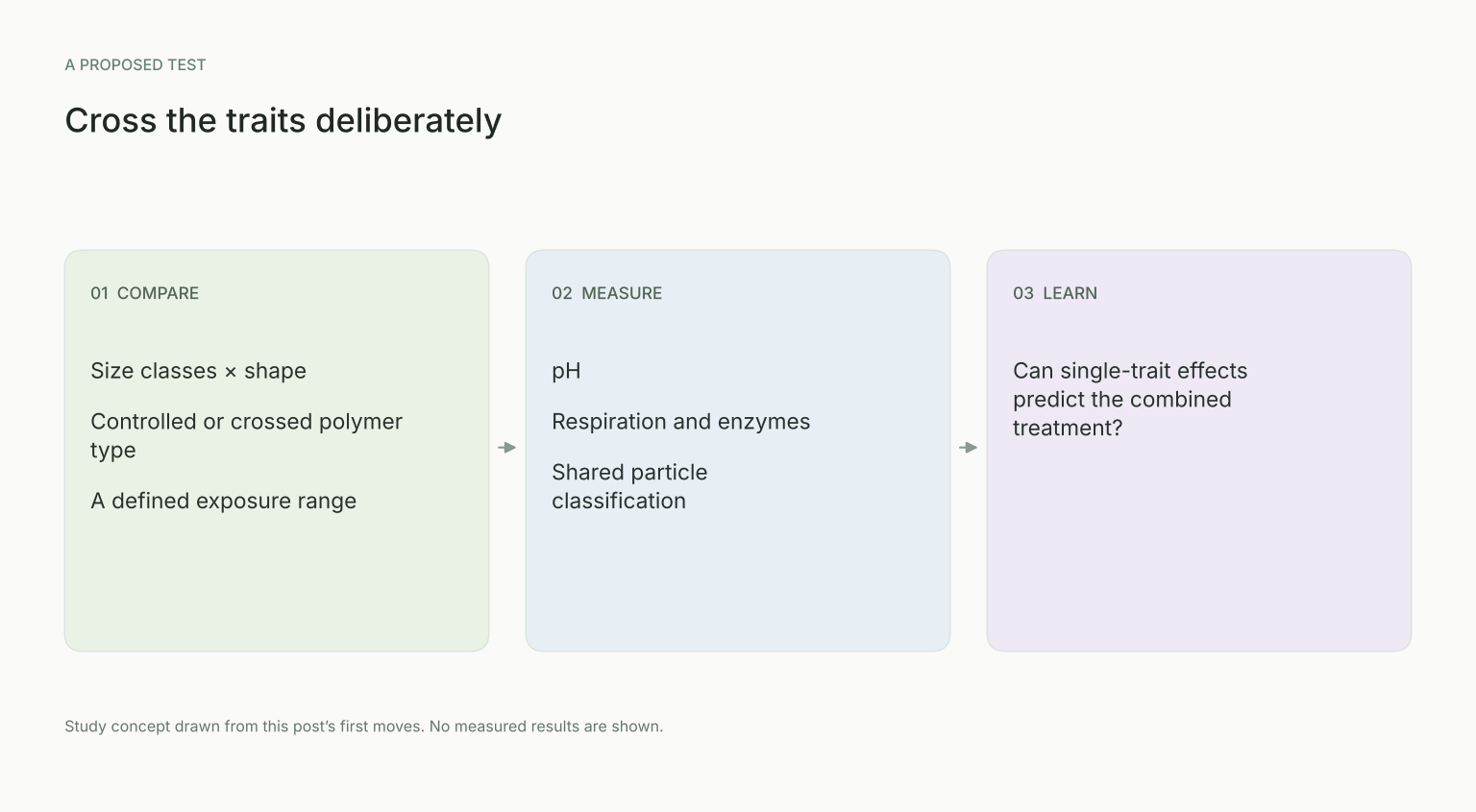
In a factorial soil incubation that crosses particle size and shape against polymer type at realistic concentrations, do the effects on pH, respiration, and enzyme activity stay additive, or do size and shape interact to produce responses you couldn't predict from either trait alone?
Each trait clearly moves soil function on its own, so the obvious question is what they do together. If the effects stay additive, you can measure one trait at a time and add up the results. If size and shape interact, then single-variable studies will keep producing numbers that won't line up, and the reviews' 'type-dependent' shrug is really an untested interaction. Few studies have crossed the traits, so no one can say yet.
First moves
- 1
Add size to the shape-by-polymer cross
Zhao, Lozano and Rillig crossed shape against polymer type in one soil (Zhao, Lozano & Rillig, 2021). The smallest honest next step is a size axis, two or three size classes per shape, to test whether size and shape effects add up or interact.
- 2
Run it at a field-realistic dose
The reviews keep asking for realistic amounts and longer exposures (Aralappanavar et al., 2024). Repeat a factorial trait design at a dose closer to what Rothamsted-style buildup implies (Cusworth et al., 2024), and hold it past 31 days.
- 3
Agree on particle bins first
Because no standard extraction or classification method exists (Sajjad et al., 2022), agree up front on how size and shape classes are defined and counted, so separate labs' interaction results can be compared.
Where I land
Where I land: I think size and shape probably interact rather than simply add, and that unmeasured interaction is a big part of why the numbers won't line up. The reviews keep calling it type-dependent, which reads to me like an interaction no one has run the experiment to see. A handful of factorial designs at realistic doses could turn that shrug into a map of which traits matter together. Until then, single-variable studies will keep disagreeing.
An invitation
If you run soil incubations, you're the person who could turn 'it's type-dependent' from a shrug into an answer, a design that says which particle traits interact and how, in real soil. I've laid out how I read these five papers and where I think the missing cross sits, but I'm a student turning this over, not the one holding the pipette. Where would you push back?
Questions about this gap
What does a size-by-shape interaction mean?
It means the effect of size depends on shape, or vice versa, under the chosen comparison model. Separate size and shape effects would not predict the combined response.
Why include polymer type in the design?
Different shapes can be made from different materials. Controlling or crossing polymer type reduces the risk of attributing a material effect to shape alone.
Why agree on bins before the experiment?
Shared definitions of size and shape prevent categories from changing during analysis and allow other laboratories to repeat the comparison.
Which responses does the post propose following?
Soil pH, respiration, and enzyme activity provide complementary endpoints. They should be measured at the same times rather than assembled from unrelated studies.
What would a simple additive result tell us?
It would support treating those tested trait effects separately within that design. It would not rule out interactions at other doses, soils, or durations.