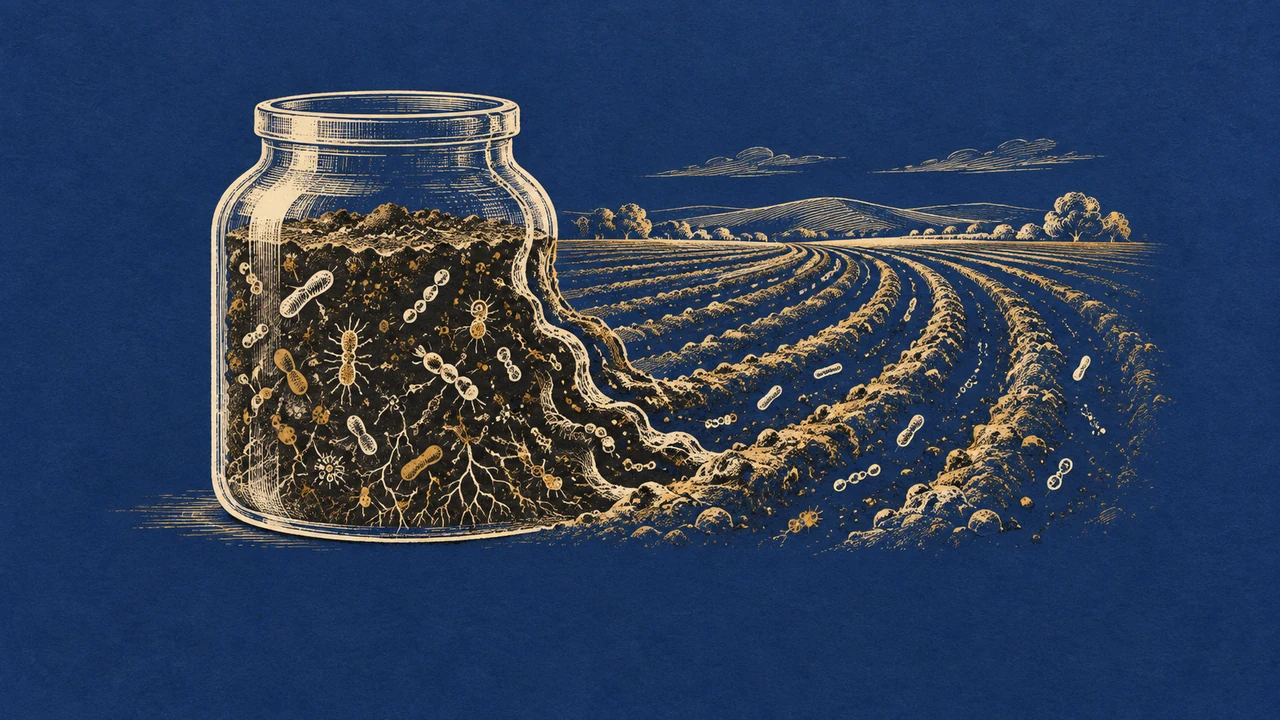
Biodegradable is a reassuring word. The plastic breaks down, the problem goes away, everyone can relax. I’d like that version. Soil makes it more complicated.
I’ve approached the plastic-and-soil question from the plant side. In my backyard, I grew tomatoes, beans and peppers in 27 pots, comparing a control with PET plastic and PET plus oyster mushrooms. Here, I want to zoom in on the microbes.
The first clue is that some soil microbes can use a biodegradable plastic as food. In a study by Zhou and colleagues, microbes near a plastic called PHBV grew faster and had more active biomass than those in the surrounding soil. My reading of that paper was limited to the abstract, but it raises a question I want to follow: what does that extra activity actually do for the soil?
A busy microbe is not automatically a helpful microbe. Microbes help process carbon and nitrogen, including forms of nitrogen that plants can use. If plastic changes their activity, I want to know whether that changes the supply of nutrients, how quickly carbon leaves the soil, or neither very much.
Then there’s a finding that makes the picture more interesting. Han and colleagues grew rice and wheat in a greenhouse over one year, comparing ordinary polyethylene with a biodegradable plastic called PLA. Both shifted the mix of bacteria and reduced the share of larger soil clumps, known as aggregates. Those clumps are part of the soil’s physical structure.
I was tempted to put these papers on opposite sides: biodegradable plastic feeds microbes; biodegradable plastic disrupts soil. So which is it?
When I looked closer, the comparison started to come apart. The studies used different plastics and measured different things. Zhou looked at microbial activity right beside PHBV; Han measured bacterial communities and soil structure with PLA and polyethylene. The findings weren’t directly contradicting each other. I’d been treating them as answers to the same question, when they weren’t.
That left me with something more interesting to chase: could a plastic feed the microbes around it without improving the soil? “They ate it” is a start. I’d like the rest of the story.
The field is where I’d take that question next. Rain, roots and changing seasons add conditions a greenhouse experiment can’t fully capture. The review by Aralappanavar and colleagues calls for longer field studies at environmentally relevant plastic levels. I’d build on that by following the microbes and their work together, in the same plots, over several growing seasons.
- Type
- Emerging, not settled
- Field
- Soil microbes
- Comparative basis
- Greenhouse findings and changes across field seasons
- Methods
- Bacterial sampling, carbon and nitrogen measurements, repeated field visits
Why this is answerable now
There’s something concrete to follow
Han’s experiment gives me two things to watch: changes in bacteria and changes in soil clumps. A field comparison could show which changes persist once weather and seasons join in.
The amount of plastic matters
Han used 0.5% plastic by soil weight: 5 grams in each kilogram of soil. Before using that dose outdoors, I’d check what is actually in the field. A precise number is useful; a precise number from the wrong setting is less useful.
“Biodegradable” leaves me with another question
Zhou’s PHBV study makes microbial feeding worth looking at. I’d want to follow what happens next, rather than treating feeding as the end of the investigation.
We can ask who’s there and what they’re doing
A sample can tell us which bacterial groups are present. Other measurements can tell us about carbon and nitrogen processing. Putting those results side by side is where I think this gets interesting.

Sources cited
Papers I read for this question. These notes distinguish reviews from primary studies and identify the limits of my access.
Background on how plastic reaches soil, moves through it and affects soil life. Helps connect this question to the plastic a field actually contains.
Connects microbes with carbon and nutrient cycling, and calls for longer field studies at environmentally relevant plastic levels. A useful starting point for the comparison I’m proposing.
Reviews plastic sources, effects and the challenges of measuring it in soil. Helps explain why the amount and kind of plastic need careful attention.
04Microplastics alter soil structure and microbial community
Primary experimentThe one-year greenhouse rice–wheat experiment comparing polyethylene and PLA at 0.5% by weight. Both shifted bacterial communities and the distribution of soil-clump sizes.
Microbes used PHBV as a carbon source, with greater activity near the plastic than in the surrounding soil. PHBV is a different plastic from Han’s PLA. Abstract only.
What’s missing — the gap
The question I want to pursue is this: at plastic levels measured in a particular field, which microbial changes last, and do they change how the soil processes carbon and nitrogen?
I’d follow the same plots through several growing seasons. A burst of activity beside a plastic particle might fade. A different mix of bacteria might keep doing much the same work. Or a change might stick around and affect nutrient processing. Those are very different stories, even if an early sample from each says “the microbes changed.”
First moves
- 1
Find out what’s already in the field
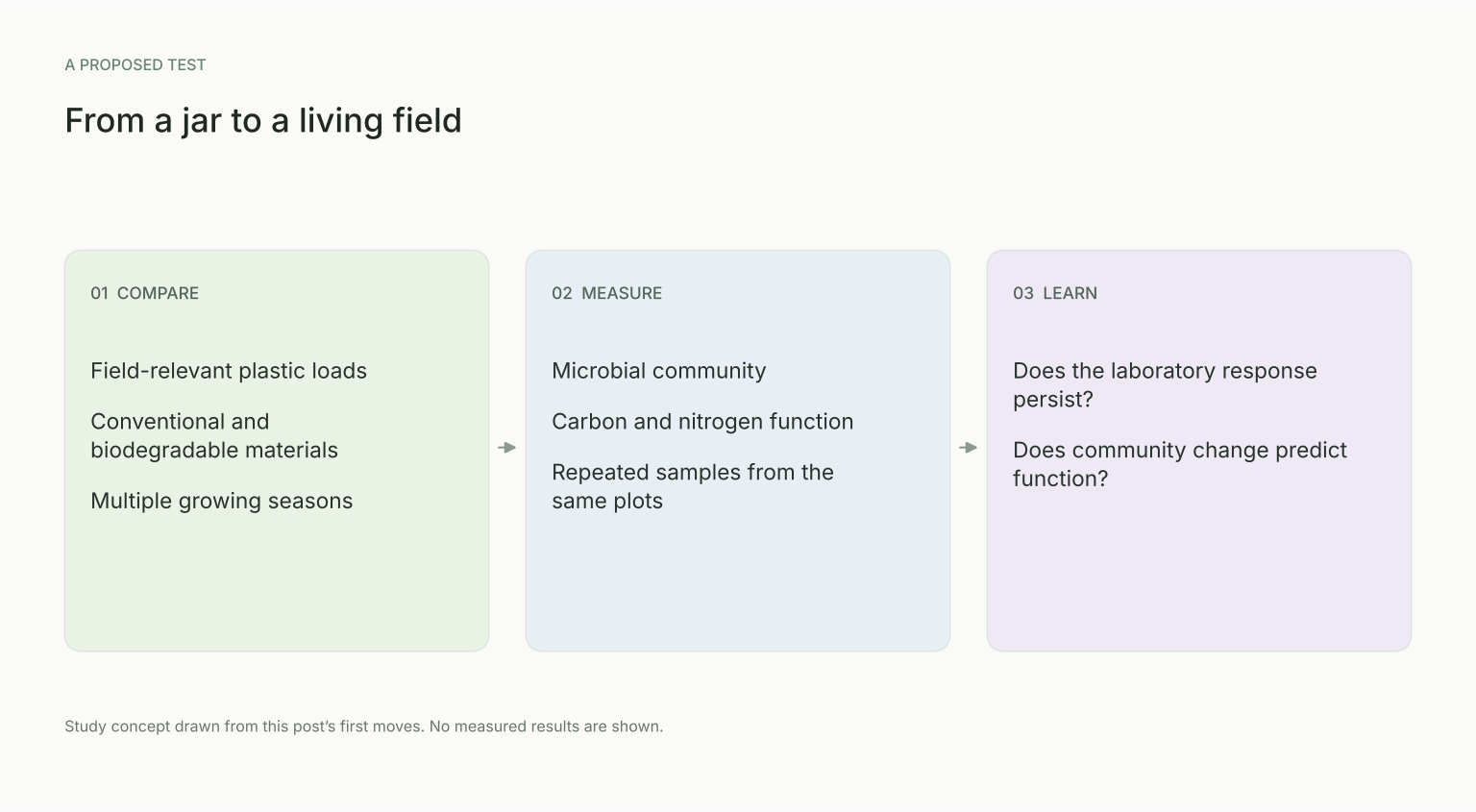
I’d measure the kinds, sizes and amounts of plastic already present, then use those results to choose the amounts to test. Some plots would get no added plastic. I’d record both particle counts and weight: a thousand tiny pieces and a thousand large ones are not the same dose.
- 2
Give the comparison time
I’d compare polyethylene with one specified biodegradable plastic across several plots for each treatment, keeping the crop management and plastic size and shape as similar as possible. I’d sample before adding plastic, then at the same stages of each growing season, and keep track of weather and soil moisture.
- 3
Check what the microbes are getting done
Alongside the bacterial samples, I’d measure carbon dioxide released from the soil and track nitrogen forms and a nitrogen-conversion process. I’d also check the soil clumps. If practical, I’d sample right beside plastic particles as well as farther away. A busy patch around one particle might tell a different story from the rest of the plot.
Where I land
My hunch is that some greenhouse effects will become less obvious in a field, while the activity right beside plastic will still stand out. That’s a prediction, not a result.
The result I’d be most curious to chase is a field where the bacteria change but nutrient processing barely moves. Are different microbes picking up the same jobs? Is the effect too local to show up across the plot? I wouldn’t have the answer yet, but I’d have a much better next question. That’s what draws me into this: a reassuring label turns into a microbial meal, and suddenly I want to know what the rest of the soil is doing.
An invitation
If you know a field study that follows both microbes and nutrient processing over time, I’d love to read it. And if you’re coming to this without a soil-science background, I’m curious what you’d want to know before calling a biodegradable plastic good for the soil. That word “good” is doing quite a lot of work.
Questions about this gap
Did I actually run this experiment?
No, not this one. My backyard work used PET plastic and oyster mushrooms. This post follows a different question from the papers: what happens when microbes feed on biodegradable plastic? The field comparison I describe is an experiment I’d like to see, not one I’ve carried out.
How would I tell which bacteria are there?
By sequencing a genetic marker, such as the 16S ribosomal RNA gene, in a soil sample. That helps identify bacterial groups and their relative shares. It doesn’t tell me how much nutrient-processing work they’re doing, which is why I’d measure that separately.
What was the 54% result in Han’s paper?
Plastic addition accounted for about 54% of the variation in bacterial community composition in the study’s analysis. It’s a measure of how the communities differed, not a claim that 54% of the bacteria died or that the soil lost 54% of its function.
Would a different field result mean the greenhouse study was wrong?
No. The dose, weather, soil and other conditions can change the response. I’d want to know where the greenhouse finding carries over and where it doesn’t. That makes the result more useful.
Would this settle whether biodegradable mulch is safe?
No single comparison could settle that. It would tell me about the particular plastic and field conditions tested. Breakdown, additives, crop effects and other soil organisms would still matter. Useful evidence, yes. A universal seal of approval, no.