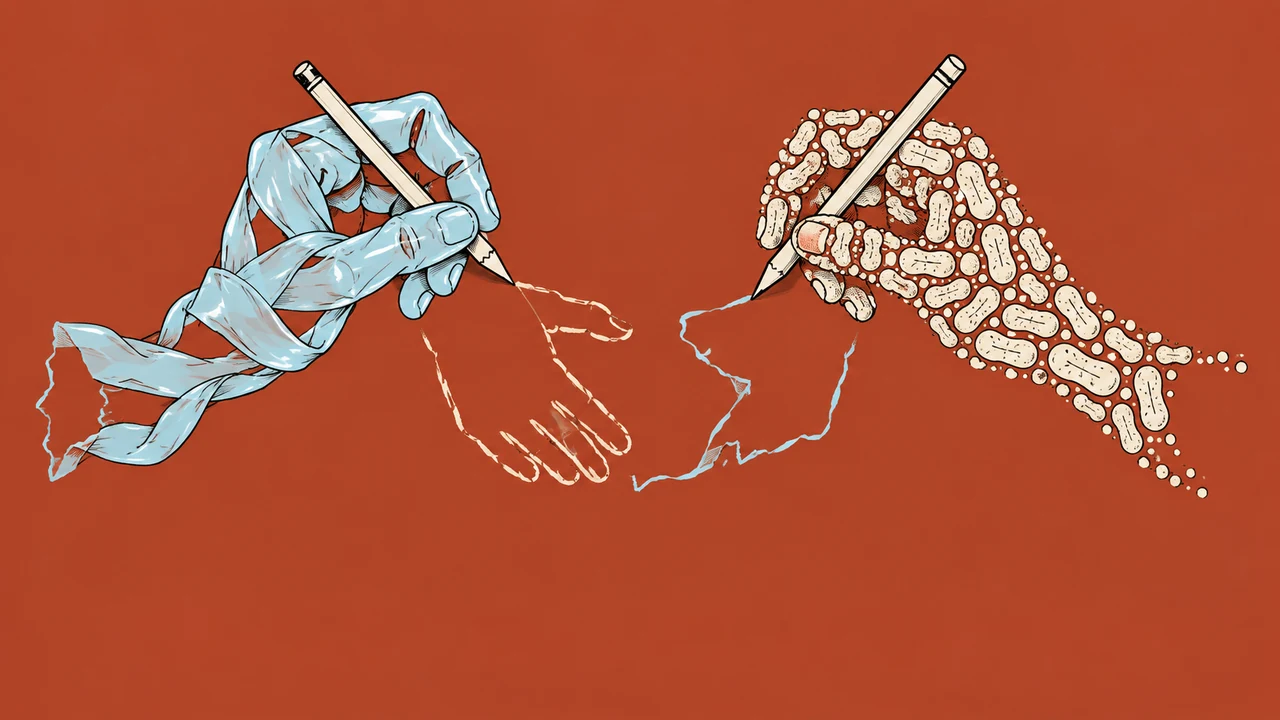
Two things get studied to exhaustion here: what microplastics do to soil microbes, and what those microbes do to the plastic. Almost nobody measures both at the same time, while each is changing the other.
Start with what the microbes feel. Aralappanavar and colleagues, reviewing contaminated soils, report communities that differ from clean soil and hold less variety, tilted toward plastic-degrading groups like Actinobacteria, Proteobacteria, Bacteroidetes, and Ascomycota. At the same time the nutrient work shifts: more microbes that pull nitrogen from the air and free up phosphorus, fewer that turn nitrogen into a form plants can use. So the plastic changes which microbes dominate, and it changes the soil's ability to feed a crop.
Han and colleagues add a physical layer. Mixing polyethylene or PLA into a silty loam at 0.5% by weight broke big soil crumbs into small ones, small crumbs up from 17% to 29-35%, big crumbs down from 84% to 65-71%. That structural change alone explained about 54% of the shift in bacteria, and the microbes living in the small crumbs were the most affected. Some of what looks like a chemical effect of plastic on microbes may be the plastic rearranging the physical spaces the microbes live in.
This is where the papers argue, and the argument is the interesting part. Han found the structural and community effects were about the same whether the plastic was regular or biodegradable, and about the same across particle sizes of 50, 150, and 300 micrometres. Their conclusion is blunt: switching to biodegradable plastic wouldn't cut the harm much. Zhou and colleagues looked at the thin skin of soil right against a biodegradable particle, PHBV, and saw the microbes eat it as food. Growth rates rose, the biomass got more active, enzyme activity ran 0.6 to 5.0 times higher than in the root zone, and variety actually went up, with Acidobacteria and Verrucomicrobia gaining ground.
Read side by side, these aren't really contradictory. One asks what a biodegradable particle does to the whole community's structure over a season. The other asks what the community does to the particle at its surface in real time. The variety even moves in opposite directions, down in the contaminated-soil reviews, up in the skin around Zhou's particle. That tells me the answer depends on which scale, which timeframe, and which direction of the interaction you pointed your instrument at.
And that's before the third player almost no one includes. Microplastics in soil carry other pollutants with them, phthalates, antibiotics, toxic metals, PAHs, and PCBs (Sajjad et al., 2022), and those land on the same microbes the plastic is already changing. The same review notes there's no standard way to sample and extract soil microplastics yet, and most of the microbe evidence comes from short, high-dose lab jars (Aralappanavar et al., 2024). We know each thread, and we've barely tied any two of them together.
- Type
- Interaction, under-studied
- Field
- Soil microbial ecology
- Comparative basis
- Plastic-on-microbes vs. microbes-on-plastic
- Methods
- 16S sequencing, enzyme mapping, respiration tests
Why this is answerable now
Soil is the neglected part
Microplastics are now treated as an emerging soil contaminant, yet soil is still understudied next to the ocean (Guo et al., 2020). The microbe-interaction questions are wide open because the whole compartment came late.
The exposure is already large
Mulch film is the biggest source, and with sludge, compost, dust, tyre wear, and coated fertiliser, about 700,000 tonnes reach farmland yearly in Europe and North America (Sajjad et al., 2022). The exposure is happening whether or not the interaction science keeps up.
The 'biodegradable is safer' claim is contested
Han found biodegradable and regular plastic harmed soil about equally, while Zhou found microbes actively feed on a biodegradable polymer and reshape the community at its surface. That disagreement only resolves if you study the interaction directly.
The tools finally line up
16S sequencing with network analysis, enzyme mapping, and respiration tests are now routine enough to run together (Han et al., 2024; Zhou et al., 2021). The two-way plastic-microbe interaction is measurable in one experiment for the first time.

Sources cited
Papers I read for this question. These notes distinguish reviews from primary studies and identify the limits of my access.
Frames soil plastic as neglected, but treats impact as one-directional.
Effects depend on type, dose, and soil, which points to the interactions.
Adds co-contaminants as a third factor; no standard method yet.
04Microplastics alter soil structure and microbial community
Primary experimentStructure explained about half the community shift; biodegradable was no safer.
Microbes ate the biodegradable plastic and variety rose. Abstract only.
What’s missing — the gap
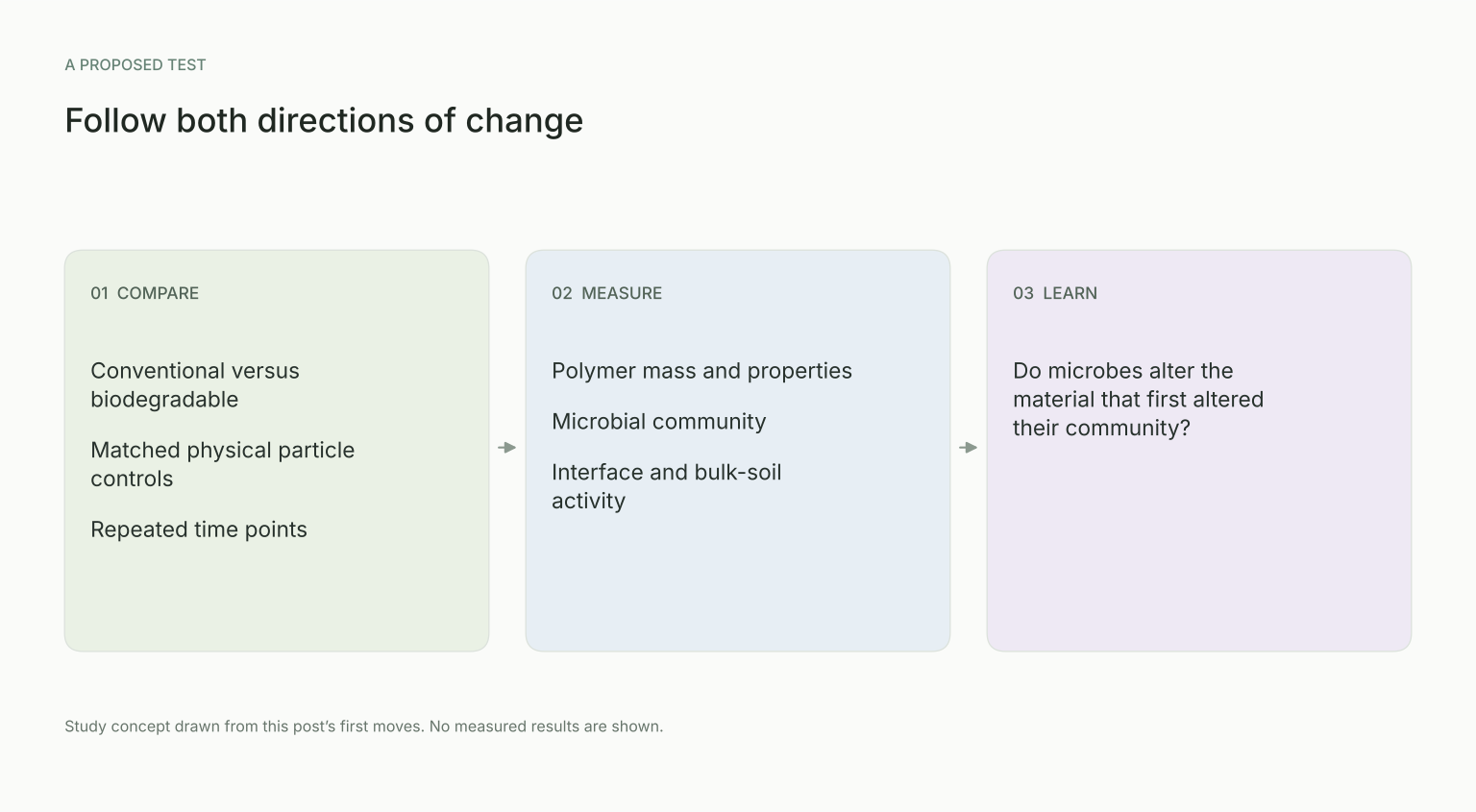
When soil microplastics and their microbes are studied together, one experiment tracking how plastic type, size, and co-contaminant load change the community while the community degrades and alters the plastic, do the interaction effects differ from what single-direction, single-factor studies predict, or can the outcomes be explained by the main effects alone?
Each thread is mapped with care. Plastic changes microbes, microbes change plastic, particle type and size and soil structure and co-contaminants all matter. Almost none of them are co-studied. Han and Zhou already disagree on whether biodegradable plastic even points the community the same way, and they disagree partly because they measured different scales. Until someone holds both directions in one experiment, we're stacking one-sided results and hoping they add up.
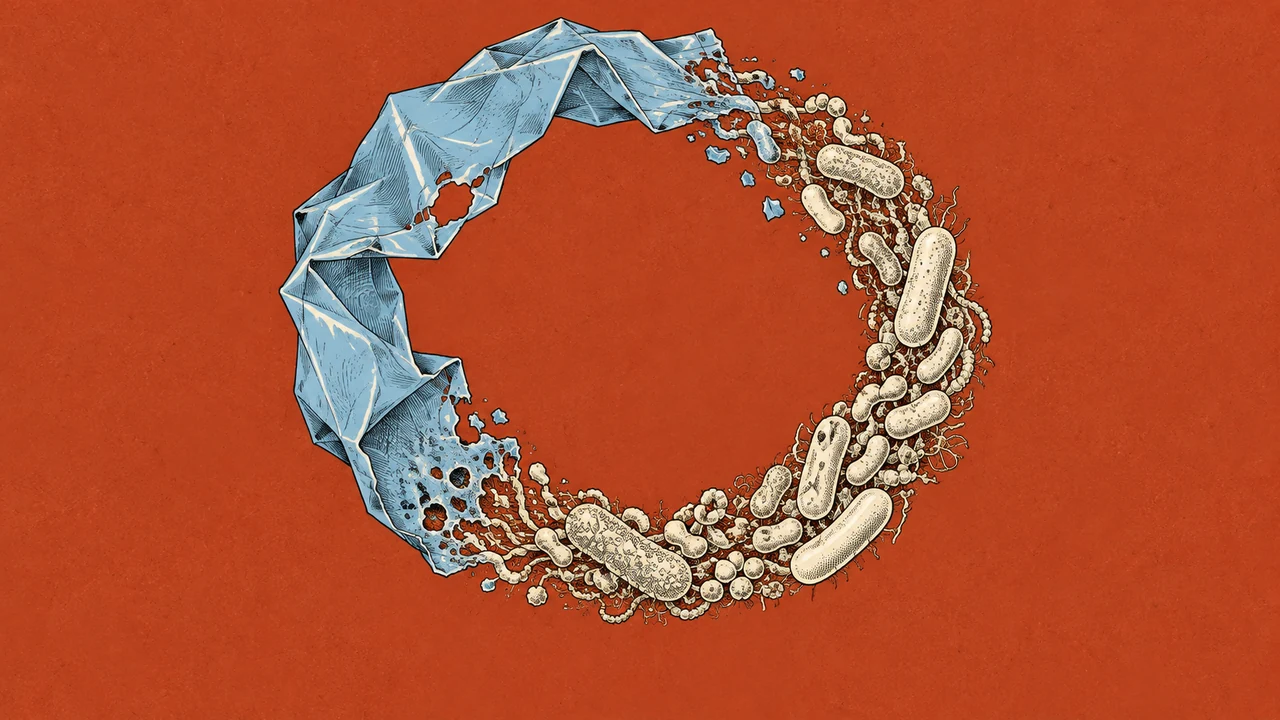
First moves
- 1
Run both directions in one microcosm
Set up one long-term, field-realistic-dose experiment that measures the community's response (16S with network analysis) and the plastic's fate (mass loss, surface enzyme activity) on the same particles over time. That captures the plastic-to-microbe and microbe-to-plastic effects together instead of in separate papers.
- 2
Cross plastic type against co-contaminant load
Combine regular versus biodegradable plastic with a controlled co-contaminant the literature already flags, like an antibiotic or a phthalate. That tests directly whether Han's 'biodegradable is no safer' finding holds once the plastic is carrying another pollutant, rather than assuming type and carrier effects simply add up.
- 3
Separate structure from chemistry
Since crumb rearrangement explained about half the community shift in Han's soil, pair a plastic treatment with an inert particle that mimics only the physical break-up of crumbs. That isolates how much of the microbial change is the plastic itself versus the plastic simply breaking the soil apart.
Where I land
Where I land: I don't think Han and Zhou actually disagree, and I think the interaction is the whole story. Han measured the bulk soil over a season and saw variety fall; Zhou measured the skin around a particle in real time and saw it climb, because there the microbes were eating the plastic. Both can be true in the same field at the same time. That's exactly why one-sided studies keep contradicting each other, and why I'd bet a two-direction experiment shows the tidy main-effect story falls apart. The factor I'd cross first is plastic type against co-contaminant load, because that's the one policy is already betting on.
An invitation
If you work on soil microbes, or plastic degradation, or soil physics, this gap sits on the seam between your fields, and it stays open mostly because each of us measures the half we know best. I'd like to know whether an experiment that holds both directions in view at once would confirm the tidy main-effect story or break it, and which factor you'd put first if you could only cross two. Am I wrong to find it strange that we've mapped every thread and tied almost none of them together?
Questions about this gap
What makes this a feedback question?
Plastic may change microbial communities, while those communities may alter the plastic. A feedback study follows both directions through time.
Why track polymer mass as well as microbial activity?
More microbial activity does not demonstrate polymer loss. Following the material itself helps separate a biological response around the particle from transformation of the particle.
What does an inert-particle comparison add?
A matched particle that microbes cannot readily use helps distinguish physical disturbance from the effects of an available substrate. Size and shape still need to be controlled.
Why could two studies report opposite diversity changes?
They may sample different polymers, doses, soils, or zones around a particle. A matched experiment can test these explanations without assuming one result invalidates the other.
Can one sampling date reveal the feedback?
It can show an association, but it cannot establish the sequence. Repeated measurements are needed to examine whether a material change precedes or follows the microbial response.