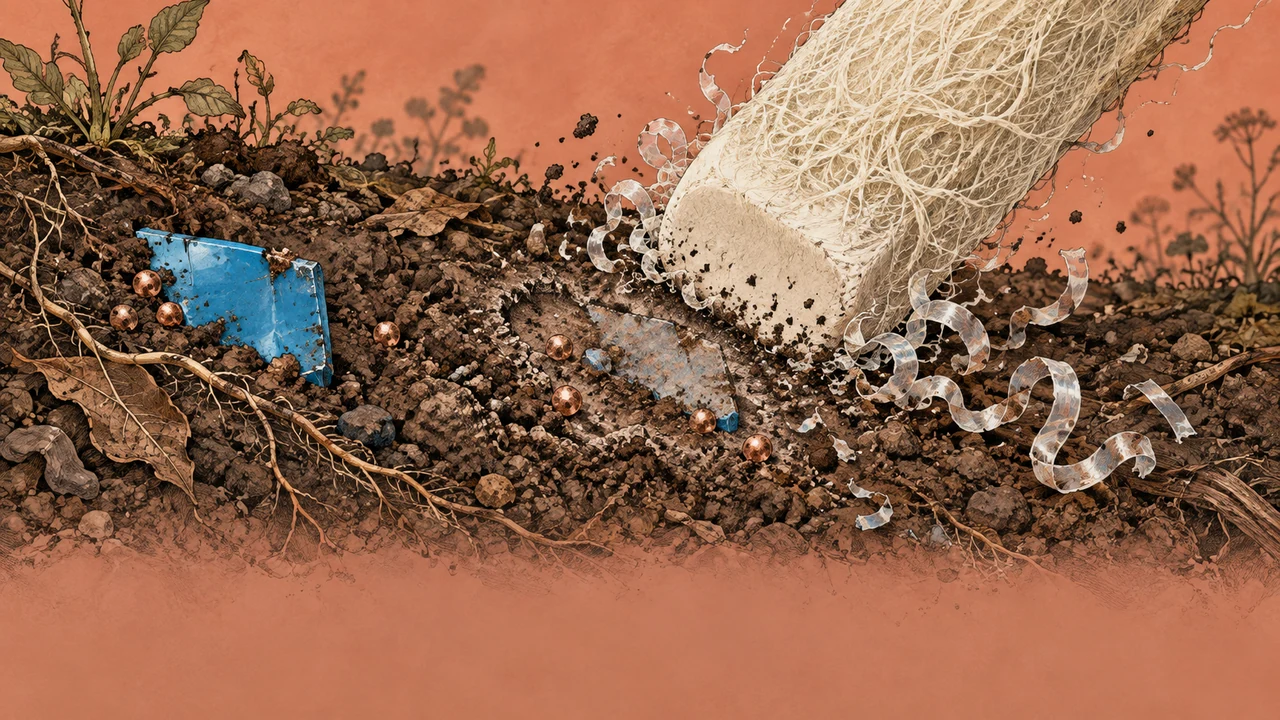
The big hope for getting microplastics out of soil comes in two forms: let the right microbes break the plastic down, or swap in biodegradable plastic that nature is supposed to clear on its own. Both get studied hard. What almost nobody studies is the removal and the living soil at the same time, the plastic being cleared, the microbes doing the clearing, and the co-contaminants and soil structure that come along with it. We keep watching one part and letting the rest blur.
Start with the most hopeful version: soil microbes eating the plastic. Looking at the thin layer of soil right against a biodegradable PHBV particle, Zhou and colleagues found microbes used the polymer as food. Growth rates rose, the biomass got more active, two enzyme activities ran 0.6 to 5.0 times higher than in the root zone, and the number of species actually climbed, with Acidobacteria and Verrucomicrobia gaining ground. Put plainly: some microbes treat biodegradable plastic as food, and a busy little zone forms right at the surface of each particle. That is removal happening on its own, and it is the process a cleanup strategy would want to lean on.
This is where the papers start to argue. Han and colleagues mixed polyethylene and biodegradable PLA into a silty loam at 0.5% by weight for a year. Both broke big soil clumps into small ones. Small clumps climbed from 17% to as high as 35%, big clumps fell from 84% to about 65%, and plastic explained about 54% of the shift in the microbes. The damage barely changed with the type of plastic or its size. Their conclusion is blunt: swapping in biodegradable plastic would not efficiently reduce the harm.
Read against Zhou, that is a real tension. One study shows microbes eating biodegradable plastic and thriving. The other shows the same class of plastic still wrecking soil structure on the way out. So the plastic can be disappearing as a particle and still be doing damage as it goes. Biodegradable and remediated may not be the same thing.
That is before you add the part almost no removal study includes. Microplastics in soil are not clean plastic. Sajjad and colleagues note they carry phthalates, antibiotics, toxic metals, and PAHs with them. If a microbe or a substitution clears the plastic, what happens to the co-contaminants it was carrying? The same review adds that there is still no standard way to sample and extract soil plastic, and Aralappanavar and colleagues note most of the evidence leans on short, high-dose lab jars rather than long field studies at realistic amounts.
All of this sits in a soil that Guo and colleagues call understudied next to the ocean. I keep coming back to the same puzzle. We know how to make plastic vanish, we know soil is a living system that pushes back, and we have barely tied those two facts into one experiment.
- Type
- Under-studied interaction
- Field
- Soil microplastic remediation
- Comparative basis
- Plastic removal vs. soil response
- Methods
- Zymography, 16S sequencing, respiration assays
Why this is answerable now
Biodegradable sold as the fix
Swapping biodegradable for conventional plastic is a live policy lever. Han finds the two harm soil about equally, while Zhou shows a biodegradable polymer eaten and reshaping the microbes at its surface. Whether that swap actually cleans anything only resolves if you study removal and soil together.
The inputs are at scale
Mulch film is the biggest source, and with sludge, compost, and other inputs, about 700,000 tonnes reach farmland in Europe and North America each year. We will need removal strategies whether or not the interaction science is ready.
Removal could just move harm
Plastic carries phthalates, antibiotics, toxic metals, and PAHs, so a strategy that clears the particle without accounting for those may relocate the harm. You can only see that if the co-contaminant is in the experiment from the start.
The tools have converged
16S sequencing, enzyme mapping, and respiration measurements are now routine enough to run together. You can track a particle disappearing and the microbes responding in one experiment, so the excuse for studying one part at a time is gone.

Sources cited
Papers I read for this question. These notes distinguish reviews from primary studies and identify the limits of my access.
Frames soil plastic as neglected, but treats impact as one-directional.
Plastic-degraders enriched, mostly in short, high-dose lab jars.
Plastic carries co-contaminants. No standard extraction method yet.
04Microplastics alter soil structure and microbial community composition
Primary experimentBiodegradable harmed soil about like conventional. Clashes with Zhou.
Microbes ate biodegradable plastic and thrived at its surface. Abstract only.
What’s missing — the gap
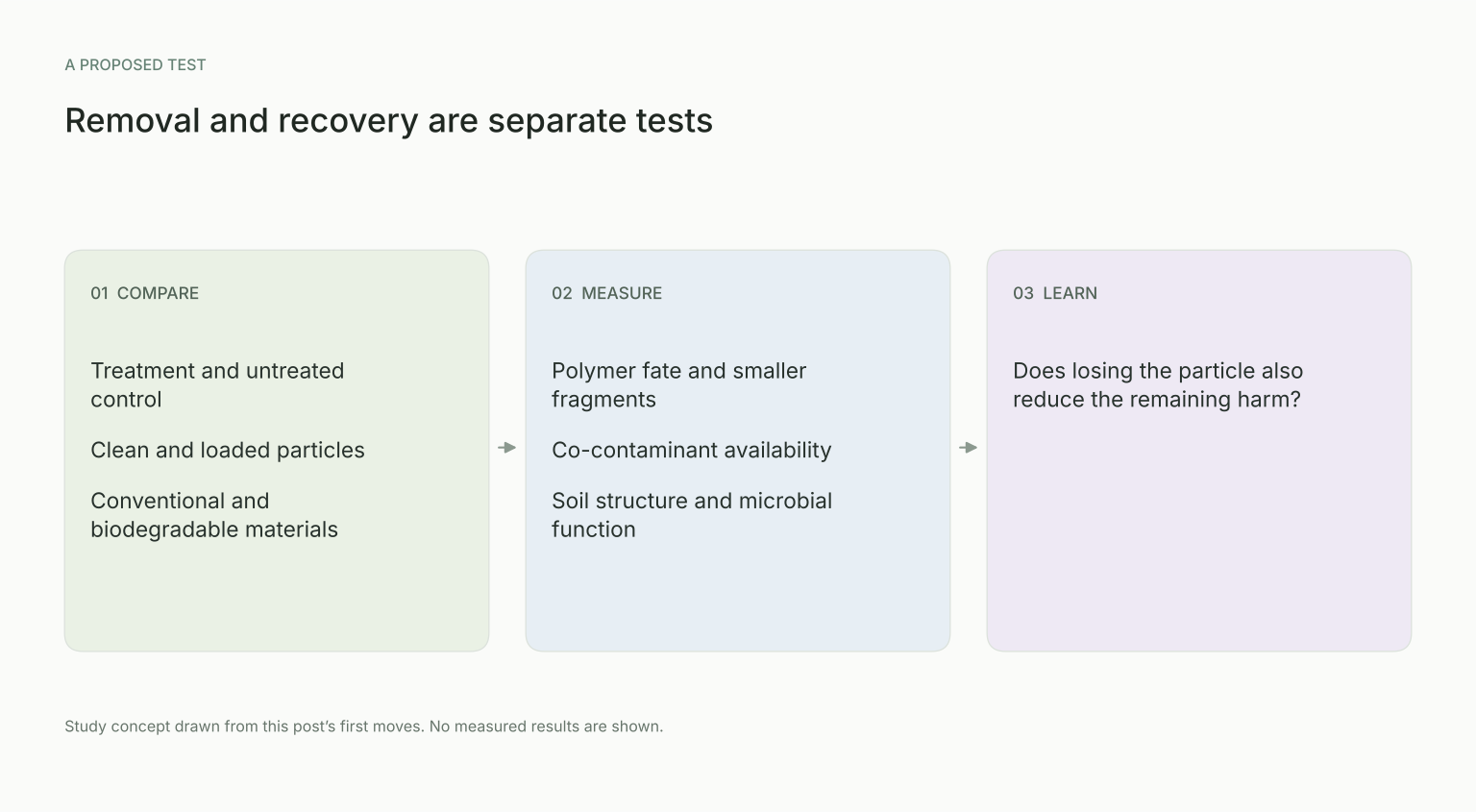
When a removal strategy for soil microplastics is studied together with the living soil it acts on, one experiment tracking how fast the plastic breaks down, how the microbes respond, and what happens to the co-contaminants the plastic carried, does the plastic's disappearance actually reduce net harm, or can the structural and co-contaminant damage stay behind even as the particle is cleared?
Right now these questions get answered in separate experiments by separate fields. Bioremediation watches the plastic degrade. Soil physics watches the structure. Contaminant chemists watch the co-contaminants. Nobody watches all of it on the same treated soil over time. Until they do, we can't tell whether making the plastic vanish heals the soil or just changes what the harm looks like.
First moves
- 1
Track disappearance and damage together
Run one long-term, field-dose experiment that measures both the plastic's fate and the soil's condition on the same treated soil over time. Then 'the plastic is being removed' and 'the soil is recovering' are tested as two separate questions instead of assumed to be one.
- 2
Put a co-contaminant in from the start
Cross conventional versus biodegradable plastic with a co-contaminant the literature already flags, an antibiotic, a phthalate, or a toxic metal. Test directly whether degrading the plastic leaves its co-contaminant behind in the soil.
- 3
Separate eaten-away from broken-down
Pair a genuinely edible particle against an inert particle of the same size and shape. That separates harm that ends when the plastic is consumed from harm the plastic causes simply by being a hard fracturing object in the soil.
Where I land
Where I land: I don't think making the plastic vanish will cleanly heal the soil. Zhou shows biodegradable plastic can be eaten and the microbes thrive, and Han shows the same class of plastic still breaking soil structure. My guess is that a particle can disappear while structural and co-contaminant damage lingers. It bothers me that we study how to make plastic go away far more carefully than what the soil is left with afterward.
An invitation
If you work on bioremediation, or on biodegradable polymers, or on soil physics and co-contaminants, this gap sits on the seam between your fields, and it stays open because each of us measures the one part we know best. I'd love to know whether an experiment that watches the plastic disappear and the soil respond at once would show that removal heals the soil, or that a particle can vanish while the damage stays. Am I wrong to find it strange that we study how to make the plastic go away far more carefully than what the soil is left with once it does?
Questions about this gap
Does fewer visible particles mean the soil has recovered?
No. Particle loss, fragmentation, contaminant release, and recovery of soil function are different outcomes. The proposed study follows them separately in the same treated soil.
Why include a co-contaminant in a cleanup experiment?
A treatment may change the plastic without removing what was bound to it. Measuring both tests whether the treatment reduces the combined problem.
How is fragmentation different from removal?
Fragmentation changes particle size while material can remain in the system. A convincing removal claim needs a material balance and a stated detection range.
Why compare edible and inert particles?
The comparison helps separate changes associated with microbial use of the material from changes caused by the particle’s physical presence.
What would count as a better cleanup outcome?
A documented reduction in the target material together with improved soil endpoints would be stronger evidence than a particle count alone. Unwanted byproducts also need consideration.