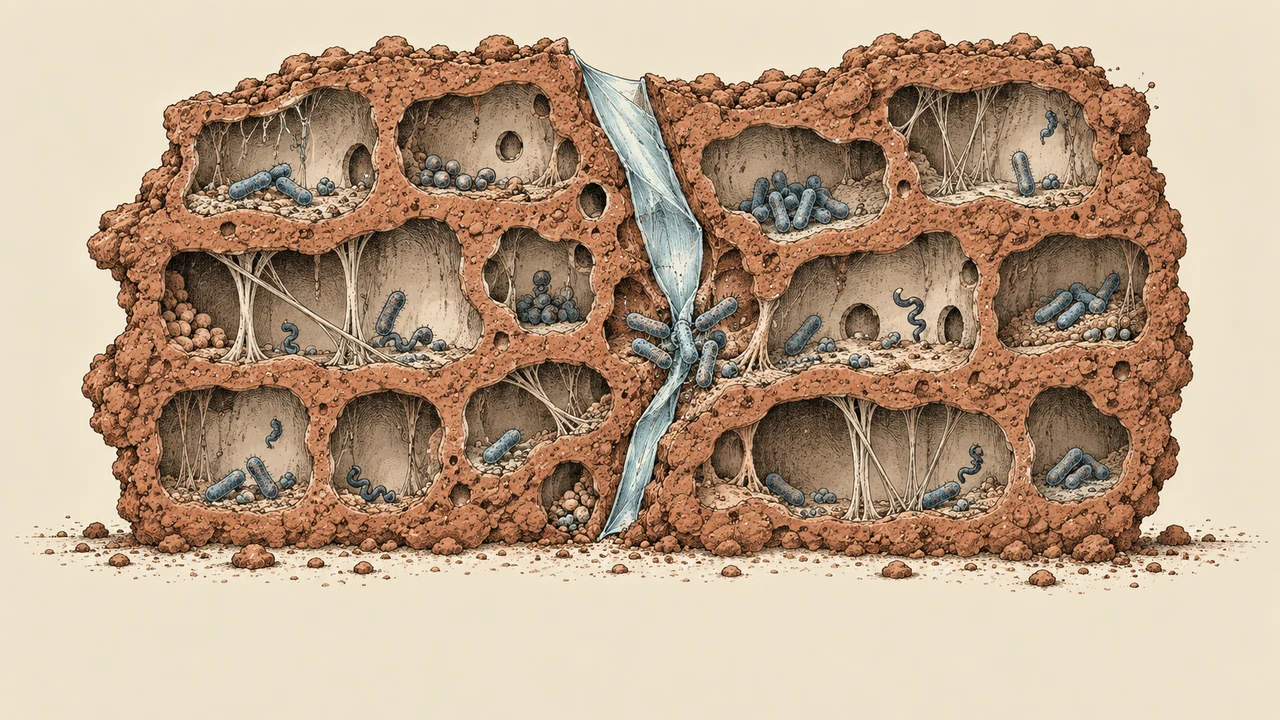
Soil structure gets studied on one bench and soil microbes on another. When plastic enters a soil it moves both at once, and the experiments that catch both in the same soil are rare.
Start with the physical soil. Sajjad and colleagues report that plastic particles change soil structure, porosity, bulk density, water-holding capacity, and infiltration, with mulch film the single largest source, and roughly 700,000 tonnes reaching farmland in Europe and North America each year. The plastic changes how tightly the ground packs, how much water it holds, and how fast water sinks in.
Aralappanavar and colleagues look at a different layer of the same soil: the microbes. Both the film growing on the plastic itself and the surrounding soil hold fewer, less varied microbes than clean soil, with more of the plastic-eating groups. Plastic tends to raise the microbes that pull nitrogen from the air and cut the ones that turn it into a form plants can use.
Those two reviews describe changes that have to be connected. Soil structure is built partly by microbes, and microbes depend on the pore spaces and water that structure gives them. But the two read like separate conversations.
The one study I found that holds both in frame is Han and colleagues' greenhouse experiment. They mixed polyethylene and PLA into a silty loam at 0.5% by weight under a rice-and-wheat rotation. Big soil clumps fell from 84% to between 65% and 71%, tiny clumps rose from 17% to between 29% and 35%, and the average clump size dropped from 1.4 mm to about 1.0 to 1.1 mm. In the same soils, plastic explained about 54% of the difference in bacteria, and the microbes living in the new small clumps were the most disturbed of all.
So the structural break and the microbe shift were one process, with the microbes most sensitive exactly where the new small clumps formed. That squares with Sajjad's structural picture and Aralappanavar's microbe picture, but it only became clear because all of it was measured together in the same pots.
It also complicates a comfortable assumption. The biodegradable PLA damaged structure about as much as the conventional PE, so Han's team concludes that switching to biodegradable plastic would not cut the harm. Underneath all of this sits a problem Kumar and Sajjad both name: there is still no standard way to sample and count plastic in soil, which is part of why measuring several properties in one honest experiment stays rare.
- Type
- Under-studied interaction
- Field
- Soil physics and microbial ecology
- Comparative basis
- Structure vs. microbial community
- Methods
- Aggregate sieving, 16S sequencing, greenhouse trials
Why this is answerable now
The physical toll is documented
Reviews now agree plastic reshapes soil structure, porosity, bulk density, water-holding capacity, and infiltration, with mulch film the largest input (Sajjad et al., 2022). The single-property story is mature enough that the connections are the obvious next thing to chase.
The biology is documented too
Plastic lowers microbe variety and shifts nutrient cycling, with more nitrogen-fixers and fewer of the microbes that make nitrogen usable (Aralappanavar et al., 2024). Two rich single-track literatures exist that almost never share an experiment.
A working template exists
Han and colleagues measured soil clumps and the bacterial community in the same pots and watched them move together (Han et al., 2024). The method to study the connection is proven. It is just not yet common.
The substitution question is live
Biodegradable PLA harmed soil structure about as much as conventional PE (Han et al., 2024), so the policy-friendly answer of switching plastics may not hold. Only coupled measurements can tell us why.

Sources cited
Papers I read for this question. These notes distinguish reviews from primary studies and identify the limits of my access.
The 2020 review that said soil was ignored next to the ocean.
How plastic reshapes soil microbes and the nutrient work they do.
The physical side: structure, porosity, water. Mulch film leads.
04Microplastics alter soil structure and microbial community
Primary experimentMeasured structure and microbes in the same pots, moving together.
Fate depends on the soil and its life. No standard method yet.
What’s missing — the gap
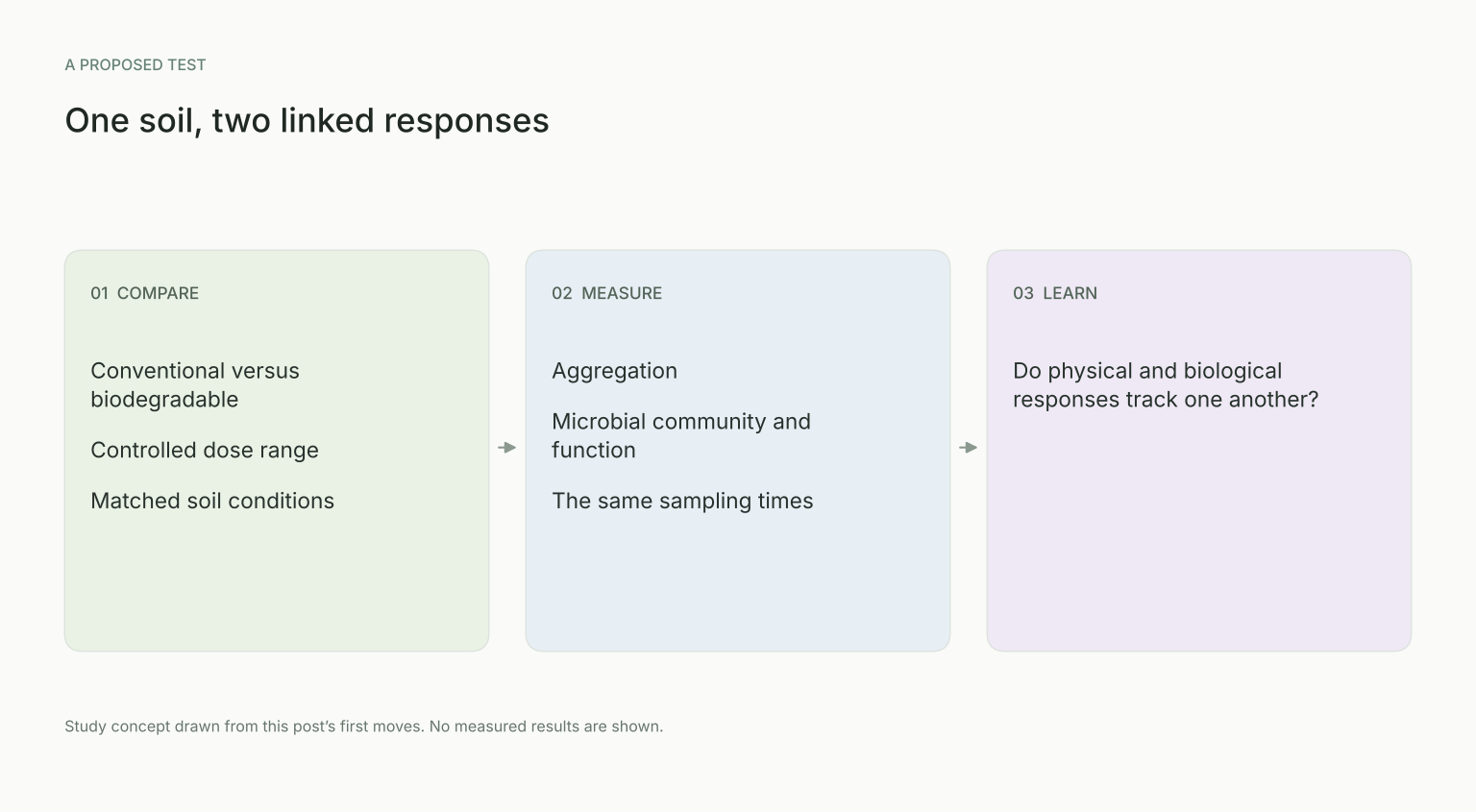
When plastic changes both the physical soil (clump structure, porosity, water-holding) and the microbes and their nutrient work in the same soil, do those changes move together as one linked response, or are they separable effects that single-property studies have been right to treat apart?
Han's one experiment suggests they move together, with the microbes most disturbed exactly where the new small clumps formed. But that is one soil, one greenhouse, one high dose. The structural reviews and the microbe reviews still read as two separate literatures. Until more studies measure both properties in the same soil, at field-realistic loads, no one can say whether the coupling Han saw is general or a feature of that single pot.
First moves
- 1
Co-measure structure and community
Run Han's setup wider: several soil textures, a field-realistic loading instead of a high lab dose, and measure both clump sizes and the microbial community in the very same samples. The smallest honest test is whether the two shifts track each other soil by soil.
- 2
Split the physical and biological paths
Use sterilised versus live soil, or lifeless versus microbe-friendly particles, to ask whether plastic changes structure directly or mostly through the microbes it reshapes. That tells you which half is driving the coupling Han saw.
- 3
Test biodegradable on the biology
Han found PLA and PE damaged structure alike. Extend that to nutrient cycling and microbe variety across a full growing season at field doses, to see whether switching to biodegradable fares any better on the biology than it did on the physics.
My working hypothesis
I think the structural change and the microbe change are two views of one process, not two independent effects, and Han's coupling is the best hint we have. But one pot cannot carry that claim. I would rather see three plainer experiments that measure both properties in the same soil than another that perfects one property alone.
An invitation
If you work on soil structure, on the plastisphere, or on nitrogen cycling, I would like to know whether you have ever measured your property alongside one of the others in the same soil, and whether they moved together or went their own ways. Everyone seems to be describing one part of what looks like a single process. Am I wrong to find it strange that we so rarely watch two of them at once?
Questions about this gap
Which responses need to be measured together?
Soil aggregation and microbial community or function need to be measured in the same treatments and sampling periods. Combining unrelated experiments cannot establish their relationship.
Would a correlation identify the mechanism?
No. Correlation can guide the next test, but particle physics, microbial activity, and soil conditions may change together. Mechanistic controls are needed to separate them.
Why include more than one polymer?
A conventional and a biodegradable material may create similar physical changes but different biological responses. Testing them together helps distinguish those pathways.
Why include a lower-dose treatment?
It tests whether a coupled response seen under a strong laboratory exposure also appears at the amounts relevant to the field being studied.
What would an uncoupled result teach us?
If structural and microbial changes do not track one another, they may need separate explanations and separate indicators in assessments of soil plastic effects.