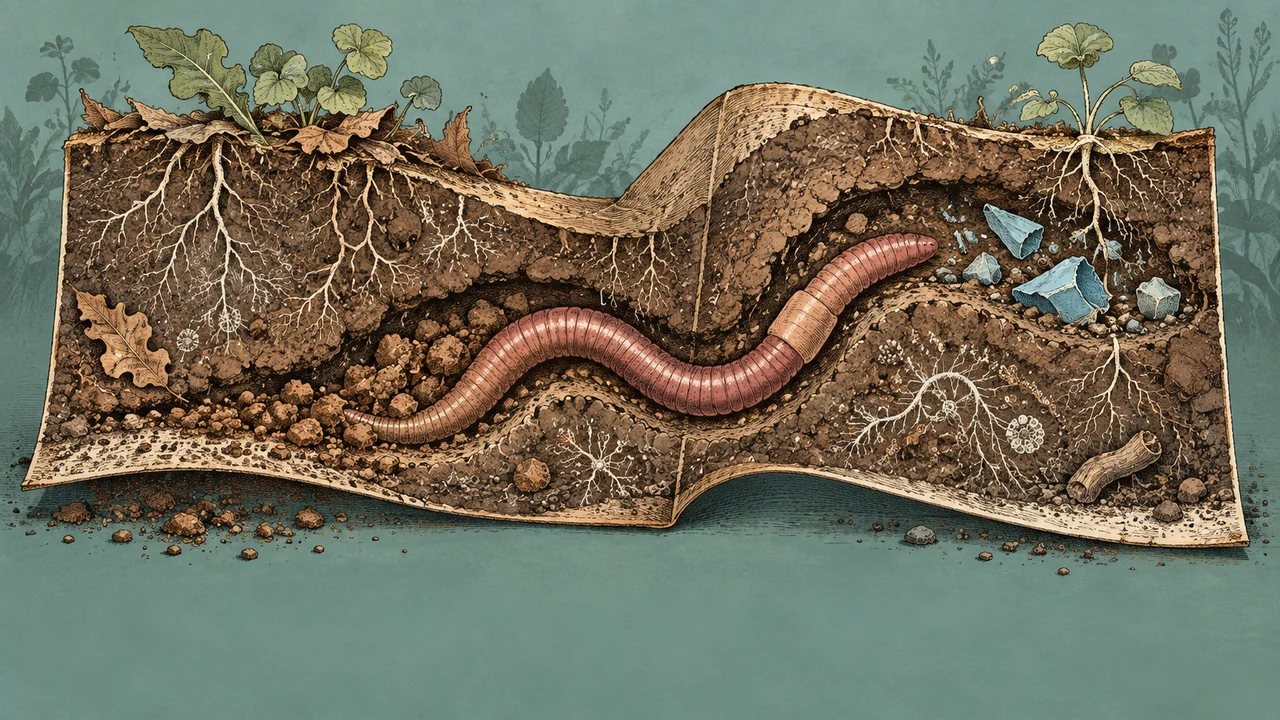
Microplastics in soil and the animals that live in soil are both studied constantly right now, almost never in the same experiment. So no one can say what a field full of plastic does to the earthworms working it, or what those worms do back to the plastic. That empty space between two busy fields is what I keep circling.
Start with what everyone agrees on. Guo and colleagues lay out microplastics as a real soil contaminant, understudied next to the ocean, tracking how they enter through mulch film, sludge, irrigation and fallout from the air, then move down through the soil and up the food chain from one animal to the next. So the plastic and the soil fauna are sharing the same dirt. That is the reason studying them apart is a problem.
Sajjad and colleagues are the ones who reach the animals. They name plastic film mulch as the largest source, show microplastics changing soil structure, porosity and water-holding capacity, and report dose-dependent harm to earthworms, nematodes and collembolans, with 1-2% plastic content causing death.
Aralappanavar and colleagues go deep on the microbes instead. Soils with plastic hold less varied communities that favor plastic-degraders, raise nitrogen-fixers and suppress nitrifiers, all shifting with dose, plastic type and soil. Same soils, two halves of one story, and no one holding both at once.
The realistic experiments exist. They just stop short of the animals. Han and colleagues ran a one-year rice and wheat rotation in silty loam, mixing conventional and biodegradable plastic at 0.5% by weight. Both broke soil aggregates from large crumbs to small ones, dropping mean weight diameter from 1.4 mm to about 1.0-1.1 mm, and plastic explained roughly 54% of the shift in the bacterial community.
Zhou and colleagues zoomed to the thin layer against a single particle. Microbes ate the biodegradable plastic as carbon and grew faster there than in the surrounding soil. (That one is abstract only, so I hold the detail loosely.)
So we can describe the altered soil the earthworm would crawl into, down to the crumb size and the microbes on the particle. Then the measuring stops, right before the animal shows up. I keep wondering why no one has closed that last inch.
- Type
- Interaction, under-studied
- Field
- Soil fauna ecology
- Comparative basis
- Microbe and structure work vs. fauna work
- Methods
- Field trials, 16S sequencing, fauna census
Why this is answerable now
Films are the biggest source
Plastic film mulch is the largest input of microplastics to farmland, alongside sludge, compost and tyre wear. This is the ordinary equipment of modern farming shedding straight into the soils where the fauna live.
The dose problem is named
Reviewers are openly calling for long-term field studies at realistic concentrations, because most current evidence is short, high-dose lab jars. When a field names its own weak spot, that is when a well-designed field study lands hardest.
Biodegradable is no easy out
Han and colleagues found biodegradable plastic broke down soil structure about as much as conventional plastic, so they doubt swapping materials would reduce harm. If material substitution won't save us, understanding how these things behave among the living soil stops being optional.
No shared measuring stick
There is still no standard method for sampling and extracting microplastics from soil. Setting the fauna-and-plastic question up now means building the protocol before everyone locks in numbers no one can compare.

Sources cited
Papers I read for this question. These notes distinguish reviews from primary studies and identify the limits of my access.
Plastic and fauna share the same soil; particles move and pass up the chain.
Deep on the microbes. Calls for field studies at realistic doses.
Reaches the animals: 1-2% plastic kills worms, nematodes, collembolans.
04Microplastics alter soil structure and microbial community
Primary experimentOne-year rotation: both plastics broke aggregates and shifted bacteria.
Microbes ate the biodegradable particle and sped up. Abstract only.
What’s missing — the gap
At realistic field concentrations over a full growing season, do the soil-structure and microbial changes from microplastics measurably alter earthworm and other fauna behavior, abundance, or survival? And do those fauna in turn change how far the plastic moves and how fast it breaks down?
The habitat change is well mapped: broken aggregates, microbe-crusted particles, shifted nutrient cycling. The animal response in that same realistic soil is not. Neither is the return direction, what burrowing worms do to the plastic's movement and breakdown. Both halves need measuring in one experiment, not borrowed across separate high-dose jar studies.
First moves
- 1
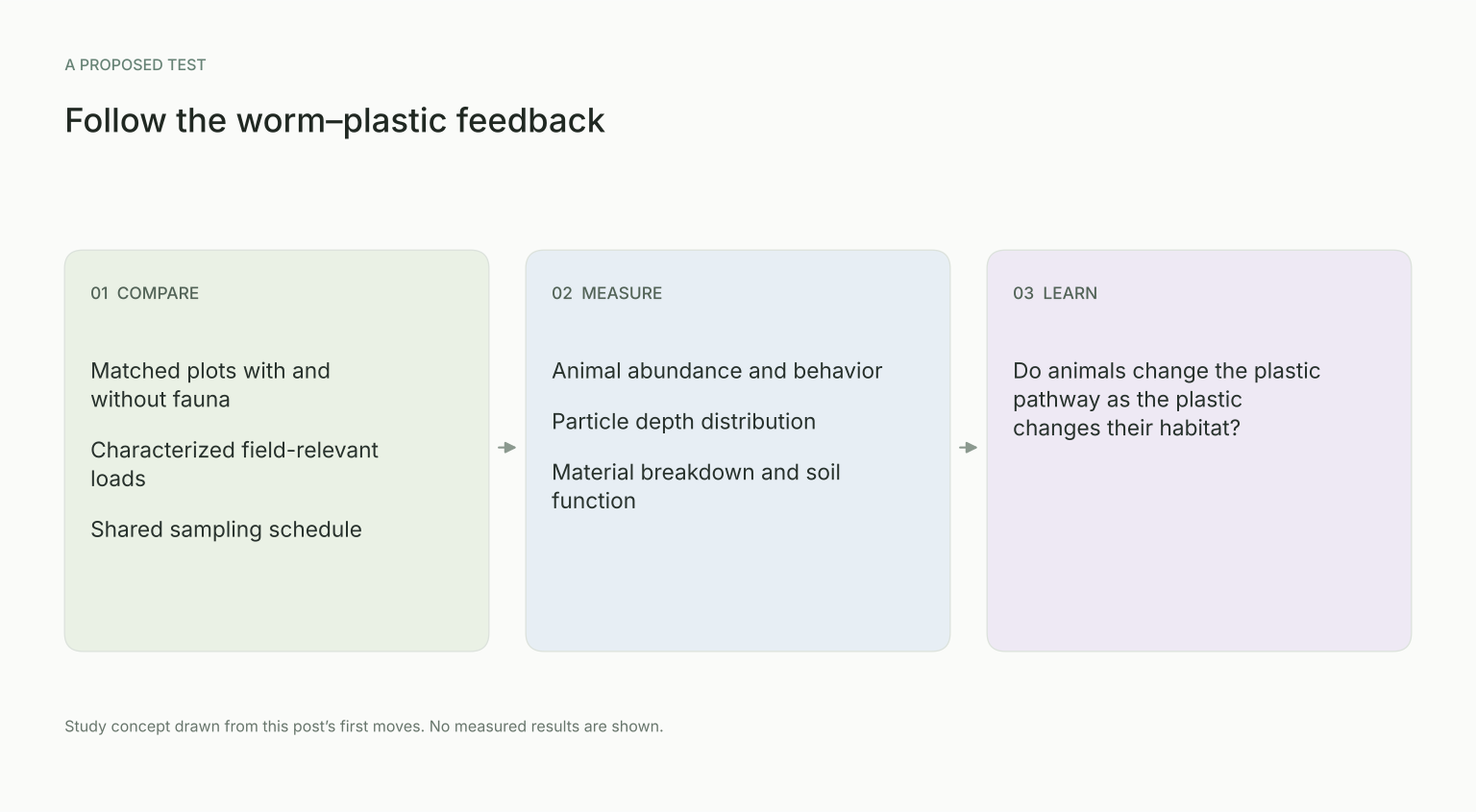
Put fauna into a mapped field
Take a realistic-concentration design like the 0.5% rice-wheat rotation and add earthworm and collembolan monitoring alongside the existing structure and microbe readouts, in the same soil and same season.
- 2
Test the feedback both ways
Set up plots with and without earthworms at matched plastic loading, then track how far the microplastics migrate down the profile and how fast the biodegradable fraction breaks down. That return half is what almost no one has measured.
- 3
Nail down the measuring stick first
Before scaling up, agree on one extraction protocol for the plastic and one census method for the fauna, and report both in full, so the next lab's numbers can actually be compared to yours.
My working hypothesis
I think the fauna effects at realistic doses will be milder than the 1-2% jar numbers suggest, but real, and the return direction matters more than people assume, since worms move and fragment plastic and change where it ends up. What bothers me is that the habitat is measured down to the grain while the animal in it goes uncounted. One realistic season measuring plastic, microbes, structure and animals together would settle a lot.
An invitation
If you run field trials in soil ecology, or you work on earthworms, nematodes and collembolans, this is the gap I would most like to see closed: one realistic-concentration season where the plastic, the microbes, the soil structure and the animals are all measured together, in both directions. I am a student reading across two fields that barely cite each other, so maybe the answer already sits in a lab I have not found. If the plastic and the animals are so plainly in the same dirt, how much longer can we study them in separate rooms?
Questions about this gap
What is the return direction of the feedback?
The post asks not only how plastic affects animals, but also whether animal activity changes particle movement or breakdown in the same soil.
Why compare plots with and without earthworms?
It provides a direct test of the animal contribution under matched plastic exposure. Other differences between treatments need to be controlled and documented.
Does 0.5% automatically represent a realistic field dose?
No. A percentage used in a cited experiment must be compared with measured exposure in the field of interest. The proposed fauna study needs that exposure check.
Why measure behavior as well as survival?
Survival is only one endpoint. Changes in movement or activity could affect soil processes without producing mortality during the observation period.
What must be standardized for a repeat?
Both the plastic measurement and the fauna census need defined methods. Otherwise a change in extraction or animal detection could masquerade as an ecological difference.