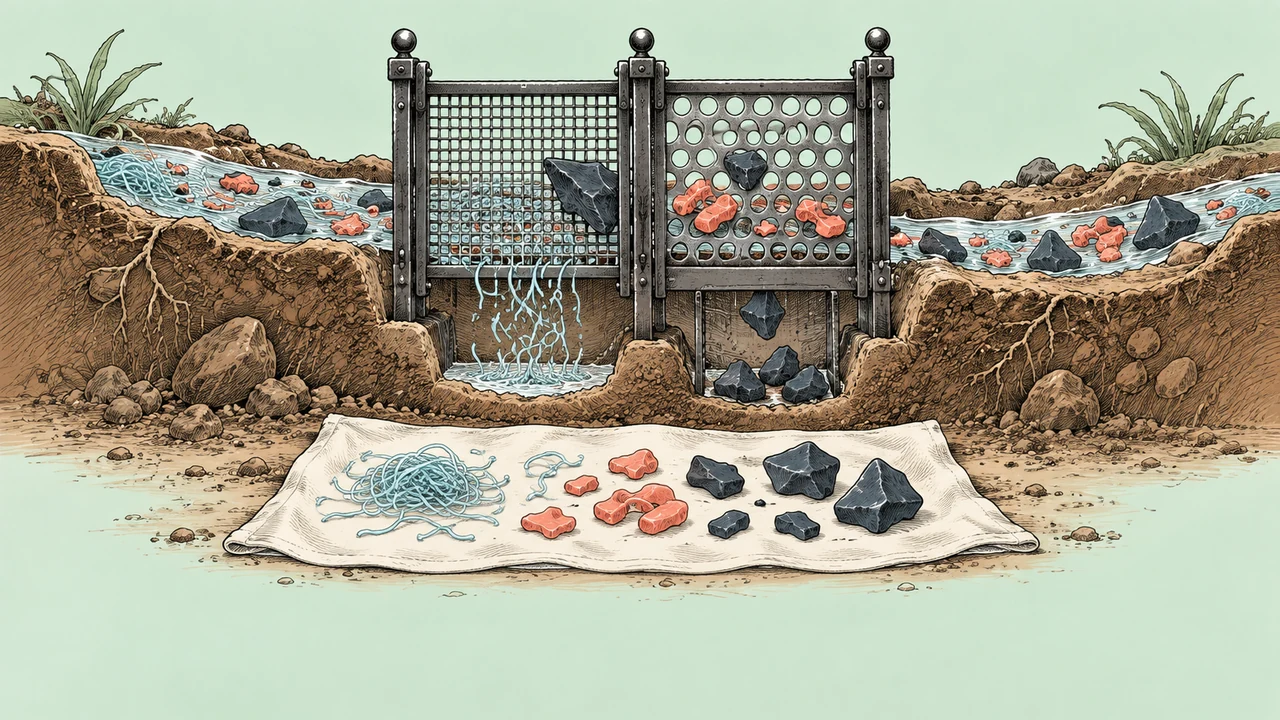
Everyone who counts microplastics in soil counts them a different way, so the numbers we already have cannot really be stacked against each other. Before we argue about how much plastic is in farmland, we have to admit we are not all measuring the same thing.
Look at two careful field studies side by side and the problem jumps out. Van den Berg and colleagues sampled Spanish soils by floatation and filtration, splitting particles into a light-density fraction (below 1 g/cm3) and a heavy-density one (above 1 g/cm3). Sludge itself carried about 18,000 light and 32,070 heavy plastics per kilogram, and sludged soils held roughly 2,130 and 3,060 against 930 and 1,100 in soils without.
Cusworth and colleagues, rebuilding 150 years of contamination in the Broadbalk wheat plots, took a different road. Peroxide digestion to burn off organic matter, iron sulphate flocculation, a common-salt brine to float the plastic out, then Nile Red staining read under fluorescence for particles above 10 microns. One lab sorts plastics by whether they float or sink and reports two numbers. The other dyes them so they glow and reports one. Two honest teams, two soils, two numbers never built to compare.
The difference is not cosmetic, because the methods do not even catch the same particles. A common-salt brine is only dense enough to lift the lighter plastics. The densest polymers tend to sink and go uncounted, and that heavy fraction is exactly what van den Berg went out of the way to capture and found to be the larger of the two. Add different size floors on top, Cusworth counted only above 10 microns, and a soil that reads as heavily polluted by one method could read as clean-ish by the other, with neither team making a mistake.
The lab studies sidestep the whole mess, which says something. Han and colleagues did not have to extract anything. They mixed polyethylene and PLA into soil at a known 0.5% by weight, so their precise results (microaggregates rising from 17% to 29-35%, mean crumb size falling from 1.4 to about 1.0-1.1 mm) come with a dose you can trust and a field relevance you cannot.
Aralappanavar and colleagues make the same point from above: most of what we know comes from short, high-dose lab jars, and they call for field studies at realistic amounts. Those realistic amounts are exactly what a shaky extraction step cannot yet deliver. Guo frames soil as a contaminant still understudied next to the oceans. I keep wondering how we close that gap when we cannot agree on how to pull the plastic out of the dirt and count it.
- Type
- Un-harmonized methods
- Field
- Soil microplastic pollution
- Comparative basis
- Competing extraction protocols
- Methods
- Density floatation, salt brine, Nile Red
Why this is answerable now
Two counts, no shared ruler
Van den Berg's density floatation and Cusworth's salt-brine-plus-Nile-Red both count plastic in farmland soil, but were never built to compare. Until the extraction step is shared, every cross-study number is apples to oranges.
The method decides the answer
A salt brine floats the light plastics and tends to leave the dense ones behind, the very fraction another team measured as the larger one. The recipe is setting the result as much as the soil.
Realistic field numbers are missing
Aralappanavar's review says the evidence is mostly short, high-dose lab work and asks for field studies at realistic amounts. Those numbers only become trustworthy once extraction is standardized.
The compartment is still being mapped
Guo puts soil as a contaminant understudied next to the oceans. Agreeing on one method now, before survey habits harden, is far cheaper than reconciling a decade of mismatched counts later.

Sources cited
Papers I read for this question. These notes distinguish reviews from primary studies and identify the limits of my access.
Says soil deserves its own study, still understudied next to the ocean.
Effects depend on dose, type, and soil, mostly from lab jars.
03Microplastics alter soil structure and microbial community
Primary experimentSpikes a known dose, so it never has to extract anything.
Shows the heavy fraction is real and often the larger one.
A rigorous count built on a completely different extraction chain.
What’s missing — the gap
If the same set of agricultural soils were run through the leading extraction and detection methods side by side, would the reported concentrations line up, or would they diverge enough to prove that current cross-study comparisons of soil microplastic abundance are not measuring the same thing?
Two careful teams counting plastic in farmland used chains that were never meant to line up. One sorts by density and reports light and heavy; the other dyes and counts above 10 microns. Their size floors differ and their brines catch different polymers. Until someone runs both on one shared soil, we cannot tell how much of the spread across studies is real and how much is the recipe.
First moves
- 1
Run one soil through every method
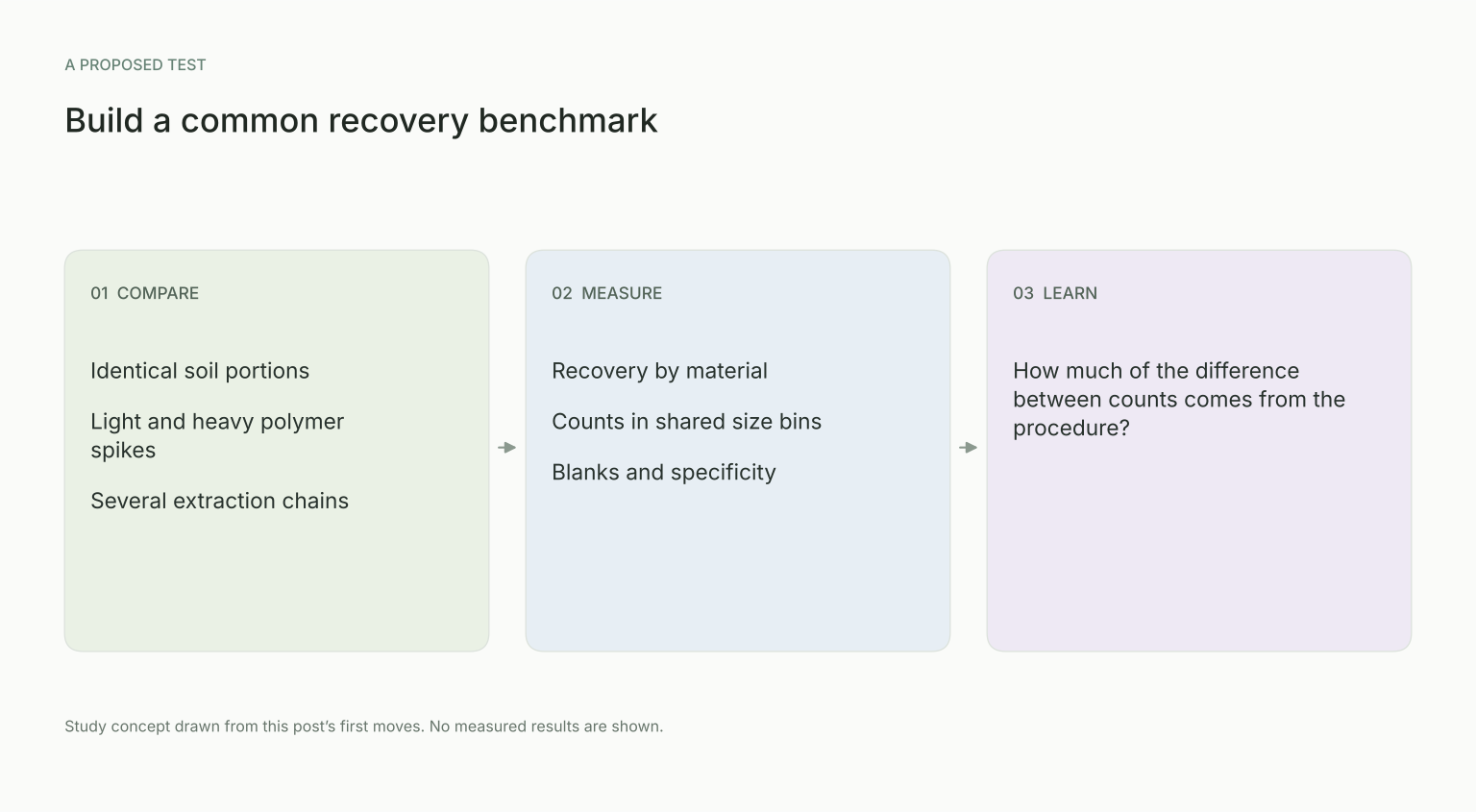
Split a single well-mixed agricultural soil and process portions through the leading extraction and detection chains, including van den Berg's density floatation and Cusworth's salt-brine-plus-Nile-Red route, then see how far the counts for the same dirt diverge.
- 2
Spike, then blind-recover
Spike soils with a known mix of light and heavy polymers at a fixed mass, following Han's known-dose logic, and hand them to different labs to measure recovery. Then the loss of dense plastics is a number, not a guess.
- 3
Publish a shared recovery benchmark
Report every protocol against the same spiked reference and size floor, so a soil plastic number always arrives with its method's recovery rate attached and cross-study numbers become correctable.
My working hypothesis
I think the method is shaping the results as much as the soil is, and probably more than the field admits. My guess is that if you ran the leading protocols on one shared soil, the counts would split apart at the dense end, where a salt brine quietly loses the heaviest polymers. That would mean a lot of cross-study comparisons are comparing recipes, not soils. This is a boring fix, one shared reference material and a recovery rate on every number, and it would do more for the field than another clever new method.
An invitation
If you sample and extract microplastics from soil, I would like to know which protocol you trust and what you think it quietly misses, especially at the dense end a salt brine tends to leave behind. The evidence keeps telling me the recipe shapes the result as much as the soil. Am I wrong to find it odd that we are still debating how much plastic is in farmland before we have agreed how to count it?
Questions about this gap
Why do different size floors undermine comparison?
A method that excludes smaller particles is counting a different population. Counts should be compared within a shared size range or reported in compatible bins.
Why include both light and heavy polymers in recovery tests?
Density-based separation may recover them differently. A mixed reference tests whether a method’s apparent performance depends on the polymers it happens to capture.
What does a procedural blank measure?
It checks contamination introduced by processing. It complements recovery testing, which asks how much of a known input the method retrieves.
Can a recovery correction fix every difference?
No. Corrections depend on representative reference particles and a validated range. Identification errors and unobserved size classes may require separate treatment.
What is the proposed first deliverable?
A transparent side-by-side recovery and counting benchmark on shared soils, with cutoffs and quality controls reported, would make the disagreement between methods measurable.