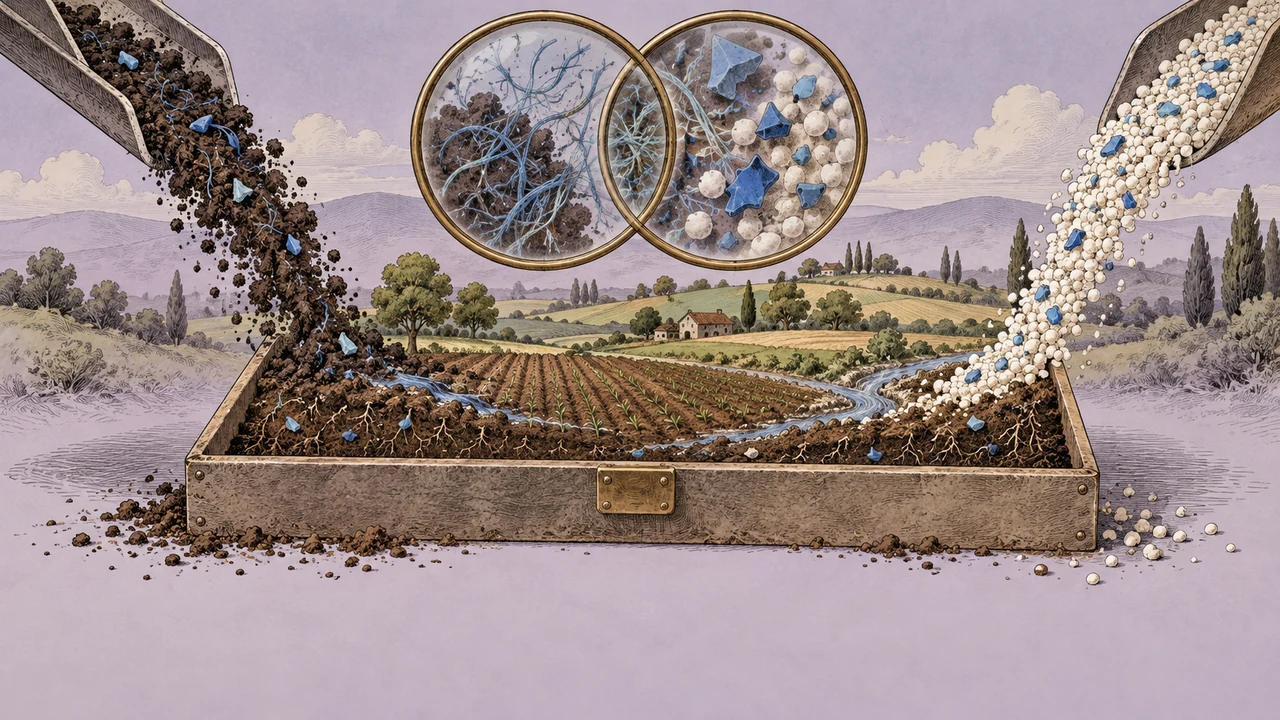
We know how to measure a lot of things about plastic in soil. What almost no one does is turn two of them on at once and watch where they meet.
Start with how plastic gets into the soil. Van den Berg and colleagues followed sewage sludge across 16 fields in eastern Spain. Soils that got sludge held about 2,130 light and 3,060 heavy microplastics per kilogram, against roughly 930 and 1,100 in soils that never got any. Each new application added on the order of 280 light and 430 heavy particles per kilo. Spread the sludge, and the count climbs step by step.
Cusworth and colleagues picked a different route: fertiliser. Working the Broadbalk wheat archive at Rothamsted, they found none before 1914 and a steady rise from 1966 on, with fertiliser and manure plots carrying more plastic than an untreated plot. Two studies, two routes, both convincing. Sludge and fertiliser land on the same real farms, and I cannot find the study that measures them acting together on one field.
Han and colleagues ran one of the rare experiments that turns two knobs at once. They crossed plastic type, regular polyethylene against biodegradable PLA, with three particle sizes, mixed into a silty loam at 0.5% by weight. Both plastics pushed the soil toward smaller crumbs: microaggregates climbed from about 17% to 29-35% while macroaggregates fell from 84% to 65-71%. That damage barely changed with type or size. So the biodegradable plastic did not spare the soil's structure.
Type did matter for the microbes. The bacterial networks turned more competitive under the longer-lasting polyethylene than under PLA. That fits the Aralappanavar review, which reports plastic tends to favor plastic-degraders like Actinobacteria and Proteobacteria while pushing nitrifiers down, but only as the dose, the plastic type, and the soil allow. The review's main caveat is the tell: almost all of that evidence comes from short, high-dose lab jars, not fields where several factors change at once.
Then there is the part hiding inside the instruments, which is what a sampling and extraction gap is really about. Van den Berg split particles by density, light below 1 g/cm3 and heavy above it. Cusworth used peroxide digestion, density separation, and Nile Red staining read under fluorescence down to 10 micrometres. Each method sees a different slice of what is there. So when one field is read by density and another by Nile Red, the numbers were never on the same footing. On a working farm the extraction method, the input route, the plastic type, and the soil all change together. Guo's review frames soil as a contaminant studied far less than oceans or rivers, which tells me the field is early enough to fix this.
- Type
- Under-studied interaction
- Field
- Soil microplastic pollution
- Comparative basis
- Single-factor studies vs. combined
- Methods
- Density separation, Nile Red, 16S sequencing
Why this is answerable now
Realistic doses arrive
The reviews keep saying the strongest numbers come from short, high-dose lab jars. Field studies now exist to set experiments at the amounts soils really carry. That is when combined effects stop being noise.
Biodegradable sold as the fix
Han found PLA hurt soil structure about as much as polyethylene. If compostable plastic is going onto farmland at scale, now is the time to test it against regular plastic in the same soil.
Two routes, one field
Sludge and fertiliser have each been convicted on their own. Real fields get both. Measuring their combined load is a cheap experiment no one has run.
Methods are splitting apart
Density separation and fluorescent staining catch different particles. The window to compare them on shared samples is closing as each camp settles on its own numbers.

Sources cited
Papers I read for this question. These notes distinguish reviews from primary studies and identify the limits of my access.
The review that said soil was ignored next to the ocean.
Best summary of the microbe and nutrient effects, mostly from lab jars.
03Microplastics alter soil structure and microbial community
Primary experimentCrossed plastic type and size: biodegradable harmed soil like regular plastic.
Sludged fields carried far more plastic, counted by a density split.
Rothamsted archive: fertiliser plots ran above the untreated plot since 1966.
What’s missing — the gap
Do the drivers of soil microplastic impact (input route, plastic type, particle size, extraction method) simply add up when studied together, or do their combined effects on soil structure and microbes come out different from what the one-at-a-time studies predict?
Right now no one can say, because the clean studies each hold everything else still. On a real farm sludge and fertiliser arrive together, plastics come in mixed types and sizes, and the method you pick decides which particles you even see. If the factors interact, stacking single-factor results gives the wrong answer for an actual field.
First moves
- 1
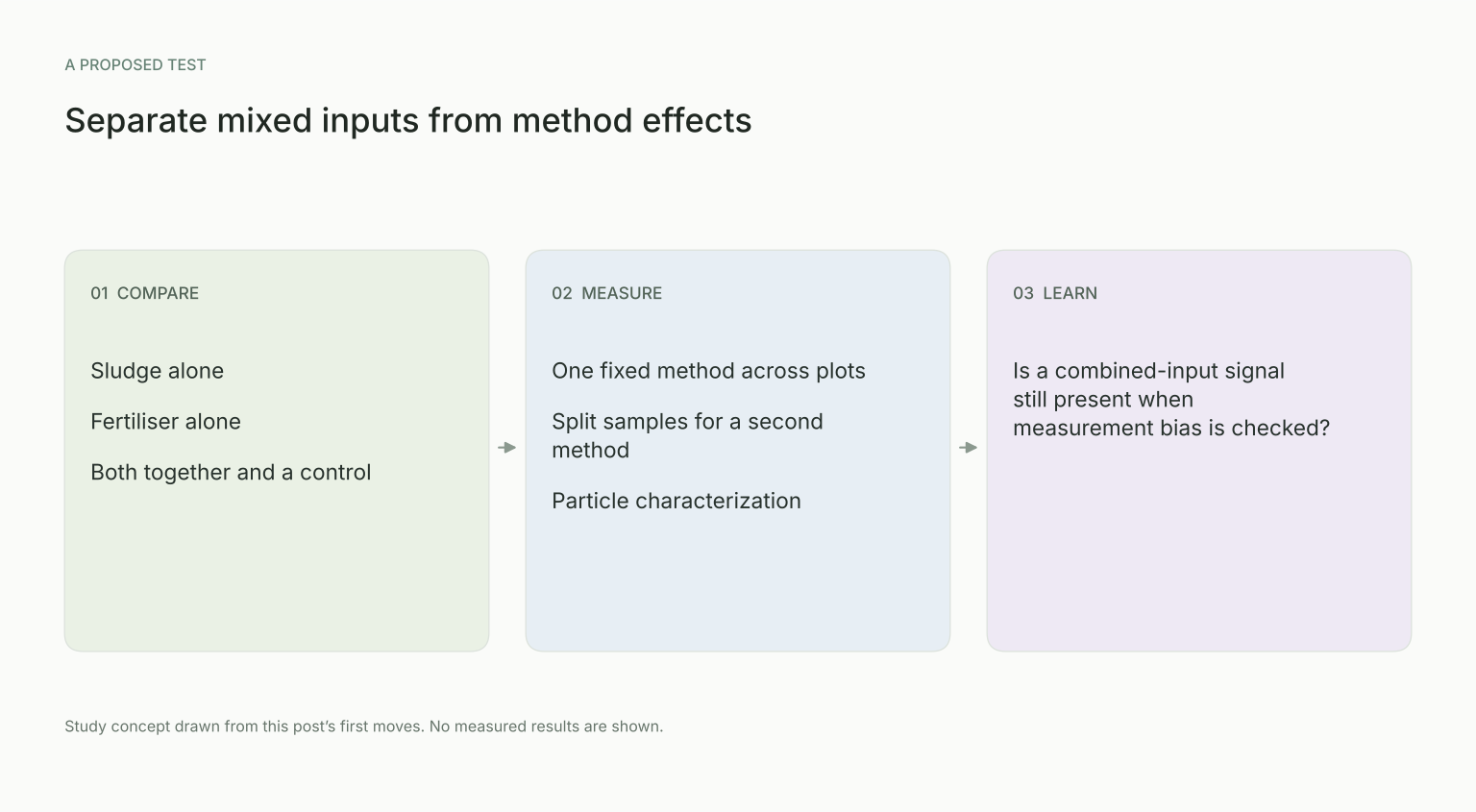
Cross sludge and fertiliser on one field
Apply sludge and fertiliser alone and together on one field design, then read plastic load with the same extraction on every plot. Van den Berg convicted sludge and Cusworth convicted fertiliser separately. The smallest honest step is seeing whether the two loads add or interact.
- 2
Run two extraction methods on one sample
Split identical soil subsamples and count one set by density separation and one by Nile Red. If the counts split apart on the same material, we finally know how much cross-study spread is method and not soil.
- 3
Repeat Han's design at field dose
Han showed a type-by-size experiment is doable, but at 0.5% in a greenhouse. Rerun it at the realistic amounts the reviews keep asking for, over more than one season, to see if the biodegradable-is-no-safer result holds outside the jar.
My working hypothesis
The single-factor work is clean and I trust each piece, but I think the combined picture will surprise us. On a real farm every knob is already turning at once, and the one result that matters most for policy, whether biodegradable plastic is actually safer, only showed up when Han varied two things together. My guess is the interactions will pull some effects up and cancel others, so stacking separate studies will mislead. One combined-factor field study would teach us more than another clean single-factor one.
An invitation
If you work on soil microplastics, I would like to know whether this reads as obvious or as a real hole. From where I sit we have beautiful single-factor studies stacked next to each other and almost nothing that turns two knobs at once, on real farms, where every knob is already turning. Maybe there is a combined-factor field study I have not found. Am I wrong to find it strange that we measured each of these things so carefully and each other so rarely?
Questions about this gap
Why study inputs and methods in the same project?
Real soils receive mixed inputs, while extraction determines which particles are observed. A design that records both can distinguish environmental combinations from measurement differences.
What would sludge plus fertiliser treatments test?
Separate and combined treatments would test whether measured accumulation matches an additive expectation. The untreated control provides the baseline for that comparison.
Does a disagreement between Nile Red and density separation identify the better method?
Not by itself. Recovery, contamination controls, identification specificity, and size limits are needed to understand why their counts differ.
Why use realistic input rates?
They make the proposed field comparison relevant to the management system being studied. Laboratory exposures chosen for detection answer a different question.
What should remain consistent across plots?
The sampling, extraction, and counting workflow should remain fixed so a treatment difference is not introduced by a change in method.