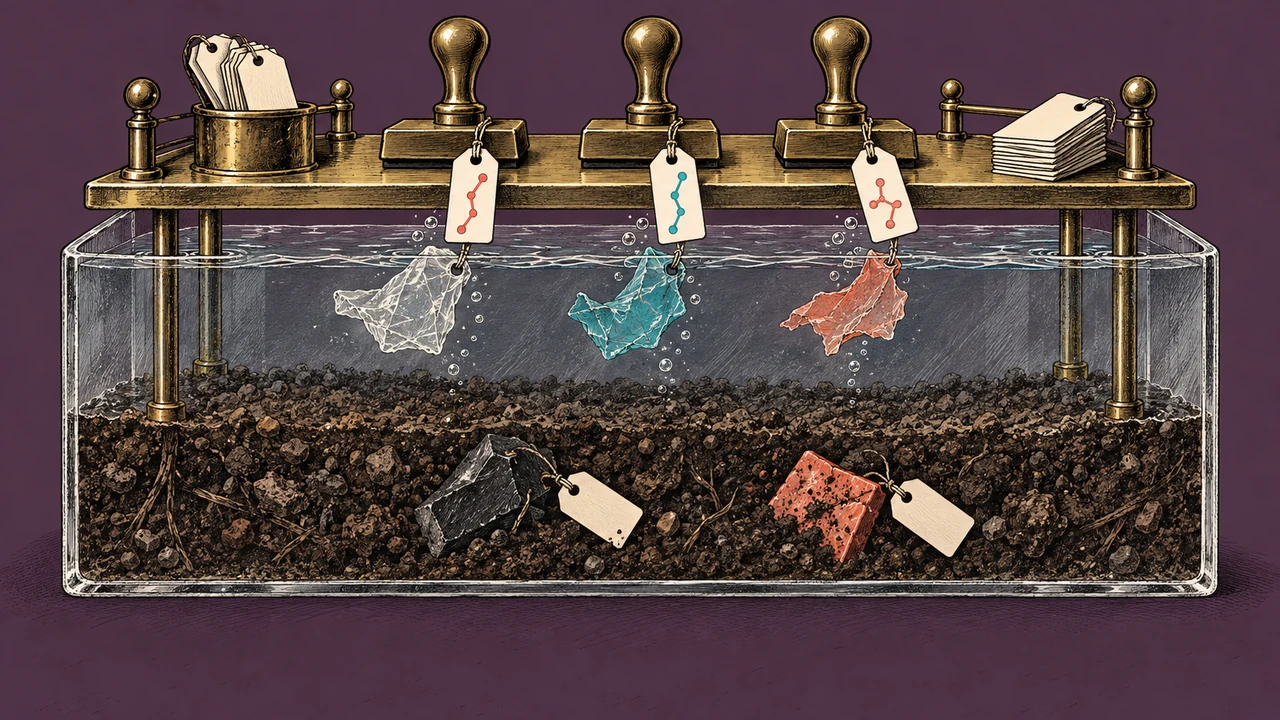
The tools for naming a plastic are borrowed from chemistry and work fine. The papers pointing them at soil are still few, and no one has settled on how to do it.
Start with why the name of a plastic matters at all. Zhao and colleagues mixed 12 secondary microplastics into a loamy sandy soil, 4 shapes across 8 polymer types, and tracked pH, respiration, and 4 enzymes for 31 days. Soil pH rose with foams and fragments. Respiration mostly held steady, except for a bump under polyethylene foams. Several enzymes dropped, depending on shape.
So swap one kind of plastic for another and the soil chemistry and the microbes react differently. Polymer type and shape change what the plastic does. That is why getting the name right is the whole game.
The field is young enough that people are still drawing the map. Chia and colleagues reviewed microplastics in soil and groundwater and called it understudied next to the ocean and lakes. They point to fibers and pellets as the common shapes and littering as the main source in topsoils, without firm numbers. Only the abstract was open to me here.
Read that next to An and colleagues, who pooled 790 data sets from 39 studies. They found microplastics can raise how available copper, lead, cadmium, iron, and manganese are to living things, while polyamide had little or no effect. That split by polymer is the striking part, and you only see it if you named the polymer right in the first place. I could only read the preview, so I hold the fine detail loosely.
Here is the part that keeps nagging at me. Whatever you identify depends on what you pulled out of the soil first. Scopetani and colleagues built an oil-based extraction because validated protocols are missing and the usual density method keeps losing the heavy plastics. Spiking 6 polymers, they recovered about 90, 97, and 95 percent for low, medium, and high density. When a fresh method can still beat the standard one on the very first step, the standard one is not settled, and everything you name afterward rides on it.
- Type
- Emerging, not consolidated
- Field
- Polymer identification and spectroscopy
- Comparative basis
- New method work vs. small existing base
- Methods
- FTIR, Raman, XPS, oil-based extraction
Why this is answerable now
Activity is climbing early
Work on identifying polymers is rising while the total body of research is still small. That is when a field is easiest to shape, before habits set that nobody thinks to question.
The instruments already exist
FTIR and XPS are mature tools from chemistry, and they already do real work in soil-plastic studies. The hard part is agreeing on how to aim them at soil, not inventing them.
Effects work depends on it
Whether a plastic frees up heavy metals or shifts soil pH depends on which polymer it is. Every effects study quietly rests on the identification being right, so fixing that step pays off across the board.
The extraction floor is missing
Researchers say plainly that validated protocols are lacking and density separation loses the heavy plastics. A young area with an admitted hole in its base is one where a careful method can still set the standard.

Sources cited
Papers I read for this question. These notes distinguish reviews from primary studies and identify the limits of my access.
01Microplastics increase soil pH and decrease microbial activities by shape, polymer type, and time
Primary experiment12 plastics, 4 shapes, 8 polymers in soil for 31 days. Type and shape drove the effects.
02Microplastic pollution in soil and groundwater: a review
Abstract onlyCalls soil and groundwater understudied. Fibers and pellets common, littering the main source. Abstract only.
03The effects of microplastics on heavy metals bioavailability in soils: a meta-analysis
Meta-analysis790 data sets. Plastics can free up metals, but polyamide barely did. Polymer type matters.
04Enhanced adsorption of polystyrene nanoplastics onto oxidized corncob biochar
Primary experimentFTIR and XPS explain why plastics stick to biochar. Surface area leads, aging helps.
05Olive oil-based method for extracting and identifying microplastics in soil and compost
Abstract onlyOil-based recovery hit 90, 97, 95 percent by density, beating the standard method. Abstract only.
What’s missing — the gap
For microplastics in soil, does an oil-based extraction paired with FTIR or Raman identification recover and correctly name high-density polymers like PVC and PET at meaningfully higher rates than standard density separation, across several soil types?
That question sits right under the whole effects literature. If density separation keeps dropping the heavy plastics, then a lot of what we report is really a measure of the polymers our methods happen to catch. Scopetani's roughly 90, 97, and 95 percent numbers give a clear target to test against outside their own lab, in soils that differ.
First moves
- 1
Race the two extractions
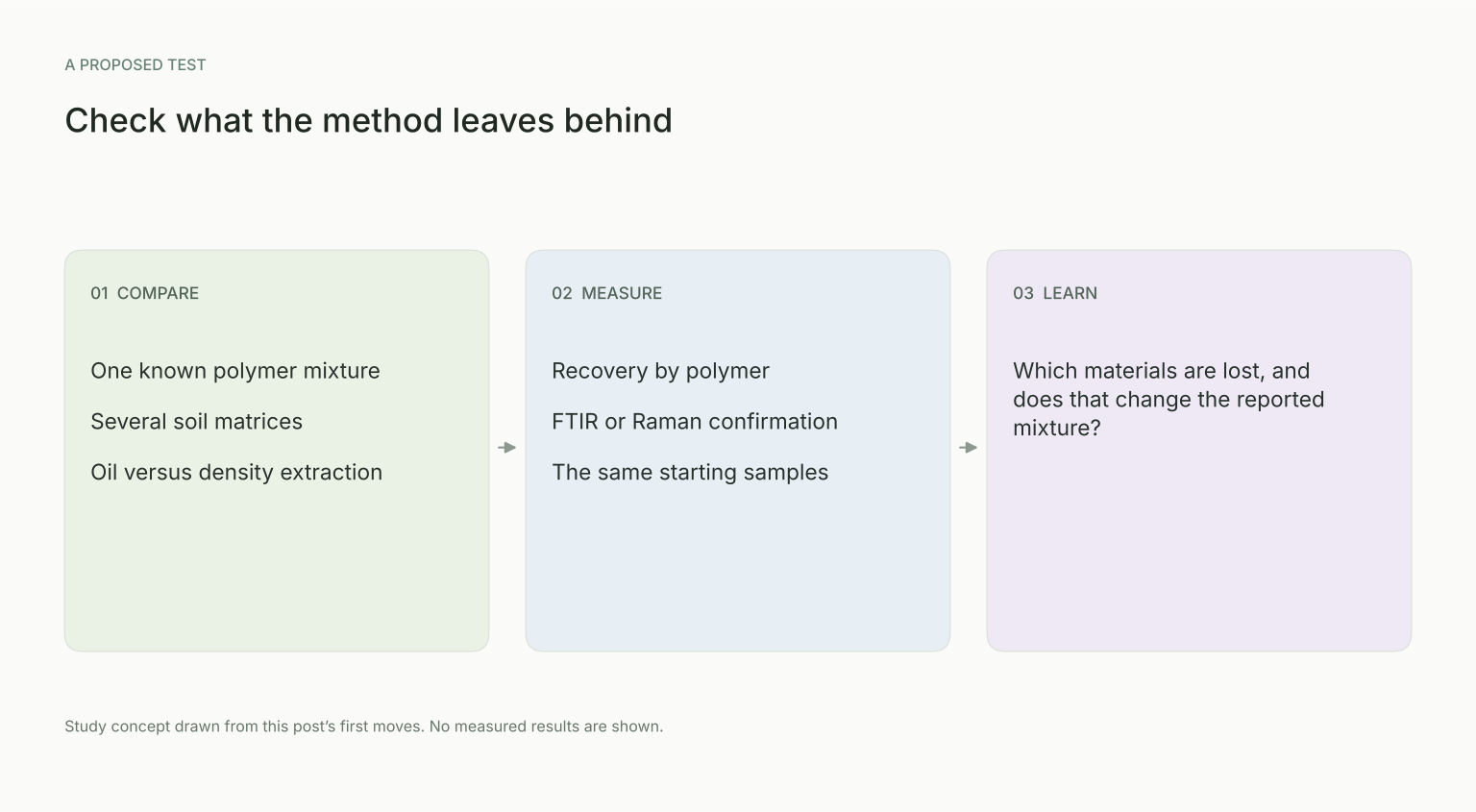
Spike sandy, loamy, and organic-rich soils with a known mix of low- and high-density polymers, then run oil-based extraction beside standard density separation on identical splits and compare recovery per polymer.
- 2
Confirm each particle by spectroscopy
Put FTIR or Raman on every recovered particle to check that the polymer you pulled out is the polymer you named. The biochar work shows these tools can carry real weight, so make them a routine mis-classification check for soil extracts.
- 3
Link recovery to a soil effect
Take one polymer An's meta-analysis flags as active on metal availability and one that looks inert like polyamide, and show how much your extraction choice changes which polymers you would even detect in a real sample.
My working hypothesis
The naming step is the quiet foundation the rest of the field is built on, and it is not solid yet. My honest read is that a good chunk of the effects literature is partly a record of which plastics our methods can catch. A careful extraction paired with routine spectroscopy could still become the method everyone reaches for, and doing it now, before the habits harden, is worth more than another effects study run on a biased sample.
An invitation
If you work with soil, spectroscopy, or extraction chemistry, this is a corner where one careful protocol could become the one everyone reaches for. I keep turning over how much of the effects literature rests on a recovery step nobody has standardized. So how much of what we think we know about plastics in soil is really just a measure of the polymers our methods happen to catch?
Questions about this gap
Why does identifying the polymer matter?
Equal particle counts can contain different materials. Identifying those materials helps connect abundance with the soil responses attributed to particular polymers.
Why might extraction miss some plastics?
A separation method’s density range and sample preparation can favor some particles over others. Recovery tests reveal which polymers the method retains or loses.
Does a high recovery rate in one soil validate every soil?
No. Recovery can depend on the soil matrix and particle properties. The proposed comparison tests methods across soils instead of extending one recovery figure to all samples.
What do FTIR or Raman measurements add?
They can help confirm polymer identity after particles are extracted. Extraction recovery and spectroscopic identification answer different parts of the measurement problem.
What is the smallest useful comparison?
Split the same spiked soils between extraction methods, then identify recovered particles. A known input makes losses visible rather than treating the two reported counts as equally complete.