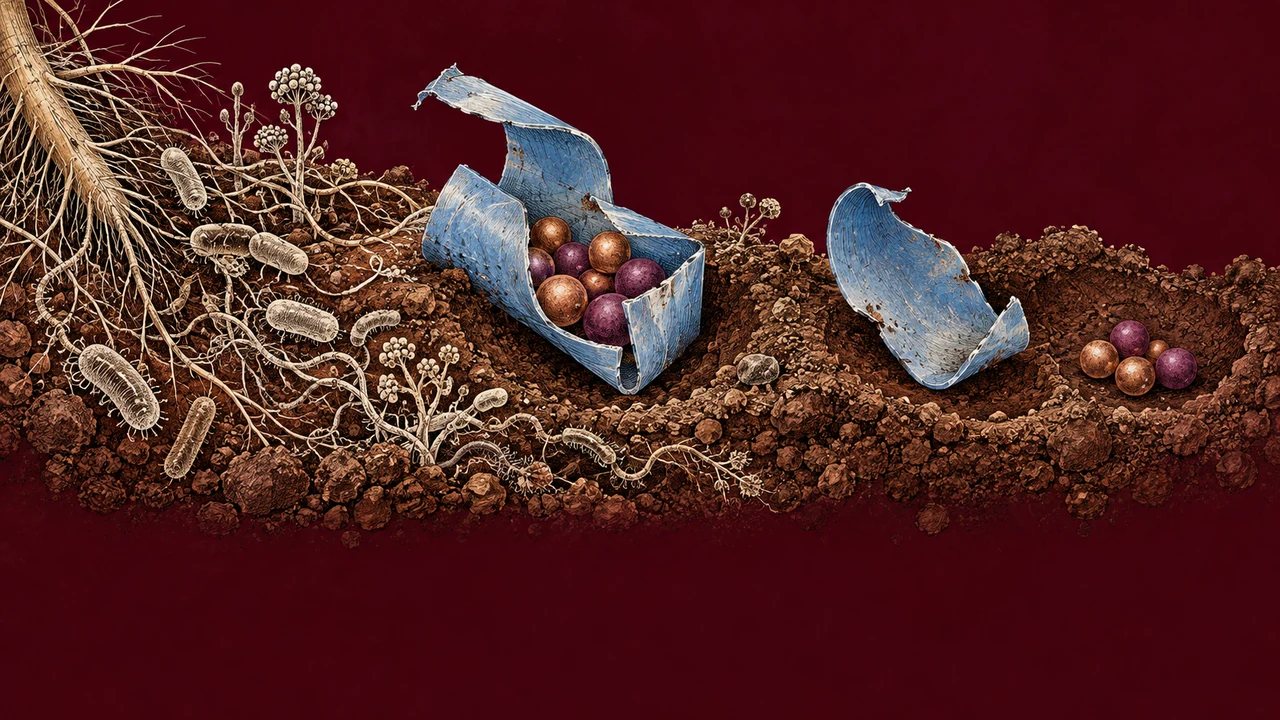
Sorption of pollutants in soil is one of the busiest corners of the field and one of the emptiest. We measure how much of a metal a microplastic can hold, and separately what an antibiotic does to soil life, each in its own clean experiment. The plastic and the poisons it carries get studied constantly, almost never in the same experiment. So no one can say what the two do once they are stuck together.
Start with the claim that makes this a sorption story at all. Sajjad and colleagues state it flatly: microplastics in soil act as carriers for other contaminants, including phthalates, antibiotics, potentially toxic elements, PAHs and PCBs. So a plastic particle binds other poisons on its surface and can move them somewhere new.
The same review counts plastic film mulch as the single largest source, on top of sludge, compost, tyre wear and coated fertilisers. Something like 700,000 tonnes of plastic reaches farmland in Europe and North America each year, and up to 90% of Swiss floodplain soils are already polluted.
Aralappanavar and colleagues traced what plastic alone does to soil microbes. It shifts the community toward plastic-degraders like Actinobacteria and Proteobacteria, nudges nitrogen-fixers up and pushes nitrifiers down, and they name combined toxicity with co-contaminants as an open frontier. That fits Sajjad's carrier claim. If a particle both carries other pollutants and rewires who does the nitrogen work, the sorbed poison and the biological damage are unlikely to be independent.
It cuts against any hope of a clean number, though, because both reviews stress the effect changes with dose, plastic type, and soil. The same plastic can bind and release a pollutant differently depending on the dirt it lands in. We have the sorption chemistry on one bench and the toxicity on another, with no wire between them.
The gap is partly a measurement problem. Aralappanavar's team is candid that most of what we know comes from short, high-dose lab jars testing one variable at a time, the exact design that cannot see an interaction. Sajjad and Kumar both add that there is still no standard way to sample and extract microplastics from soil, so two labs studying the same sorption question may not be measuring the same thing.
Meanwhile Cusworth and colleagues, reading archived Broadbalk soil back to 1846, show the plastic load only climbing: undetectable before 1914, rising across every plot from 1966 to 2022, with fertiliser and manure plots above baseline. The surface that does the sorbing keeps accumulating whether or not we have measured what it binds.
- Type
- Interaction, under-studied
- Field
- Soil ecotoxicology
- Comparative basis
- Sorption chemistry vs. toxicity
- Methods
- Sorption isotherms, 16S sequencing, fauna assays
Why this is answerable now
The carrier list is concrete
Sajjad and colleagues name the specific co-contaminants microplastics carry: phthalates, antibiotics, potentially toxic elements, PAHs, PCBs. Once the list is concrete, the combination experiments become concrete too, and that part is still wide open.
A review asks for this
Aralappanavar and colleagues flag combined toxicity with co-contaminants as an open frontier and call for field studies at realistic concentrations. When a field's own review keeps pointing at the same missing piece, build there.
The reservoir is still filling
Cusworth and colleagues show soil microplastic only rising since the 1960s, with fertiliser and manure plots above baseline and the load poorly reversible. The particles accumulate faster than the science on what they bind.
The measurement floor is named
Both Sajjad and Kumar admit there is no standard soil sampling or extraction method. Whoever pins down a shared sorption-and-toxicity protocol sets the bench everyone else has to use.

Sources cited
Papers I read for this question. These notes distinguish reviews from primary studies and identify the limits of my access.
Soil ignored next to the ocean; particles move and pass up the food chain.
Plastic reshapes microbes and nutrients. Names combined toxicity as open.
Plastic carries phthalates, antibiotics, PAHs, PCBs. No standard method yet.
04Microplastics as pollutants in agricultural soils
Abstract onlyFarm soils understudied. Wants standard methods. Abstract only.
Archived soil back to 1846: plastic rising since 1966, fertiliser adds more.
What’s missing — the gap
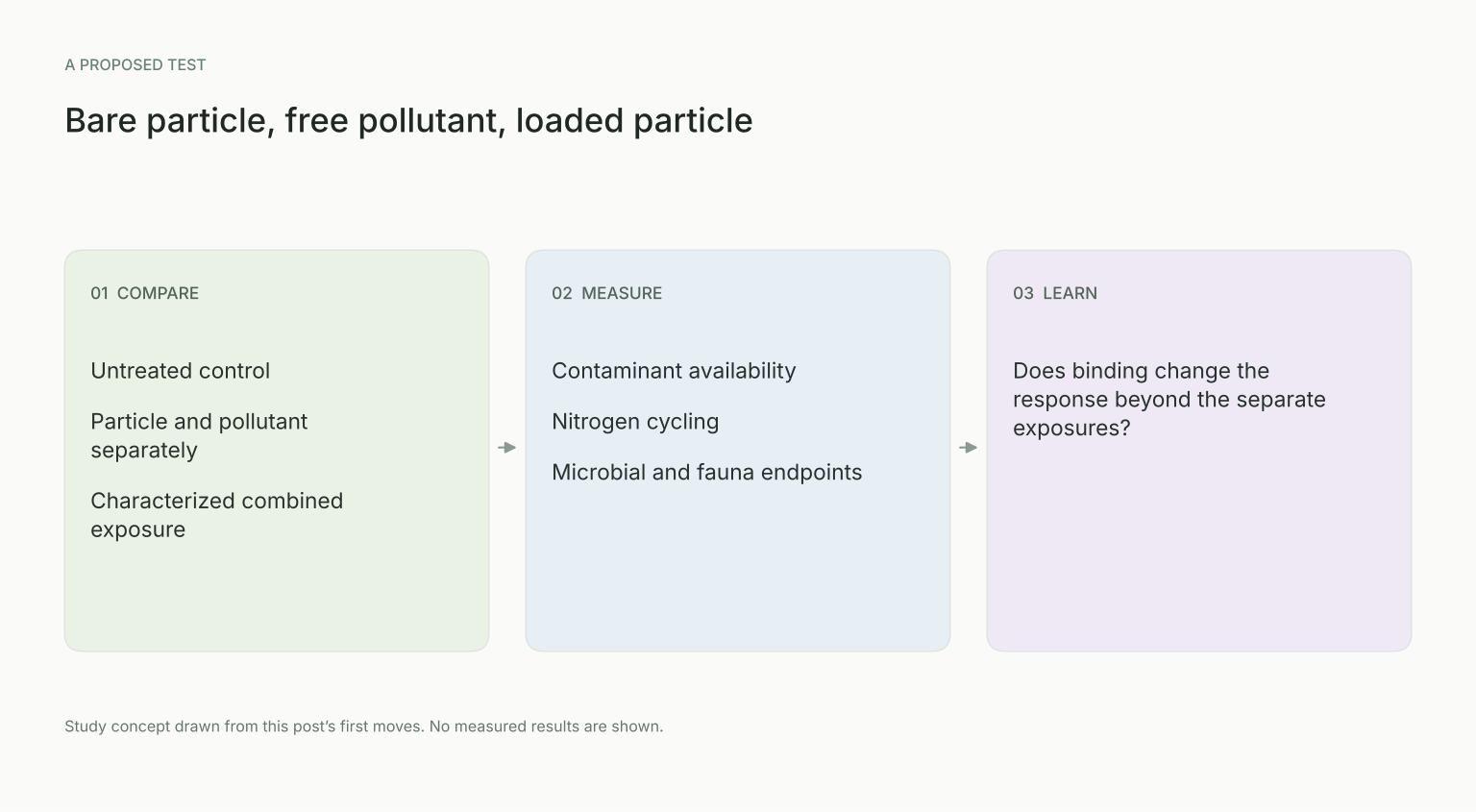
Does a microplastic loaded with a common co-contaminant change soil nitrogen cycling, microbial diversity, or fauna survival differently than the same dose of the bare particle or the free pollutant alone, at a realistic field concentration?
Plastic's carrier role is mapped on one bench and its solo effect on microbes on another. Almost no one has put the two in the same experiment. If a loaded particle just equals the sum of the singles, the field can relax. If it does not, the interaction the reviews keep naming is real and unmeasured.
First moves
- 1
Run the two-by-two nobody has run
Take one mulch-film microplastic and one co-contaminant it is known to bind, then test all four cells: neither, each alone, and the pollutant pre-loaded onto the particle, on soil nitrogen cycling and microbial diversity.
- 2
Take it out of the microcosm
Seed field plots at loads near the low, field-relevant end, pre-load the particles with a measured amount of a common co-contaminant, and track enzyme, nitrogen and soil-fauna endpoints across a full growing season.
- 3
Fix the bench before the chemistry
Publish a shared protocol for recovering microplastics and measuring what they have bound from the same sample, so two labs can finally compare sorption numbers at all.
My working hypothesis
My guess is the loaded particle does not behave like simple addition, because the same reviews say plastic reshapes the very microbes that would break the bound pollutant down. But it is a guess built on two literatures that barely meet. The surface where the sorption chemistry and the toxicity actually touch is the most interesting place left to dig here, and it is nearly blank.
An invitation
If you work on soil sorption or ecotoxicology, you probably have the pieces already: a sorption isotherm on one bench, a microbial or fauna assay on another, never wired into the same experiment. I would love to see someone load a particle with the poison it is known to carry, put it in real dirt, and tell me whether the combined effect is boring addition or something stranger. Am I wrong to find that meeting point the most interesting place left to dig?
Questions about this gap
What are the essential comparison treatments?
An untreated control, the particle alone, the pollutant alone, and their combination provide the basic comparison. A pre-loaded particle treatment also needs its loading explicitly characterized.
Why is a loaded particle not automatically equivalent to free pollutant?
Binding can change where and when the pollutant is available. The experiment must measure that behavior rather than assume equal nominal doses create equal exposure.
Which endpoints would connect chemistry to soil function?
The post proposes nitrogen cycling, microbial diversity, and fauna outcomes. Measuring contaminant availability alongside them would help interpret the biological response.
What would an additive result mean?
Under the tested conditions, the combined response would match the specified expectation from the single treatments. That would not establish additivity for every material or contaminant.
Why validate the recovery method?
Recovering plastic and measuring its bound chemicals can alter the association being studied. Method checks are part of testing the interaction, not merely a counting step.