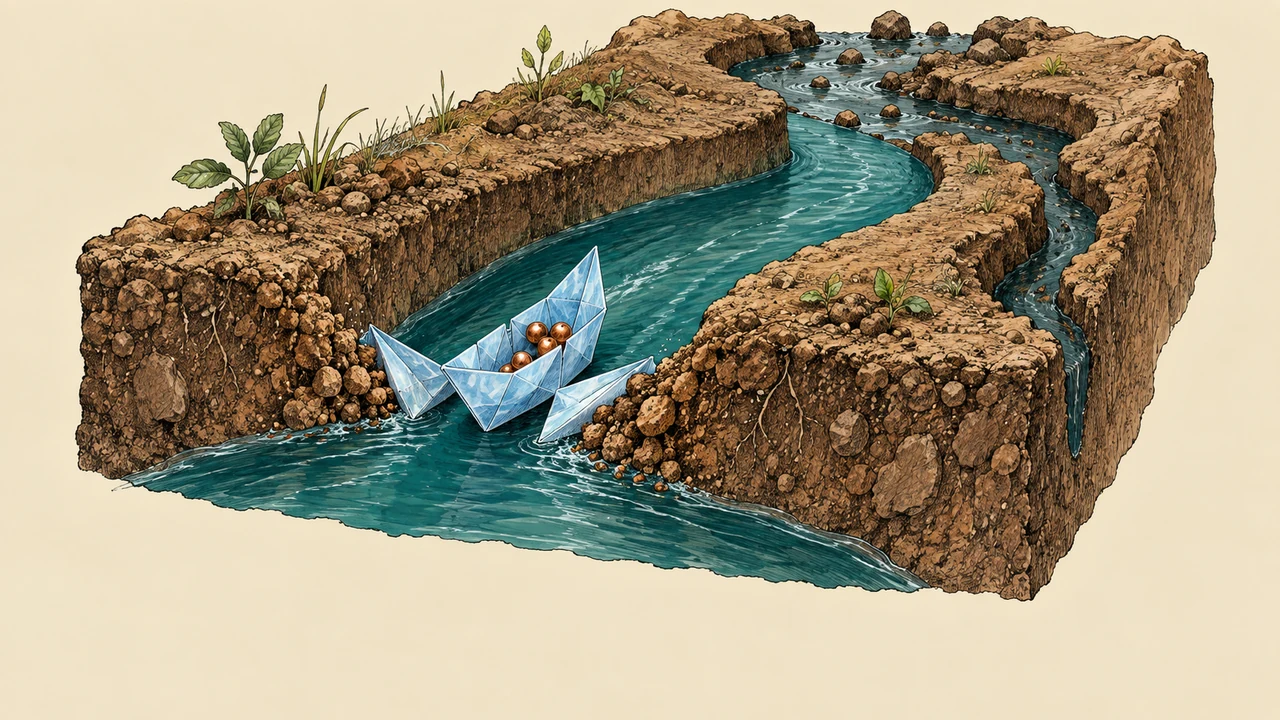
The same plastic particle does two jobs in soil. It changes how fast water sinks in, and it moves along with that water, carrying other pollutants. We keep describing those two jobs in separate papers.
Start with delivery. Van den Berg and colleagues sampled 16 fields in eastern Spain that had taken between 0 and 8 rounds of sewage sludge. Soils with no sludge held about 930 light and 1,100 heavy microplastics per kilogram. Sludged soils held about 2,130 light and 3,060 heavy, with each round adding a few hundred more. So the load in the ground is roughly a tally of how many times the field was treated.
Sajjad and colleagues widen that picture. Plastic mulch film is the biggest source, and with sludge, compost, dust, tyre wear, and coated fertiliser, about 700,000 tonnes reach farmland in Europe and North America each year. Up to 90% of Swiss floodplain soils are already polluted. The plastic arrives, and it builds up.
Now the moving part, which is what pulls me in. That same Sajjad review reports two things about one particle. Once microplastics are in a soil they change its structure, porosity, bulk density, water-holding, and infiltration. Separately, they carry other pollutants: phthalates, antibiotics, toxic metals, PAHs, PCBs. So the same particle changes how fast water sinks through the soil and then rides that water while holding other chemicals. Those read like two different conversations, one about water flow and one about chemical hitchhiking, but the water that leaches the chemicals is the same water whose path the plastic already changed. Guo and colleagues sharpen it: they describe the plastic migrating down and sideways through the soil. A thing that reshapes the pores is also a thing being moved through those pores.
We already have a hint of the mechanism sitting in a different paper. Han and colleagues mixed polyethylene and PLA into a silty loam at 0.5% by weight and watched large soil crumbs fall from 84% to 65-71% while small crumbs climbed from 17% to 29-35%, dropping average crumb size from 1.4 mm to about 1.0 mm. Smaller, more numerous crumbs mean a different pore structure, and pore structure is what governs how water and fine particles drain. So Han's structure result and Sajjad's infiltration-and-carrier result should close a loop: plastic changes the crumbs, the crumbs change water flow, water flow moves the plastic and its chemicals.
I have not found the study that measures accumulation, structural change, and co-contaminant transport together in one soil. Han's team also found the biodegradable PLA damaged structure about as much as regular PE, so switching plastics may not spare the water flow either. Until someone measures the whole loop at once, we're guessing at how the load van den Berg counted actually travels.
- Type
- Interaction, under-studied
- Field
- Soil physics and transport
- Comparative basis
- Structure change vs. particle transport
- Methods
- Soil columns, aggregate analysis, co-contaminant tracing
Why this is answerable now
Accumulation is now quantified
Van den Berg and colleagues showed sludge loads plastic into soil in predictable steps, a few hundred particles per kilogram per application. We can now say how much arrives, which is the precondition for asking where it goes.
The carrier role is documented
Microplastics are known carriers of phthalates, antibiotics, toxic metals, PAHs, and PCBs, and they change infiltration in the same soils (Sajjad et al., 2022). Both halves of the transport question are mature. They just haven't been joined.
A structural lever is in hand
Han and colleagues showed microplastics shift soil from large crumbs to small ones and drop average crumb size. That's a concrete, measurable lever on pore structure, which connects the plastic being present to water moving differently.
The substitution question is live
Biodegradable PLA reshaped soil structure about as much as regular PE (Han et al., 2024), so switching polymers may not protect soil water flow. Only coupled transport-and-structure measurements can tell whether it changes leaching at all.

Sources cited
Papers I read for this question. These notes distinguish reviews from primary studies and identify the limits of my access.
Maps inputs and movement separately, not how they drive each other.
Microbe effects depend on dose, type, and soil; mostly short lab jars.
Names both faces of transport: changed water flow and chemical carrying.
04Microplastics alter soil structure and microbial community
Primary experimentThe structural bridge: plastic shrinks crumbs, but never tracked transport.
Clean accumulation baseline; stops at the topsoil count.
What’s missing — the gap
When microplastics build up in farm soil, do the changes they make to structure and infiltration measurably change how the particles and their sorbed chemicals then move down and sideways, or do accumulation, structural change, and transport stay effectively independent?
The literature reads as three separate stories: the plastic arrives, the plastic changes the soil, the plastic moves. Each is measured with care. None is measured together with the others in one soil. If the loop is real, then the amount of plastic van den Berg counted at the surface is not a settled load but a starting point that keeps draining down. If the three stay independent, the topsoil count is closer to the whole story. Nobody has run the experiment that would tell them apart.
First moves
- 1
Couple accumulation, structure, and leaching in one column
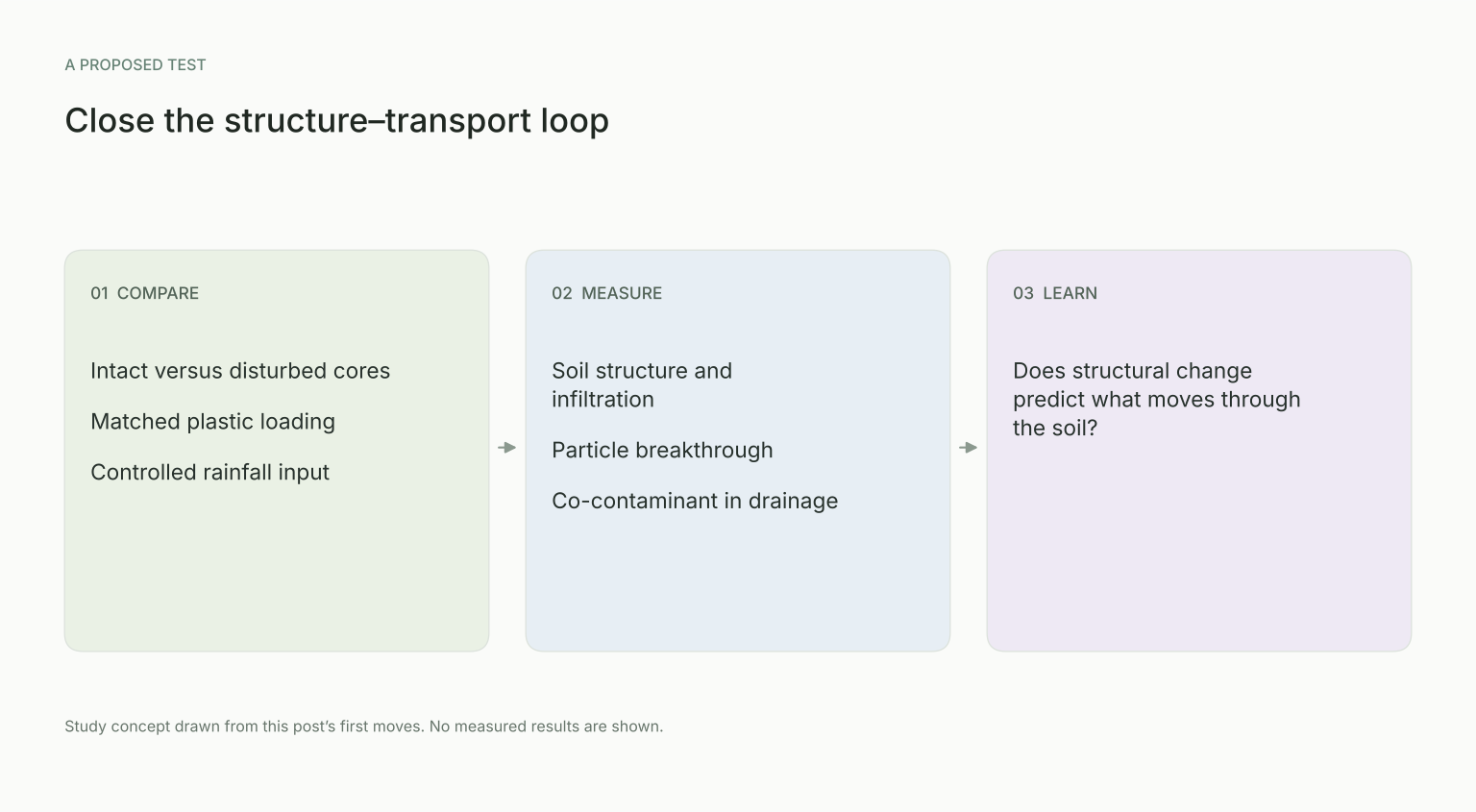
Run van den Berg's sludge gradient through instrumented soil columns. Measure plastic count, crumb-size spread, and infiltration on the same cores, then add a rainfall equivalent and catch what drains out, both particles and one sorbed chemical. The smallest honest test is whether the leachate tracks the structural change.
- 2
Separate the water path from the particle path
Compare intact against disturbed cores at a realistic field loading, to ask whether the plastic changes transport mainly by reshaping pores (Han's mechanism) or by moving as buoyant particles itself. That tells you which lever governs the leaching Sajjad's carrier role implies.
- 3
Put biodegradable polymers on the transport test
Han found PLA and PE damaged structure alike. Extend that to transport: dose both into columns and measure how much of a sorbed chemical breaks through across a full crop season, at field amounts, to see whether switching polymers changes leaching at all.
My working hypothesis
My read is that these three stories are one process, and the separateness is an accident of who studies what. Soil physicists measure water flow, plastisphere people measure the particle, and sludge researchers count the load. The particle that changes how water moves is the particle the water carries, so I'd expect a coupled experiment to show the leaching does track the structural change. If I'm right, switching to biodegradable plastic won't help, because it damages structure the same way. That's the version I'd most want tested, because it's the one that would change what we do on farms.
An invitation
If you work on solute transport, or the plastisphere, or where sewage sludge ends up after it hits a field, I'd like to know whether you've ever watched the plastic count, the pore structure, and what leaches through all move in the same experiment, and whether they turned out to be one process or three. A single particle seems to be both the thing changing how water moves and the thing that water carries, and we keep splitting those two jobs across papers. Am I wrong to find it strange that we so rarely watch the plastic arrive, settle, and travel all at once?
Questions about this gap
What feedback loop does this post propose?
Plastic may change soil structure, which may change water flow and subsequent particle or contaminant transport. The proposed columns measure those links together.
Why compare intact and disturbed cores?
Intact cores retain more of the original pore structure. Comparing them with disturbed material helps test how much transport depends on the soil’s existing architecture.
Why collect both particles and dissolved chemicals?
A co-contaminant may detach from plastic during movement. Measuring only one fraction would miss part of the transport pathway.
Would more infiltration necessarily mean more plastic leaching?
No. Particle retention and flow pathways also matter. The study needs direct measurements of what actually leaves the column.
Why extend the comparison over a crop season?
Time allows changing moisture, roots, and material weathering to enter the picture. A brief pulse experiment would answer a narrower transport question.