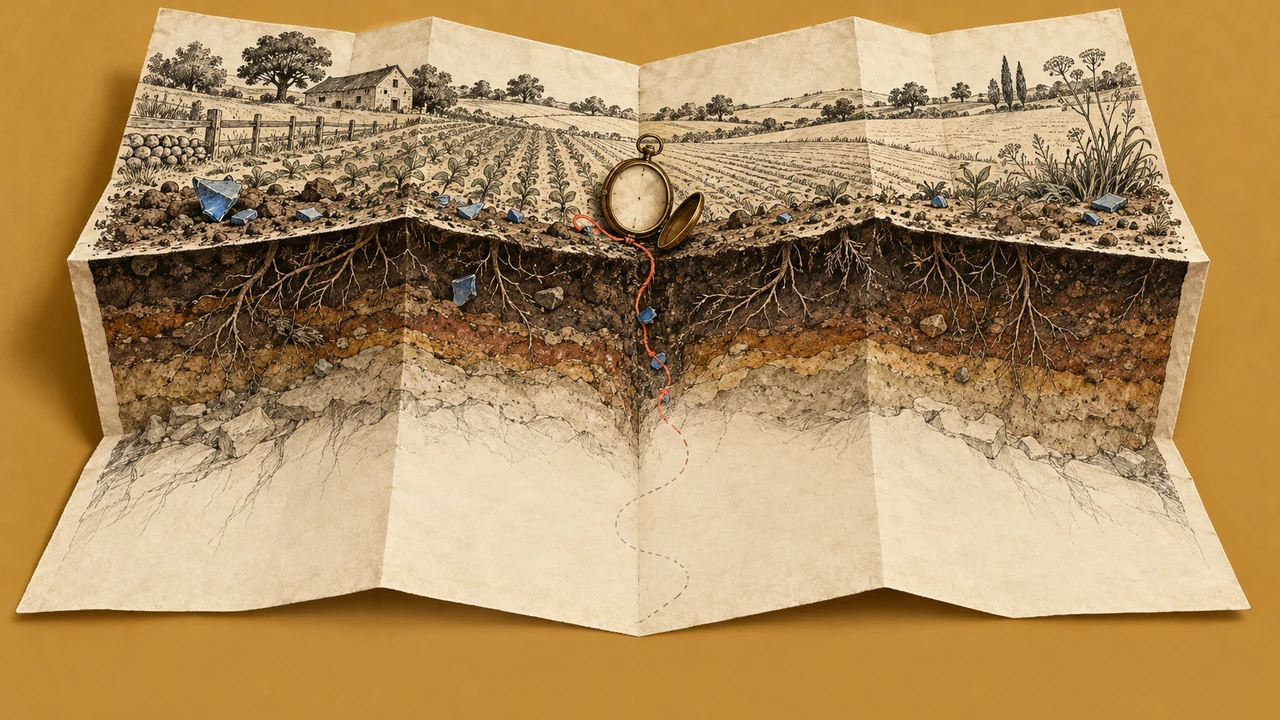
A few years ago, almost nobody measured how microplastics move through farm soil. Now the work is picking up fast, and the picture of where the plastic goes is still mostly blank.
Start with how the plastic gets into the ground. Guo and colleagues, in a 2020 review, listed the ways in: mulch films, sewage sludge, irrigation water, and dust falling from the air. Once it lands, they wrote, it sinks down through the soil, spreads sideways, and gets eaten and passed up the food chain.
Van den Berg and colleagues put a number on one of those routes. In eastern Spain they sampled 16 fields and found that soils given sludge held about 2,130 light and 3,060 heavy microplastics per kilogram, against roughly 930 and 1,100 in soils that got none. Each new round of sludge added a few hundred more per kilogram. So the count in the ground climbs in step with how many times the field was treated.
Sajjad and colleagues reviewed the field in 2022 and named plastic mulch film as the biggest source, with about 700,000 tonnes of plastic reaching farmland across Europe and North America each year. Up to 90% of Swiss floodplain soils are already polluted. Their point that matters most for movement is that the plastic carries other pollutants with it: phthalates, antibiotics, toxic metals, PAHs, PCBs. When the plastic travels, those chemicals can travel too.
If you want to predict where the plastic goes, you have to know how it changes the soil it moves through. Han and colleagues ran a greenhouse test with regular polyethylene and biodegradable PLA at 0.5% of the soil's weight. Both broke big soil crumbs into smaller ones. The small-crumb fraction rose from 17% to 29-35%, and the average crumb size dropped from 1.4 mm to about 1.0 mm. Smaller, weaker crumbs leave wider gaps for water to run through, and water is what carries fine plastic down. The biodegradable plastic did about as much of this as the regular kind.
Here's the catch the reviews keep flagging. Aralappanavar and colleagues say plainly that almost all of what we know comes from short experiments in jars, at plastic levels far above what a real field ever sees. They ask for long-term field studies at realistic amounts. So we can watch the soil structure change in a pot over a year. We still can't say what a decade of real dosing does to how fast plastic drains through an actual field.
- Type
- Emerging, not settled
- Field
- Soil physics and transport
- Comparative basis
- Lab mechanism vs. field data
- Methods
- Depth sampling, soil columns, aggregate analysis
Why this is answerable now
The inputs keep growing
Mulch film, sludge, compost, and dust from the air are all still adding plastic to farmland. Sajjad and colleagues put mulching as the largest source and about 700,000 tonnes reaching farmland yearly in Europe and North America. The more that goes in, the bigger the transport question gets.
Accumulation is now visible
Van den Berg's Spanish fields show the plastic count rising with each sludge application. That's a clean field signal. It turns a moving target into something you can measure.
The mechanism is testable
Han and colleagues showed microplastics measurably change soil crumb size and pore space in a controlled test. The physical levers behind leaching are something a lab can now change on purpose.
The reviews want field data
Aralappanavar and colleagues say plainly that most evidence is short-term, high-dose lab work, and they ask for long-term field studies at realistic amounts. When the reviews name the hole themselves, that's the moment to fill it.

Sources cited
Papers I read for this question. These notes distinguish reviews from primary studies and identify the limits of my access.
The 2020 review that mapped the input routes and said soil was ignored next to the ocean.
Says most evidence is short lab work and asks for field studies at real amounts.
Mulch film is the top source. The plastic also carries other pollutants along.
04Microplastics alter soil structure and microbial community
Primary experimentGreenhouse test: plastic shrank soil crumbs and opened pore space; biodegradable did too.
The plastic count rose in step with each sludge application. Abstract-level detail only.
What’s missing — the gap
Under long-term, realistic-concentration loading, does microplastic actually move deeper and sideways through the soil, carrying its co-contaminants with it, or does most of it stay in the topsoil where it lands?
The input routes are mapped and the crumb-scale mechanism is now measurable in a pot, but no one has joined them in the field. If the plastic drains downward with its chemicals along for the trip, then every field we called lightly polluted at the surface was measured too shallow. If it stays put, the transport worry is smaller than it looks. Right now no one can say which, because the deep, long-term field measurement doesn't exist.
First moves
- 1
Turn a sludge gradient into a transport test
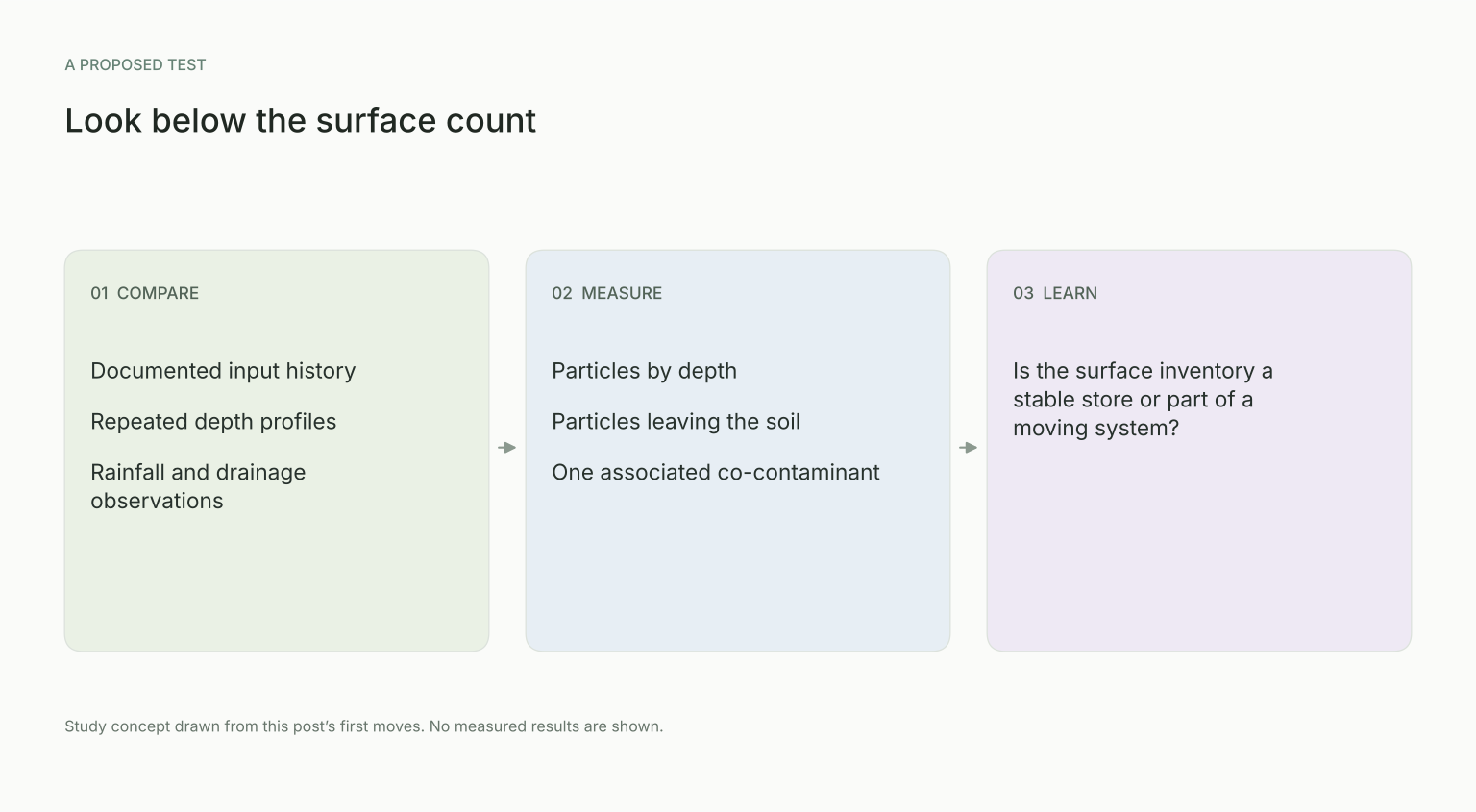
Van den Berg's fields already differ by how many times they got sludge. Sample those same profiles by depth, not just the topsoil, and you get a first real read on how far down the plastic has actually moved.
- 2
Take Han's crumb finding outdoors
Han showed microplastics shrink crumbs and open pore space in a pot. Run the same measurement on field soil that's been dosed for years at realistic amounts, the condition Aralappanavar keeps asking for, and check whether the change shows up where it counts.
- 3
Measure a co-contaminant at depth
Sajjad's carrier point is testable. Measure an antibiotic or a phthalate deep in the profile alongside the plastic itself, and see whether the two move down together. That tells you whether transport is one problem or two.
My working hypothesis
My honest guess is that the plastic does travel downward, slowly, riding the water through the wider pores it helped open, which would mean surface-only sampling has been undercounting the real load. But I'd bet a lot of it also stays near the top for a long time. What bothers me is that we keep calling fields lightly polluted based on the top few centimetres, when nobody has looked deep in a long-dosed field. One careful, boring, deep-profile study would settle more than another year of pots.
An invitation
If you work on soil physics, sludge, or plastic in the field, this is the corner I'd most want someone to grab. The inputs are mapped, the mechanism is finally measurable, and the field-scale transport story is nearly blank. These five papers point me to one plain question: does the plastic really travel, or mostly stay put where we drop it? If it's quietly draining down with its chemicals riding along, then how deep have we actually looked?
Questions about this gap
Why is a topsoil count incomplete for this question?
It describes one part of the soil profile. Measuring deeper layers and drainage is necessary to test whether particles leave that layer or accumulate below it.
Does movement of water prove movement of plastic?
No. Water and particles can follow different pathways. The proposed study measures particle transport rather than using infiltration alone as a substitute.
Why track a co-contaminant as well?
The question includes both the particle and what it may carry. Their movement can differ, so each needs to be measured rather than assuming they stay together.
Why use a known history of sludge applications?
A documented input history provides a starting point for comparing accumulation across fields. It does not eliminate differences in soil, management, or rainfall.
What would make the field study stronger?
Repeated depth profiles combined with measured inputs and drainage would connect exposure, accumulation, and possible movement over time.