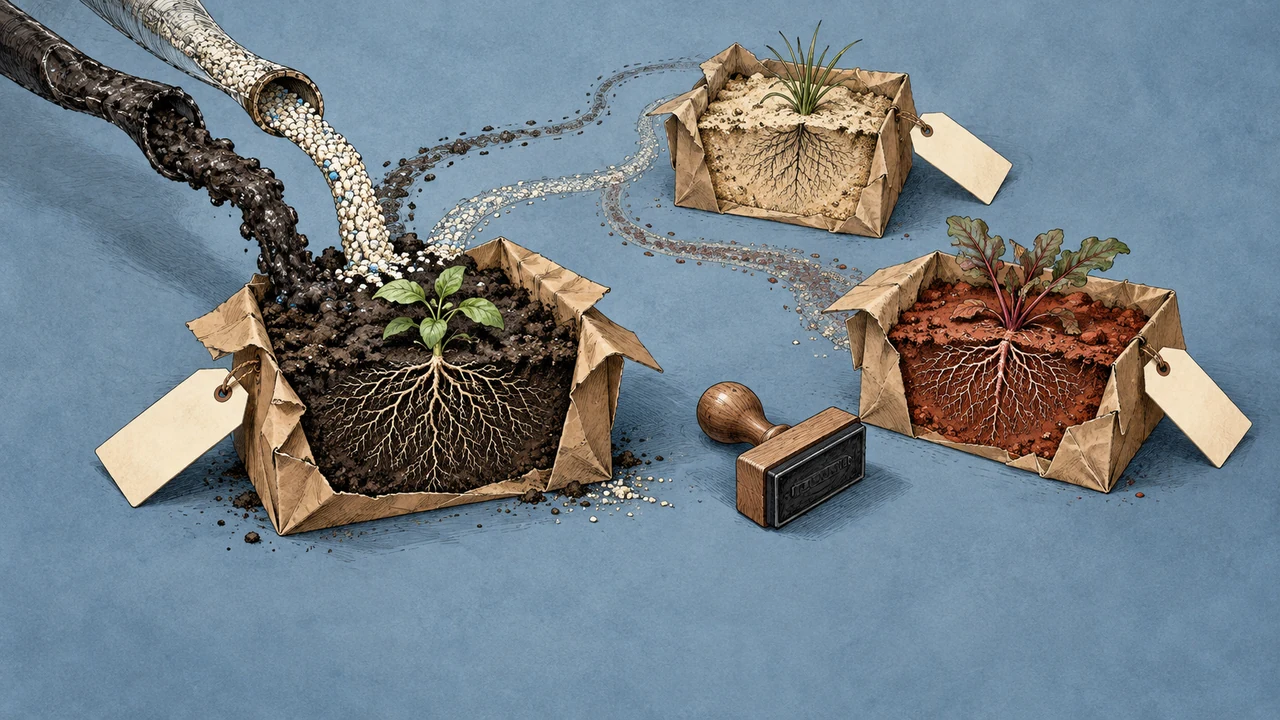
By now it reads as settled. Plastic gets into farm soil through mulch film, sewage sludge, irrigation, fertiliser, and dust. The reviews list those pathways as established. When I line the actual primary studies up behind that list, I keep asking a harder question: how many of these inputs has anyone reproduced?
Start with the framing the reviews give. Guo and colleagues argue that soil is understudied next to marine and freshwater systems, and lay out the inputs plainly as an established list (Guo et al., 2020). Aralappanavar and colleagues add the caveat that matters here: most of the evidence is short, high-dose lab pots rather than long field work at realistic amounts, and they call outright for the latter.
So the reviews treat the sources as known, while quietly admitting the studies underneath tend to dump a lot of plastic into a pot for a short time. That distance between the confident list and the thin base is what I want to poke at.
Now look at the two primary studies that actually measure inputs in a real field. Van den Berg and colleagues sampled 16 fields in eastern Spain that had received between zero and eight sludge applications, split the particles by density, and found each application added roughly 280 light and 430 heavy particles per kilogram of soil. They watched the plastic count climb with every application.
Cusworth and colleagues did something just as clean for a different input. They reconstructed plastic levels in a single UK field from archived soil going back to 1846: none before 1914, then a clear rise from 1966 on, with the manured and fertilised plots ending up higher than the untreated plot. Two careful studies, two different inputs, two different countries, and, as far as I can find, never cross-checked against each other.
This is what makes it a replication gap. Each study flags its own narrowness. Van den Berg's is one sludge-receiving region of Spain. Cusworth's rests on a single long-term site, quantified by one analyst using Nile Red staining. The authors say so themselves.
The greenhouse studies cited for effects run at doses the field data do not support. Han and colleagues mixed plastic in at 0.5% by weight, which is 5 grams of plastic per kilogram of soil, while van den Berg's real sludged fields carried a few thousand particles per kilogram, a far smaller load. So when a review states that sludge and fertiliser are confirmed inputs, the honest footnote is: confirmed once, per input, per region, per method. That is a claim cited far more often than it has been reproduced.
- Type
- Under-confirmed primary work
- Field
- Soil pollution and inputs
- Comparative basis
- One study per input vs. independent repeats
- Methods
- Density counting, archive time-series, dose-matched trials
Why this is answerable now
Cited ahead of confirmation
Reviews present sludge, fertiliser, mulch, and deposition as an established input list (Guo et al., 2020), but each pathway rests on a small number of single-region studies. This is the moment to reproduce them across soils before the list hardens into something everyone repeats and no one rechecks.
The strongest studies self-limit
Van den Berg's evidence is one region of Spain, and Cusworth's is one UK site quantified by a single analyst (van den Berg et al., 2020; Cusworth et al., 2024). Both are excellent and both ask to be extended. Replicating them is unglamorous, high-value work the original authors invite.
A dose mismatch nobody closed
Aralappanavar's team calls for realistic field concentrations (Aralappanavar et al., 2024), yet Han's greenhouse ran at 0.5% by weight (Han et al., 2024) while real sludged soils carry a few thousand particles per kilogram (van den Berg et al., 2020). Confirming inputs at field-realistic loads is the missing rung.
Amendments are policy levers
Sludge and fertiliser are things a farm or regulator can turn up or down. If soil plastic loads track those inputs dose by dose, as van den Berg found, reproducing that relationship across regions turns a single finding into something you can write rules around.

Sources cited
Papers I read for this question. These notes distinguish reviews from primary studies and identify the limits of my access.
Lists the inputs as established, but is a synthesis, not confirmation.
Admits the base is short, high-dose lab work. Calls for field studies.
03Microplastics alter soil structure and microbial community
Primary experimentCited for effects, but at 5 grams per kilogram, far above field loads.
Sludge plastic climbs dose by dose. One region only. Abstract only.
Fertiliser adds plastic above baseline. One site, one analyst.
What’s missing — the gap
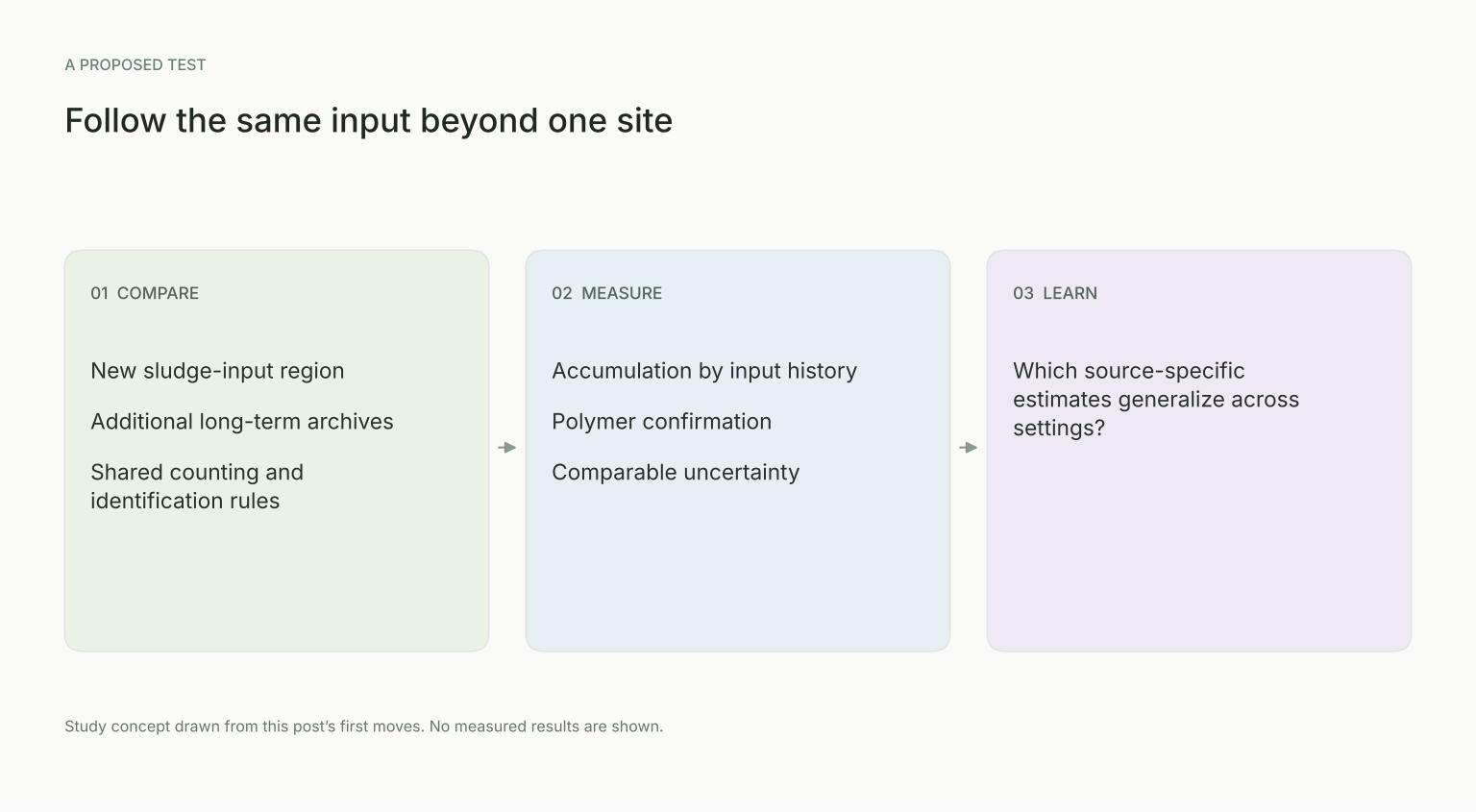
The reviews list sewage sludge and fertiliser as established plastic inputs, but each rests on one single-region, single-method study: van den Berg in eastern Spain and Cusworth at one UK site with one analyst. If independent teams measured plastic inputs from sludge and fertiliser across several regions and soils under one shared protocol, would they reproduce the same dose-proportional accumulation these single-site studies report?
Right now each input pathway carries the weight of a single excellent study. Van den Berg watched sludge plastic climb dose by dose in one region, and Cusworth traced fertiliser plastic over a century at one site. Neither has been repeated by another team in another soil. Until someone runs the same design in different dirt, sludge and fertiliser are widely cited inputs resting on far less confirmation than the reviews suggest.
First moves
- 1
Reproduce the sludge-dose curve
Take van den Berg's design, fields grouped by number of sludge applications with particles split by density, and run it in a different country and soil. The first honest question is not whether sludge adds plastic but whether someone else gets the same per-application increment in different dirt.
- 2
Extend the archive method
Cusworth's archived-soil time series worked at one UK experiment. Apply the same reconstruction to two or three other long-term sites, and pair Nile Red with a confirmatory identification, to test whether the fertiliser signal holds beyond one field and one analyst.
- 3
Confirm inputs at real doses
Aralappanavar calls for realistic concentrations, yet the effects studies run high (Han et al., 2024). Design one experiment dosed to the few-thousand-particles-per-kilogram range van den Berg measured, so the input and effect literatures finally describe the same amount of plastic.
My working hypothesis
I think sludge and fertiliser are probably real inputs, but the confidence in the reviews outruns the evidence, which is two studies carrying one input each. I would rather see one of them reproduced in a second soil than another review restate the list. Confirming these pathways at field-realistic doses would also close the gap between the input numbers and the much higher doses the effects studies use.
An invitation
If you work on soil plastic inputs, I would like to know whether you think the sludge and fertiliser pathways are as confirmed as the reviews make them sound, or whether, like me, you see two great studies each carrying a lot of weight. It seems odd that inputs cited this widely have been reproduced this little. Am I wrong to find that strange?
Questions about this gap
Is the proposal questioning whether sludge contains plastic?
The sharper question is whether specific accumulation estimates reproduce across regions with comparable methods. Confirming a pathway and generalizing its rate are different tasks.
Why repeat an archived-soil analysis elsewhere?
A second long-term site tests whether the observed association belongs to one management history or appears under other documented conditions.
Why add confirmatory identification to fluorescence counting?
A fluorescence signal alone may not establish polymer identity. Confirmatory analysis helps test what fraction of the counted material is actually the target plastic.
What needs recording about each input?
Its application history, material composition, and measured particle properties matter. A label such as sludge or fertiliser can cover different mixtures.
How can input and effects studies be connected?
Characterize exposure in the input study and use that characterization to design the effects study. A particle count without size or mass information is not a complete dosing specification.