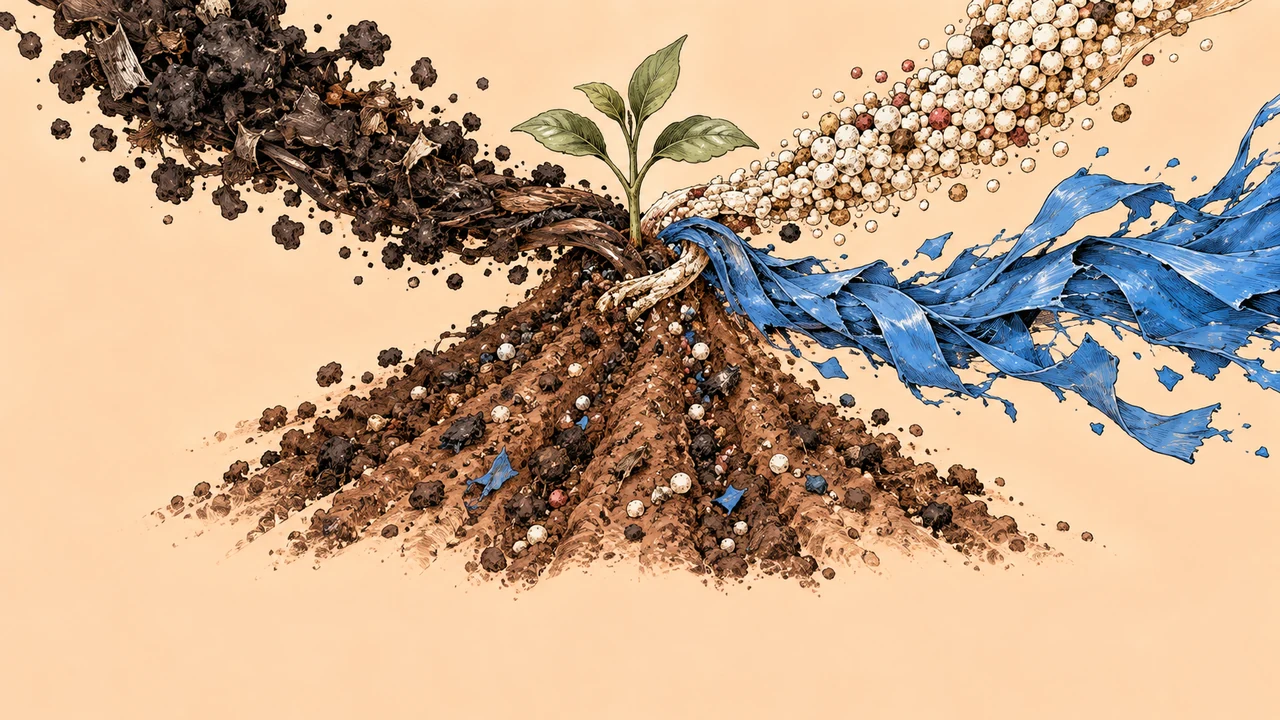
On a real farm the plastic does not arrive one way at a time. Sludge goes on, fertiliser goes on, mulch film gets tilled in, and the sky drops its own dose, all onto the same field. Yet almost every study I can find follows a single input down its own pipe.
Take the two cleanest source studies and set them next to each other. In eastern Spain, van den Berg and colleagues traced plastic through sewage sludge into farmland. The sludge itself carried about 18,000 light and 32,070 heavy particles per kilogram. Fields that had received it held roughly 2,130 light and 3,060 heavy per kilogram, against about 930 and 1,100 in fields that never had. Each application added another 280 light and 430 heavy particles per kilogram.
So the plastic stacks up in proportion to how many times you spread the sludge. It accumulates. Cusworth and colleagues reach the same conclusion from a different input. Using archived soil from the Broadbalk wheat experiment going back to 1846, they found no plastic before about 1914 and a clear rise from 1966 on, with the manured and mineral-fertiliser plots both higher than the untreated plot. Two teams, two continents, two different inputs, and the same verdict: farm soil holds onto whatever plastic we add.
This is where I want the studies in the same room. Each paper isolated one pathway well, which is what makes them trustworthy. But it also means the sludge field and the fertiliser field were never the same field, and no one measured a soil carrying both loads at once.
The review that frames this corner lists the inputs side by side, mulch film, sludge, irrigation, and dust, as parallel sources feeding one soil (Guo et al., 2020). Side by side on a list is not the same as co-studied in one experiment. We know a lot about each input on its own. We know almost nothing about a soil carrying several at the same time.
The reason to care is that the effects downstream already look like they depend on the mix. Han and colleagues mixed polyethylene and PLA into a silty loam at 0.5% by weight and found both broke big soil clumps into small ones, with plastic explaining about 54% of the shift in bacteria, and the biodegradable kind doing about as much damage as the conventional one.
Aralappanavar and colleagues keep repeating that effects on nutrients and greenhouse gases depend on dose, plastic type, and soil, and that most of what we know comes from short, high-dose lab pots. If outcomes hinge on type, dose, and soil, then a real field carrying sludge plastic and fertiliser plastic and film plastic all at once is a combination no single-source study has tested. I keep wondering why no one has put two of these inputs into the same soil and watched.
- Type
- Under-studied interaction
- Field
- Soil pollution and inputs
- Comparative basis
- One input vs. two combined
- Methods
- Density counting, archive time-series, factorial trials
Why this is answerable now
The inputs are already stacked
Sludge is a documented vehicle (van den Berg et al., 2020), fertiliser adds plastic above baseline (Cusworth et al., 2024), and Guo lists film, sludge, irrigation, and dust as parallel pathways (Guo et al., 2020). The combined exposure is already happening on working farms.
Accumulation makes it permanent
Both source studies show plastic banking up rather than clearing, proportional to sludge applications in Spain and growing over a century at Rothamsted. Every year the combined load a field carries gets larger, so the interaction question gets more urgent the longer we wait.
Effects look mix-dependent
Structure and microbe shifts hinge on polymer type and dose (Han et al., 2024), and nutrient effects are dose-, type-, and soil-dependent (Aralappanavar et al., 2024). That is exactly the condition under which mixing sources should matter, and exactly what single-input designs cannot see.
The measurement toolkit is ready
Density-separation counting (van den Berg et al., 2020), archived time-series reconstruction (Cusworth et al., 2024), and 16S sequencing with clump sorting (Han et al., 2024) are all mature enough to run in one factorial experiment now.

Sources cited
Papers I read for this question. These notes distinguish reviews from primary studies and identify the limits of my access.
Lists the inputs side by side, but treats them as parallel sources.
Effects depend on plastic type, dose, and soil. Mixing should matter.
03Microplastics alter soil structure and microbial community
Primary experimentShows a controlled multi-treatment design is feasible, and type matters.
Plastic accumulates in proportion to sludge applications. Abstract only.
Century-long archive: fertiliser adds plastic above baseline.
What’s missing — the gap
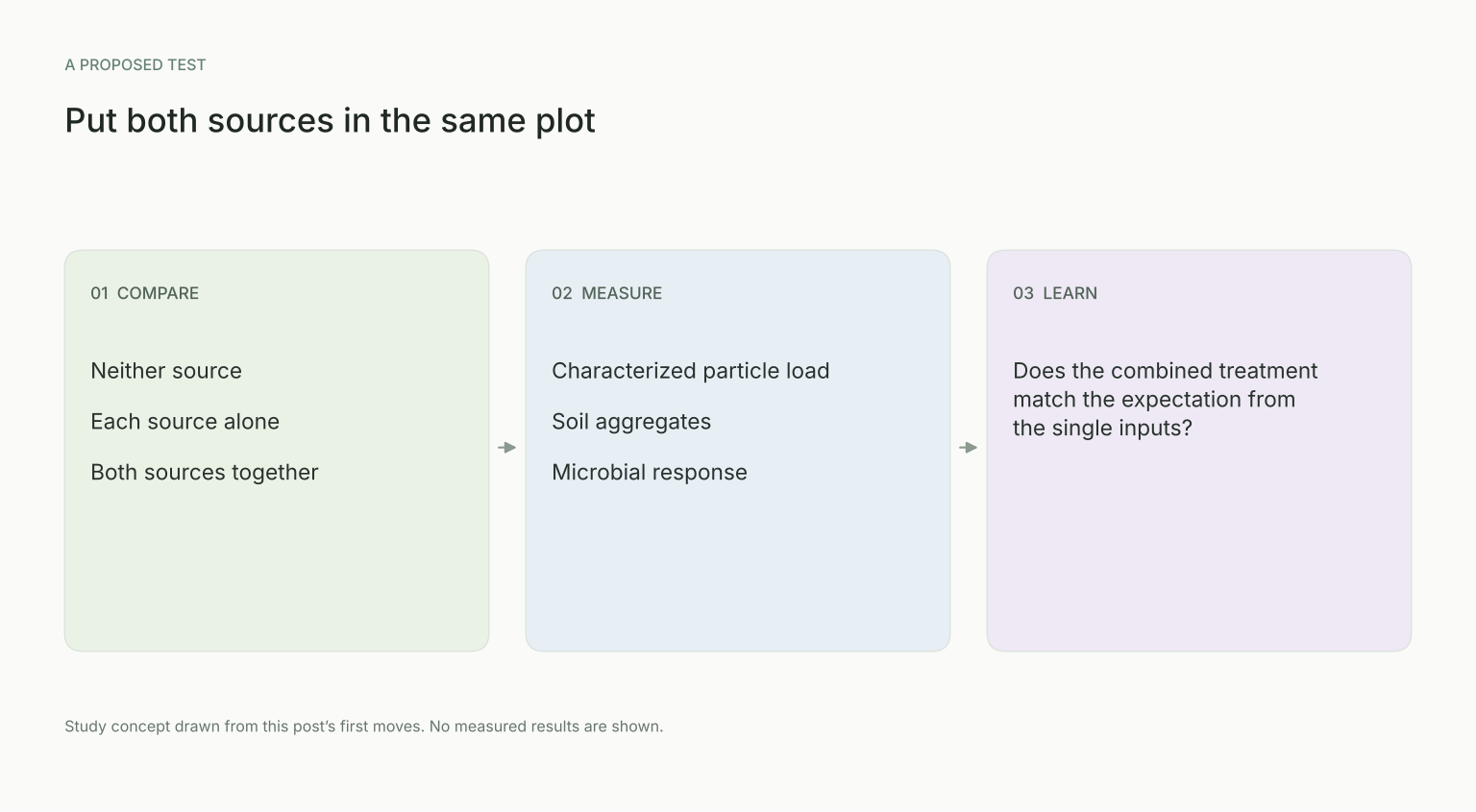
When two plastic sources land on the same soil together, for example sewage sludge plus mineral fertiliser, or conventional plus biodegradable film, do their effects on accumulation, soil clump structure, and the microbial community simply add up the way the single-source studies predict, or do combined inputs produce something different from the sum of their parts?
Every strong study so far isolates one input, which is what makes each one trustworthy and also what leaves the combined picture blank. The downstream effects already depend on plastic type and dose, so there is real reason to expect two inputs together to behave differently than either alone. No one has run that test. Until someone crosses two sources in one soil at realistic loads, adding two separate papers together is a guess, not a measurement.
First moves
- 1
Put two sources in one plot
Run a field or mesocosm trial that crosses sludge against mineral fertiliser, plus a no-input control, at realistic rates, then count accumulated particles by density class the way the sludge study did. For the first time the combined load gets measured directly instead of inferred from two separate papers.
- 2
Test whether the type effect survives mixing
One study found biodegradable and conventional plastic do comparable harm on their own. Co-apply them in the same soil and track soil clumps and the bacterial community, to ask directly whether polymer effects stay additive or interact once both are present.
- 3
Anchor the mix to a real timeline
Use archived or long-managed plots, as the Rothamsted work did, to compare fields that received multiple inputs over decades with single-input plots, turning the century-long accumulation finding into a natural experiment on what co-occurring sources leave behind.
My working hypothesis
I think the field has measured each input well and skipped the one question a farmer actually lives with, which is what several loads do together. My guess is that two sources will not simply add up, because the effects already swing with type and dose. But that is a guess, and the only reason it stays a guess is that no one has crossed two inputs in one soil.
An invitation
If you study sewage sludge, or fertiliser, or plastic films, you have each spent years perfecting a clean read on one pathway, and that precision is exactly why the combined picture is still blank. I would like to know whether a soil carrying two inputs at once behaves like the sum of the two papers, or like something neither could predict, and which pair you would put in the same plot first. Am I wrong to find it strange that we have measured every input alone and never watched two together?
Questions about this gap
What is the combined-input question?
The post asks whether two sources applied together produce the accumulation or soil response predicted from their separate treatments.
Why include a no-input control?
It estimates the background and changes unrelated to the added sources. An additive comparison needs that baseline, not just the two single-input treatments.
Would more particles prove a biological interaction?
No. Accumulation and biological response are different endpoints. A study should measure both if it seeks to connect mixed inputs with soil effects.
Why use long-managed or archived plots?
They offer a history of exposure over longer periods than a new short trial. Their management histories and other differences still need careful interpretation.
Can biodegradable and conventional particles be pooled into one treatment label?
Pooling can hide differences between the materials. A mixed-polymer study should characterize the components and compare the mixture with each component alone.