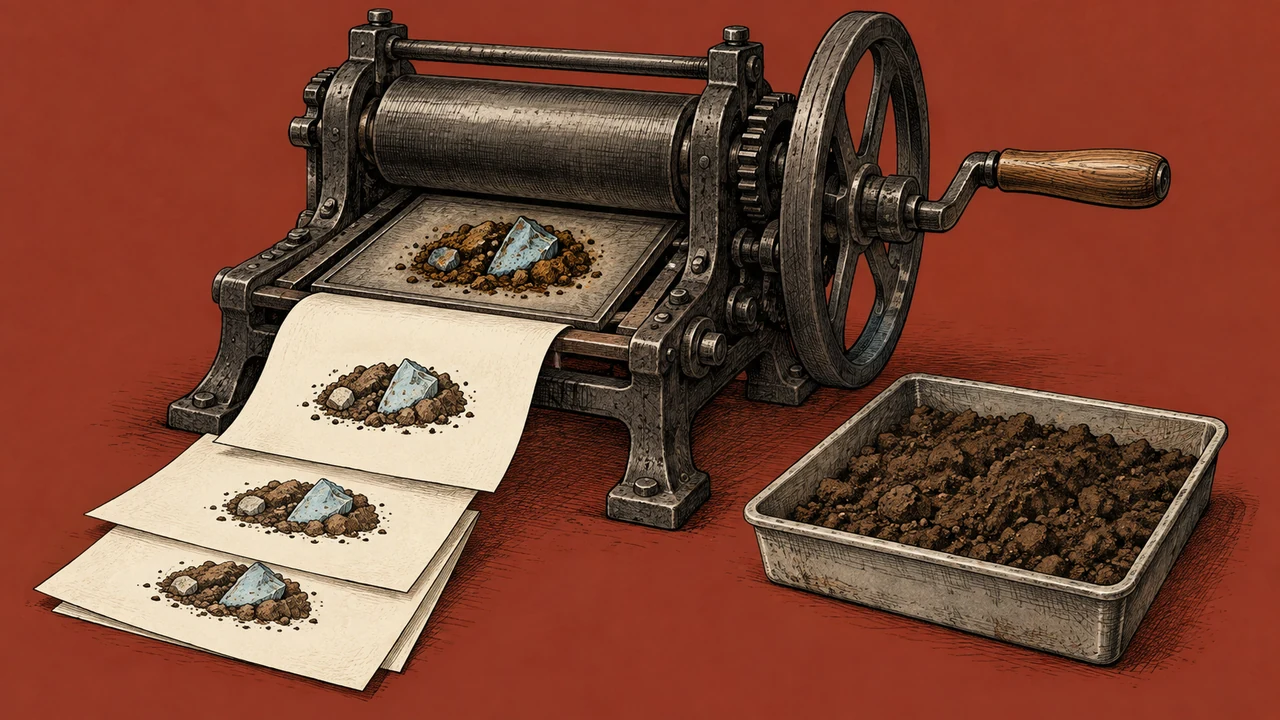
A striking result in soil microplastics gets cited, then cited again, until it starts to feel settled. Behind the confidence sits a quieter question: has anyone actually reproduced it?
Take one of the sharper primary findings. In a one-year rice-wheat rotation, Han and colleagues mixed both conventional polyethylene and biodegradable polylactic-acid microplastics into a silty loam at 0.5 percent by weight and watched the soil's crumb structure come apart. The microaggregate fraction rose from 17 to 29-35 percent while macroaggregates fell from 84 to 65-71 percent, dropping mean weight diameter from 1.4 mm to about 1.0-1.1 mm.
So the little clumps that give soil its sponge-like tilth broke down into finer, less stable bits, and this happened whether the plastic was the persistent kind or the compostable kind. That last part is the claim that begs to be re-run, because it says the green substitute did roughly the same structural damage as the plastic it was meant to replace.
Now set that beside a different primary experiment that seems, at first, to disagree. Zhou and colleagues studied the microplastisphere, the thin zone of soil right at the plastic's surface, and found that a biodegradable PHBV biopolymer was readily eaten by microbes as a carbon source, raising growth rates and building a more active biomass, with beta-glucosidase and leucine aminopeptidase running 0.6 to 5.0 times higher than in the rhizosphere.
One study reads biodegradable plastic as damage to soil structure while the other reads it as a feast for microbial life. I do not think these actually contradict each other, because one measures physical clumps and the other measures enzyme hotspots. The gap is that I have to reason my way to that reconciliation, rather than point to a replication that tested both endpoints together.
The reviews say the quiet part out loud. Aralappanavar and colleagues, surveying how microplastics reshape microbial diversity and the nitrogen, phosphorus, and carbon cycles, note that most of the evidence is short-term, high-dose lab microcosms, and they call for long-term field studies at realistic concentrations. Sajjad's review adds the mechanical reason to be careful about pooling any of these numbers: there is still no standard method for sampling and extracting microplastics from soil. When the doses are unrealistic, the durations are short, and the extraction methods differ study to study, a single striking effect size is a hypothesis, and few of these effects have been independently confirmed.
- Type
- Under-confirmed primary work
- Field
- Degradation and weathering
- Comparative basis
- Primary results vs. independent re-runs
- Methods
- Rotation trials, aggregate sieving, zymography
Why this is answerable now
Primary work is piling up
Degradation and weathering now has a real body of primary experiments on structure, aggregates, and the microplastisphere, but almost no synthesis confirming those results hold. That is the moment replication pays off most.
The biodegradable question is live
Han's finding that compostable PLA damaged soil structure about as much as conventional PE is the kind of result that changes farm decisions if true. It deserves a direct re-run before anyone leans on it.
No standard method yet
Sajjad's review flags that there is still no agreed way to sample and extract soil microplastics. Until that stabilizes, every replication attempt is also a method test, which makes doing them now unusually informative.
The field is asking for it
Aralappanavar's review explicitly calls for long-term field studies at realistic concentrations instead of short high-dose microcosms. The community has named the missing piece. Someone has to build it.

Sources cited
Papers I read for this question. These notes distinguish reviews from primary studies and identify the limits of my access.
A young field that grew fast, before the confirming work caught up.
Most evidence is short high-dose microcosms. Calls for long-term field studies.
No standard sampling or extraction method, so numbers are hard to line up.
04Microplastics alter soil structure and microbial community composition
Primary experimentPE and PLA broke down soil clumps about equally. The claim most worth re-running.
Microbes fed on PHBV and sped up at the particle surface. Abstract only.
What’s missing — the gap
Do the headline effects of microplastic weathering on soil structure and microbial function, such as Han's finding that biodegradable and conventional microplastics damage soil aggregation about equally, hold up when independently reproduced under long-term, field-realistic concentrations with a shared extraction method?
Right now the answer rests on a handful of striking single studies run at high doses over short times with methods that differ lab to lab. Until someone re-runs the biggest of them under realistic conditions with a shared protocol, an effect size is a hypothesis, and we cannot tell real biology from method drift.
First moves
- 1
Re-run the biodegradable-equals-conventional test
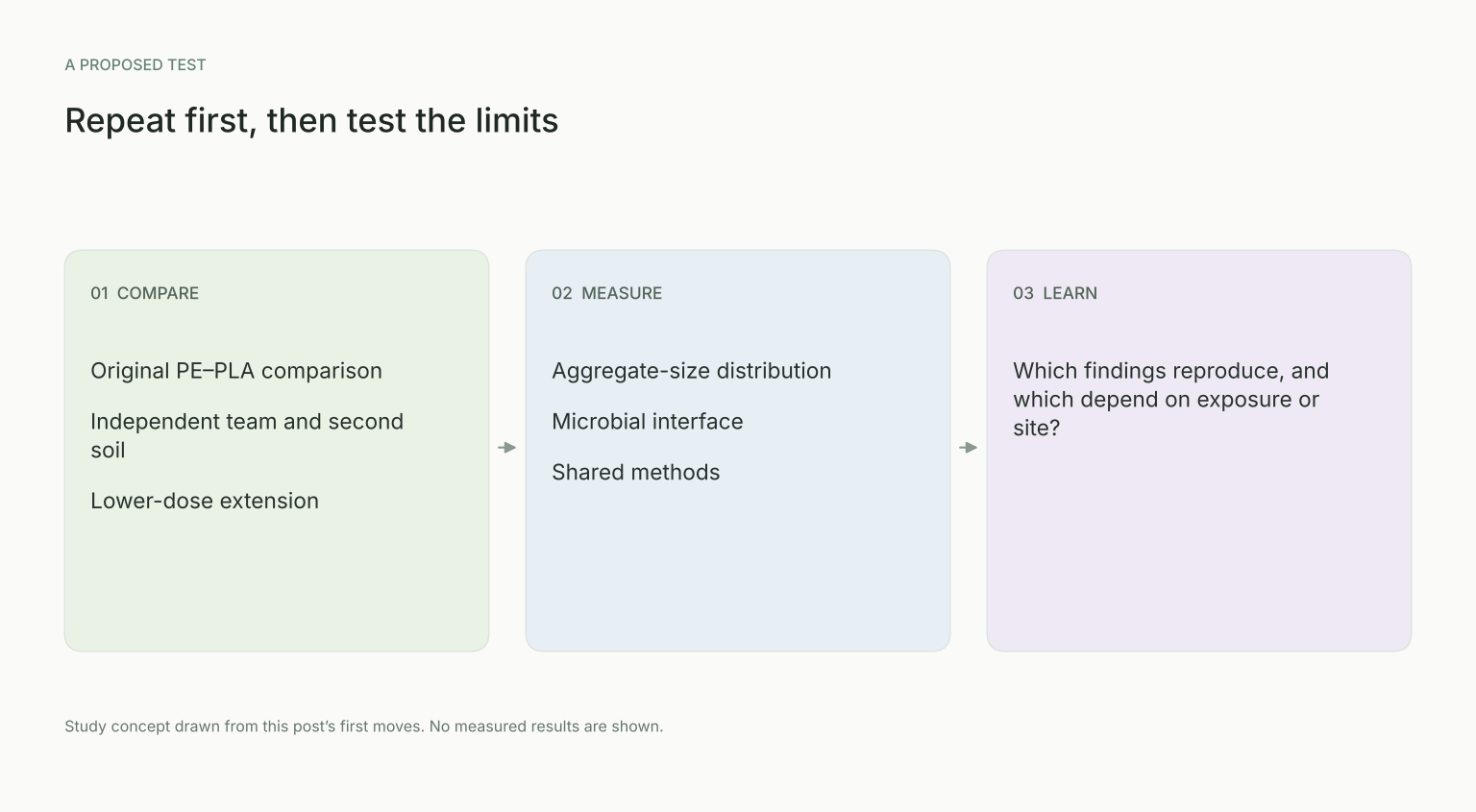
Directly replicate Han's PE-versus-PLA aggregate experiment in a second soil type and climate, keeping the 0.5 percent dose and rotation but adding a field-realistic low dose alongside it. If the structural collapse holds across soils and doses, the claim graduates from striking to confirmed.
- 2
Measure structure and microplastisphere together
Run one experiment that captures both Han's aggregate endpoints and Zhou's enzyme-hotspot endpoints on the same soils and plastics. It is the cleanest way to test whether structural damage and microbial activation are two faces of one process or separate stories.
- 3
Pin one method before comparing numbers
Pick a single sampling-and-extraction protocol, per Sajjad's flag, and have two or three labs apply it to identical spiked soils. A small round-robin would show how much between-study scatter is real biology versus method drift.
My working hypothesis
Of all these headline numbers, the one I would bet gets re-run and holds is Han's biodegradable-equals-conventional result, because it is the most consequential and the least confirmed. What unsettles me is the shape of the risk. We reached for compostable plastic to do less harm, and if it breaks soil structure the same way the old plastic does, we could spend seasons of tilth before the field runs the experiment that would catch it.
An invitation
I am a student mapping this from the outside, so take my hunch for what it is: of all these headline numbers, the one I would bet gets re-run and holds is Han's biodegradable-equals-conventional result, because it is the most consequential and the least confirmed. We reached for compostable plastic to do less harm. If it breaks soil structure the same way the old plastic does, and the field has not yet run the experiment that would catch it, how many seasons of tilth do we quietly spend before the ground itself tells us we guessed wrong?
Questions about this gap
What counts as an independent repeat?
Another team follows a sufficiently documented protocol and tests the same claim. A study on a different endpoint can add context without being a direct replication.
Why repeat the original dose before lowering it?
Repeating the benchmark checks whether the original effect can be reproduced. Lowering the dose then tests its relevance to a different exposure setting.
Why include both PE and PLA?
The cited comparison raises the question of whether biodegradable and conventional materials affect aggregation similarly. A matched repeat can test that specific comparison.
What should a second site contribute?
A contrasting soil or climate tests the limits of the finding. Shared measurements help separate site differences from differences introduced by laboratory procedures.
Should an unsuccessful replication be reported?
Yes. Effect sizes and uncertainty matter whether the original pattern reappears or not. A non-replication helps define what remains unresolved.