Han and colleagues mixed two kinds of plastic into soil and grew rice and then wheat in it for a year. One was polyethylene, a plastic often found in farm soil because of mulch film, the thin plastic sheeting farmers lay over crop rows. The other was PLA, one of the biodegradable plastics developed as an alternative. Both broke up the soil’s larger clumps by about the same amount.
That surprised me. PLA is supposed to break down. Why did it affect the soil so much like a plastic that doesn’t?
Part of the answer may be something the study didn’t measure. At the end of the year, the researchers didn’t take the plastic back out of the soil. In their conclusion, they point out that this leaves them unable to say how much the PLA broke down, or whether the changes came from the particles themselves or from substances released as the plastic aged. They suggest that future long-term experiments track how microplastics break down, especially biodegradable ones.
That changes how I read the result. The researchers take it as a sign that switching to biodegradable plastic wouldn’t do much to reduce the risks. It could also mean the PLA hadn’t broken down much in that year, so both treatments were mostly plastic particles sitting in soil. Or the PLA did break down, and what it left behind had effects of its own. The soil measurements alone can’t tell those apart.
A field study points the other way. Wang and colleagues laid biodegradable PBAT mulch film and ordinary polyethylene film over maize fields for three growing seasons, then counted the plastic pieces left in the soil. The biodegradable film left more pieces, about 70% of them smaller than a quarter of a millimetre. Even so, soil organic carbon, microbial biomass and nitrate were all higher than under polyethylene, and so were maize yields.
That doesn’t cancel out Han’s result. Wang tested a film lying on a field, mostly PBAT, over three seasons. Han mixed small PLA particles into soil in a greenhouse for one year, and the two studies measured different things. Together, they tell me “biodegradable” doesn’t predict the outcome on its own. For PLA particles like Han’s, I’d like to measure the plastic and the soil in the same samples across a growing season.
- Type
- Two processes in one soil
- Field
- Plastic breakdown and soil structure
- Comparative basis
- Soil changes and how much plastic remains
- Methods
- Recovering plastic from soil, soil sieving, bacterial DNA sequencing, repeated sampling
Why this is answerable now
Han’s team calls for this kind of follow-up
The researchers note that they didn’t recover the plastic at the end of their experiment. They ask for future long-term work that tracks how microplastics break down, especially biodegradable ones.
Biodegradable plastics are meant to replace ordinary ones
Polyethylene is common in farm soil because of plastic mulch film, and plastics such as PLA were developed as alternatives. Whether a swap helps the soil depends partly on how much of the replacement breaks down where it’s used.
The amount of plastic may change during the experiment
Both plastics went into Han’s soil at 0.5% by weight, or 5 grams per kilogram. If a biodegradable plastic breaks down over a season, the soil at harvest may hold less of it than the soil at planting, or hold it in smaller pieces. Measuring what’s left would show what the soil was exposed to at each sampling date.
Field studies can follow both
Wang and colleagues tracked how much plastic a biodegradable film left behind and how the soil changed, across three field seasons. That shows the measurements are practical outside a greenhouse. Aralappanavar and colleagues’ review also calls for longer field studies at environmentally relevant plastic levels.

Sources cited
Papers I read for this question. These notes distinguish reviews from primary studies and identify the limits of my access.
Background on how microplastics reach soil, move through it and affect soil life. Useful context for choosing which plastics to follow.
Reviews how microplastics affect soil microbes and nutrient cycling, with effects that depend on plastic type, dose and soil. Calls for longer field studies at environmentally relevant plastic levels.
Reviews plastic sources and effects in soil, including other contaminants that plastics can carry and the difficulty of extracting plastic from soil for measurement.
04Microplastics alter soil structure and microbial community composition
Primary experimentThe one-year greenhouse rice–wheat experiment comparing PE and biodegradable PLA at 0.5% by weight. Both reduced the share of larger soil clumps. The authors note they didn’t recover the plastics to measure breakdown.
Microbes used the biodegradable plastic PHBV as a carbon source, with more microbial growth near the particles than in the surrounding soil. Abstract only.
06In-field degradation of PBAT films, microplastic formation, and impacts on soil health
Abstract onlyA three-season maize field study comparing biodegradable PBAT mulch film with polyethylene film. The PBAT film left more small microplastics, while soil carbon, microbial biomass, nitrate and yield were higher. Abstract only.
What’s missing — the gap
For a biodegradable plastic like PLA, how much breaks down over a growing season, and do the soil’s changes follow the plastic that’s left?
If PLA and polyethylene affect the soil alike all season and most of the PLA is still there at harvest, Han’s result may mostly reflect particles that hadn’t had time to break down. If the PLA disappears and its effects fade with it, breakdown matters. If the PLA disappears and the soil keeps changing, or changes in new ways, then what it leaves behind deserves its own study.
First moves
- 1
Check that I can get the plastic back
Before starting, I’d mix known amounts of each plastic into the same soil and see how much I can recover. Plastic my method misses would look like plastic that broke down, so I need to know the difference.
- 2
Follow the plastic through the season
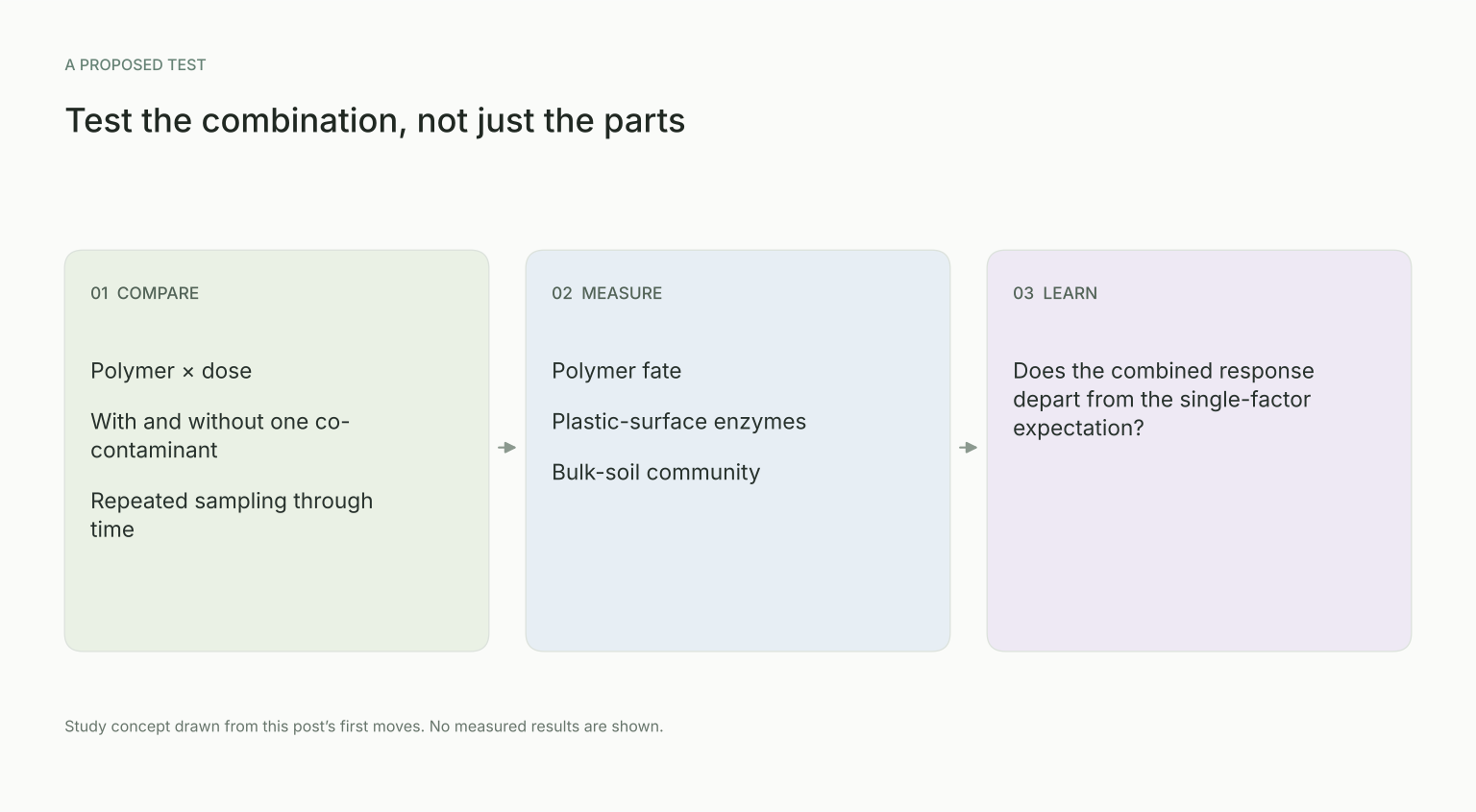
I’d compare a no-plastic control, polyethylene and PLA, each added at two amounts: Han’s 0.5% and a lower amount based on the plastic already measured in the field I’d use. Each treatment would have several replicate plots. At planting, mid-season and harvest, I’d recover the plastic and record its mass and particle sizes. If a lab could help, I’d also check for chemical changes on the particle surfaces.
- 3
Measure the soil from the same samples
At the same times, I’d measure clump sizes with Han’s sieving method and sample bacteria and enzyme activity both right beside plastic particles and in the rest of the soil. Once that comparison works, I’d add one measured co-contaminant, since plastics can carry other chemicals, to see whether it changes the soil’s response.
My working hypothesis
My hunch is that the difference between PLA and polyethylene will change over time. Early on, I’d expect them to act much the same, since both start as plastic particles in the soil. Later, if the PLA breaks down, its effects could fade, or new ones could come from what it leaves behind. I don’t know which yet. After Wang’s field result, I wouldn’t call PLA particles either the safer or the riskier choice until I’d seen the plastic and the soil measured together.
Han’s team suggests two reasons the clumps got smaller. The particles create weak points between soil grains, and the plastics changed the bacteria that make the sticky substances holding soil together. If the weak points matter most, a particle that breaks down might matter less over time. If the bacterial change matters most, breakdown might not help much, and microbes feeding on the plastic could change the soil further. Measuring the plastic and the soil in the same samples is how I’d start to tell.
An invitation
If you’ve recovered microplastics from soil at the end of an experiment, I’d like to know how well it worked and what you’d do differently. And if you’ve used biodegradable mulch in a garden or on a farm, did you find pieces of it in the soil the next season? I’m curious how that compares with what the label suggests.
Questions about this gap
Did I actually run this experiment?
No. The results described here come from Han and colleagues and the other papers cited. The season-long study is an experiment I’d like to run, not one I’ve done.
Does “biodegradable” mean the plastic is gone by the end of the season?
Not necessarily. Biodegradable means microorganisms can break the material down, but how fast depends on the plastic and on conditions such as temperature, moisture and which microbes are present. That’s why I’d measure what’s left in the soil being tested instead of assuming.
If the plastic breaks into smaller pieces, has it biodegraded?
No. Smaller pieces can still be plastic. I’d track the total mass of plastic as well as particle sizes. More, smaller pieces with the same total mass would mean the plastic fragmented without disappearing. Pieces too small for my method to recover could also look like lost mass, which is another reason to test recovery first.
Why sample right next to the plastic?
Microbes on and around a plastic particle can behave differently from those in the rest of the soil. Zhou’s study found more microbial growth near PHBV particles than in the surrounding soil. Sampling both places in the same experiment would show whether a change stays local or spreads through the soil.
Why add only one co-contaminant?
Plastics can carry other chemicals. If I added several at once and the soil responded, I couldn’t tell which one caused it. Adding one measured co-contaminant after the basic comparison works makes the result easier to interpret.