
A certain kind of number gets born in one experiment and then travels everywhere, cited and re-cited until it feels like settled fact. The quiet question under a young field is whether the result was ever reproduced.
Take the most concrete study here. Han and colleagues mixed PE and PLA into a silty loam at 0.5%, across three particle sizes, under a one-year rice-wheat rotation, and measured soil structure and the bacterial community in the same pots. The numbers are exact: macroaggregates fell from 84% to 65-71%, microaggregates rose from 17% to 29-35%, mean crumb size dropped from 1.4 mm to about 1.0-1.1 mm, and plastic explained roughly 54% of the change in the bacterial community. That precision is what makes a result quotable, and it is what makes me want to see it run again somewhere else.
The reviews that synthesize this work keep warning against trusting a single number too far. Aralappanavar and colleagues conclude the effects are strongly dose-, type-, and soil-dependent, that most evidence comes from short high-dose lab microcosms, and they call for long-term field studies at realistic concentrations. Sajjad and colleagues make the same shape of point from the physical side: enzyme responses vary by polymer type and concentration. Han's clean 0.5%-in-silty-loam result may be true and specific to Han's soil, dose, and season.
A vivid primary finding plus a review warning that everything depends on conditions still adds up to a result nobody has checked.
Even the raw record is thin. The one field study here, van den Berg and colleagues on sludge accumulation in eastern Spanish soils, reports careful counts: sludge carrying about 18,000 light and 32,070 heavy particles per kilogram, each application adding roughly 280 light and 430 heavy to the soil. Every time that sludge is spread, a few hundred tiny fragments settle into each kilogram of dirt and stay, load after load.
Only the abstract of that field study was available to me, so even that account is partial. Guo and Sajjad both name the deeper reason confirmation is hard: soil microplastics are still understudied next to their ocean cousins, and there is no standard way to sample and extract them from soil. Two labs cannot confirm the same effect if they cannot be sure they are counting the same particles.
- Type
- Under-confirmed, unreplicated
- Field
- Plant uptake and phytotoxicity
- Comparative basis
- Precise primary results vs. confirmation
- Methods
- Greenhouse pots, field plots, 16S sequencing
Why this is answerable now
The numbers are precise enough to test
Han gives hard figures: macroaggregates 84% down to 65-71%, about 54% of the bacterial change explained by plastic. Results this exact are the ones a field should try to reproduce, and no one has yet.
The reviews are asking for it
Aralappanavar states plainly that most evidence is short high-dose lab work and calls for long-term field studies at realistic concentrations. The synthesis literature has already named replication as the missing piece.
The field record is thin
For the one field study here, only the abstract was retrievable. When even primary records are partial, independent confirmation is how the field learns what is solid.
No shared measuring stick yet
Guo and Sajjad both flag that soil microplastics lack any standard sampling and extraction method. Agreeing on how to measure is the precondition for two labs checking each other's work.

Sources cited
Papers I read for this question. These notes distinguish reviews from primary studies and identify the limits of my access.
The 2020 review that said soil is ignored next to the ocean.
Says most evidence is short lab work and asks for field studies.
No standard way to sample or measure soil microplastics yet.
04Microplastics alter soil structure and microbial community
Primary experimentThe precise, quotable greenhouse result nobody has run again.
Careful field counts, but only the abstract was available.
What’s missing — the gap
Do the headline primary results here, like Han's aggregate and bacterial-community shifts at 0.5% loading or van den Berg's per-application accumulation rates, reproduce when independent groups repeat them in different soils, at realistic field concentrations, over longer times?
Right now the field's most-cited findings are also its least-confirmed. The reviews keep saying the effects depend on dose, type, and soil, which is a warning that a result from one silty loam may not survive a change of dirt. Until two labs run the same test and get the same answer, these numbers are precise guesses.
First moves
- 1
Replicate one flagship result
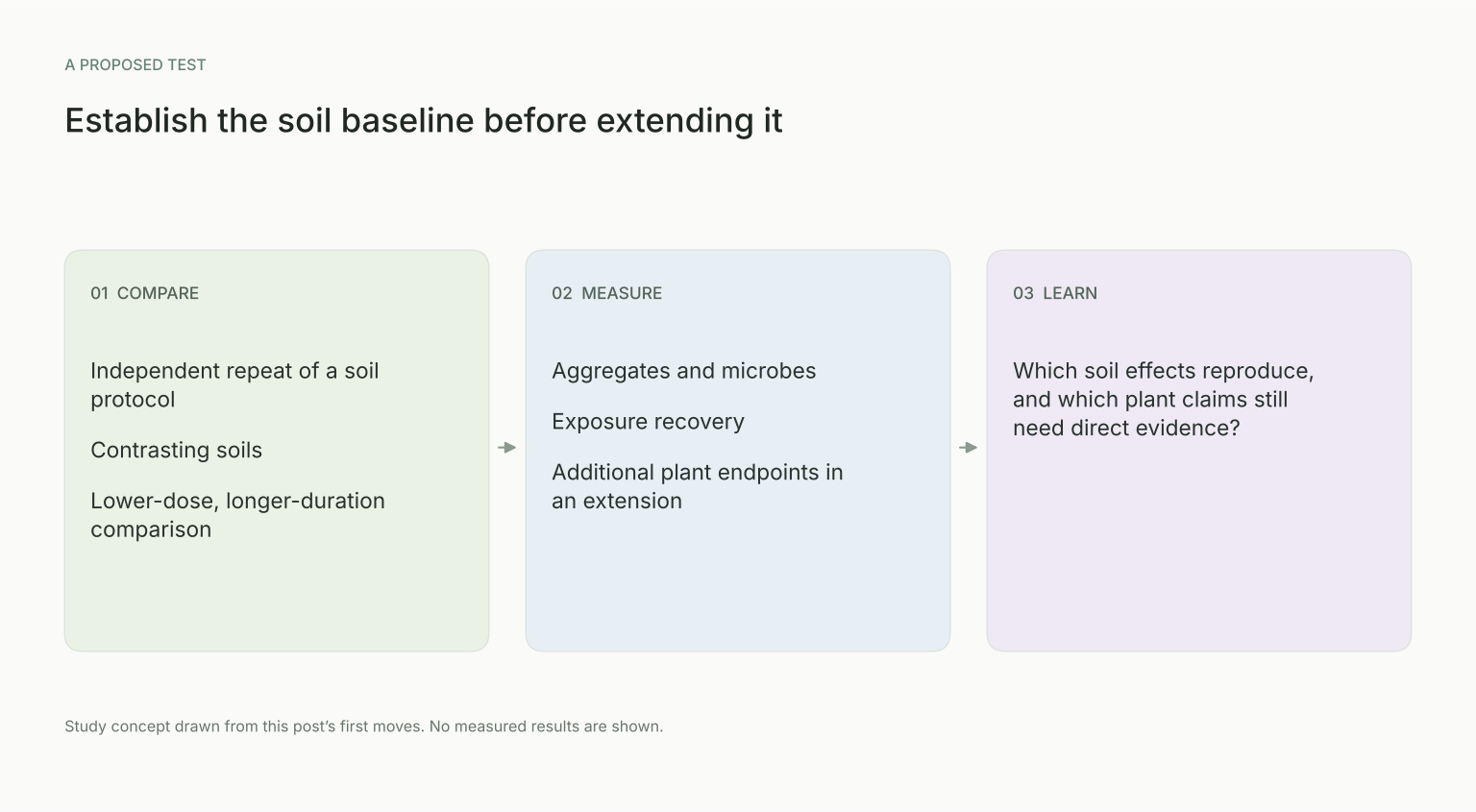
Treat Han's design as a protocol, not an anecdote: same polymers and 0.5% loading, run in two or three contrasting soils by a different group, reporting aggregate size and the 16S community the same way. The test is whether the macroaggregate loss and the 54% community effect show up outside a silty loam.
- 2
Repeat it at realistic dose and duration
Aralappanavar argues most evidence is short and high-dose. Rerun a headline effect at field-relevant concentrations over a full growing season, to ask whether it is real at the loadings soils actually carry or an artifact of heavy lab spiking.
- 3
Pin down a shared measurement first
Before comparing numbers across labs, agree on one sampling and extraction method and have several groups measure the same reference soil, since Guo and Sajjad both say none exists yet. Confirming a result means little until two labs count the same particles.
My working hypothesis
We quote these numbers with more confidence than the evidence earns. My guess is that the steady, boring effects will survive replication and the flashy exact figures will shrink once a second lab tries them in a different soil. This is a small enough field that a few honest replications, run at doses a real farm carries, would tell us more than another first-of-its-kind result.
An invitation
If you run primary soil-microplastic work, greenhouse pots or field plots, I would like to know whether you have ever tried to reproduce someone else's specific number, or had someone reproduce yours, and what happened. What pulls me back is that the most-cited findings are, as far as I can tell, the least-confirmed. Am I wrong to find it unsettling that we quote these results so confidently before anyone has run them twice?
Questions about this gap
Does this post directly replicate plant uptake?
Its proposed starting points mainly repeat soil structure, microbial, and accumulation findings. Demonstrating uptake would require additional measurements inside plant tissue.
Why begin with a well-documented soil experiment?
A defined protocol provides a reproducible baseline. It is easier to interpret a later plant endpoint when the soil exposure and response have been checked.
What changes when a result moves to another soil?
Texture, chemistry, and the biological community may all change. Recording those conditions helps explain whether an effect generalizes or is context-dependent.
Why extend the exposure through a growing season?
It tests persistence over a biologically relevant period rather than assuming a short laboratory response lasts through crop development.
What would strengthen the link to plants?
Add independently confirmed root and shoot measurements and crop endpoints to the replicated soil design, with controls that distinguish tissue uptake from surface contamination.