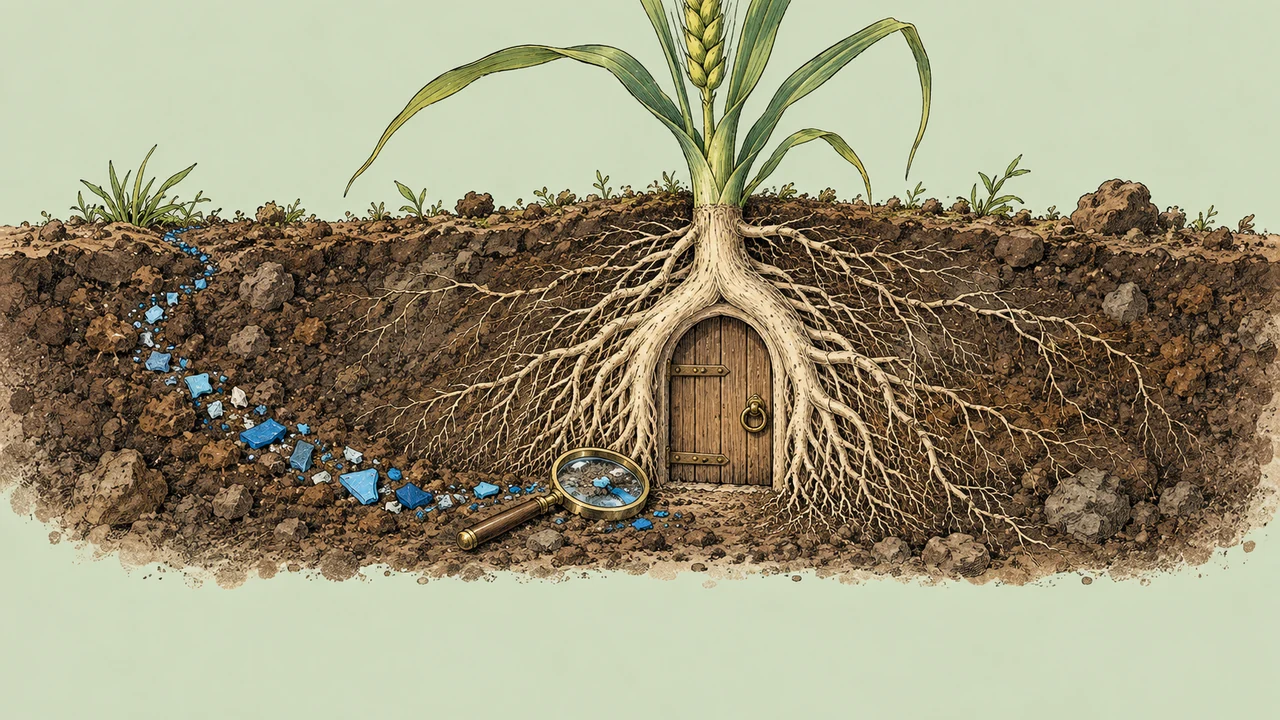
Plant uptake is a corner of soil-microplastics research that is picking up fast. The recent work keeps walking the plastic up to the edge of the plant and then setting the tools down.
Start with the ground a crop stands in. Han and colleagues mixed regular polyethylene and biodegradable PLA into a silty loam under a rice-wheat rotation, at 0.5% of the soil's weight. The plastic broke the soil's big crumbs into smaller ones: microaggregates rose from 17% to 29-35% while macroaggregates fell from 84% to 65-71%, and the mean crumb size dropped from 1.4 mm to about 1.0-1.1 mm. Crumb structure controls how water and air reach a root, but the study measured the soil, not the wheat.
The same study looked at the living part of the soil. Plastic explained about 54% of the difference in which bacteria showed up, with Proteobacteria falling and Actinobacteria and Chloroflexi rising. A 2024 review by Aralappanavar and colleagues points the same way: microplastic soils carry less varied microbes, gain nitrogen-fixers and phosphorus-solubilizers, and lose nitrifiers and ammonia oxidizers. The microbes that feed a plant its nitrogen and phosphorus get rearranged.
Aralappanavar's team is careful about its own base. Most of the evidence comes from short, high-dose lab jars, and they call for long-term field studies at realistic amounts. So there is a believable path for how plastic could change what a plant is fed, built mostly on experiments that don't look like a real field yet.
The plastic is arriving in real fields. Van den Berg and colleagues found that eastern Spanish plots given sewage sludge held about 2130 light and 3060 heavy microplastics per kilogram, against roughly 930 and 1100 in unsludged plots, with each application adding a few hundred more. Sajjad and colleagues name plastic-film mulching as the biggest single source and put the yearly load onto farmland in Europe and North America at around 700,000 tonnes.
So the sources are counted, the soil changes are mapped, and the microbe changes are mapped. What the plant itself takes up, and what that does to it, sits in the space between these papers instead of inside any one of them.
- Type
- Emerging, not settled
- Field
- Plant uptake and phytotoxicity
- Comparative basis
- Soil and microbe work vs. plant response
- Methods
- Greenhouse trials, 16S sequencing, field surveys
Why this is answerable now
Sources are counted
The inputs are measured now. Film mulching is the biggest source, sludge builds up application by application, and the yearly load runs to hundreds of thousands of tonnes. The plant's exposure is documented. Its response is not.
The trail leads to the root
Recent work shows microplastics restructuring soil crumbs and rearranging the microbes that cycle nitrogen and phosphorus, the same machinery that feeds a plant. Someone needs to follow that trail onto the plant.
The evidence is still lab-bound
The strongest reviews admit most findings come from short, high-dose jars and ask for field studies at realistic doses. Building the plant-uptake record on field-relevant exposure now would set the standard early.
Biodegradable is not a fix yet
Han found biodegradable PLA hurt soil structure about as much as regular PE. Swapping plastics won't quietly solve the problem, which makes the plant-level question more urgent.

Sources cited
Papers I read for this question. These notes distinguish reviews from primary studies and identify the limits of my access.
The 2020 review that said soil is ignored next to the ocean.
Best summary of how plastic changes soil microbes and nutrient work.
Top source is mulch film. No standard way to measure yet.
04Microplastics alter soil structure and microbial community
Primary experimentGreenhouse test: biodegradable harmed soil structure like regular plastic.
Sludged fields held roughly double the microplastics, building up per application.
What’s missing — the gap
At the low levels a real field actually carries, do microplastics measurably get into crop plants and hurt their growth or physiology?
The same studies that measure plastic restructuring farm soil, rearranging its nutrient microbes, and building up in real fields almost never measure the crop growing there. The soil-side methods exist. The smallest honest next step is to stop harvesting only the soil and check the plant too.
First moves
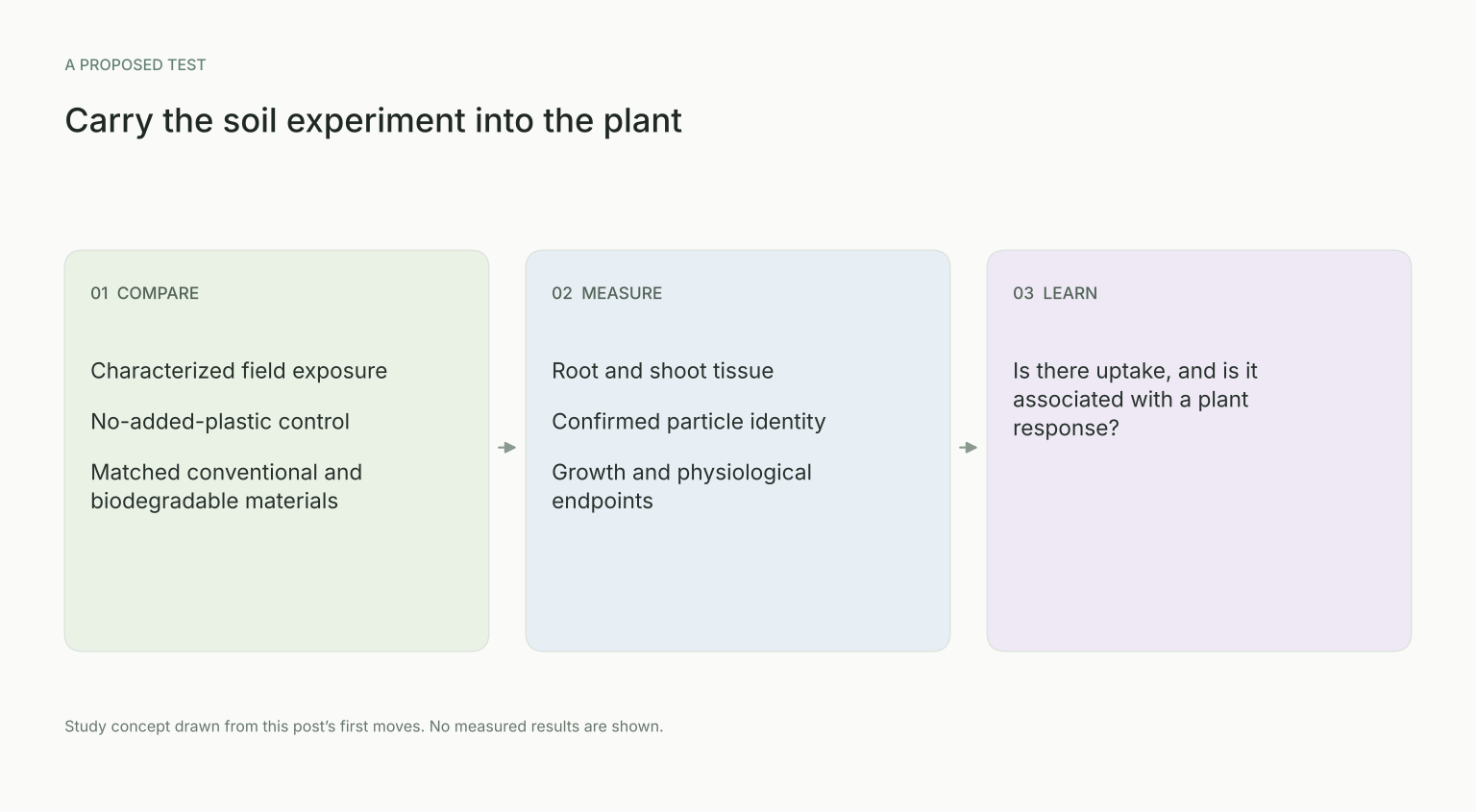
- 1
Add the plant to a soil design
Take a field-realistic exposure like the sludge-amended soils, around 2000-3000 particles per kilogram, grow a common crop in it, and measure both particle uptake into tissue and basic growth. The soil methods already exist.
- 2
Test both plastics at the plant level
Han showed PLA harmed soil structure much like PE. Run PE and PLA side by side under the same crop and ask whether the biodegradable option is any gentler on uptake and phytotoxicity.
- 3
Agree on one way to measure
The reviews report no standard soil sampling protocol. Settle early on a shared way to confirm and count a particle in root or shoot tissue, so plant-uptake numbers can be compared across labs.
My working hypothesis
The plant is the most important thing here and the least measured. My guess is that at realistic field doses the plant-level effects will be smaller and slower than the loud lab jars suggest, but the biodegradable-plastic result makes me unwilling to assume the crop is fine. One study that grows a crop in field-realistic soil and measures the plant itself would settle more than another round of soil-only work.
An invitation
If you work on crops, soils, or the microbes between them, this is the corner I'd love to see claimed. The papers have walked the plastic all the way to the root and then set their tools down. Am I wrong to find it strange that we can count the particles in the field but not in the plant growing there?
Questions about this gap
Does finding plastic in soil demonstrate uptake by a crop?
No. Soil exposure and confirmed particles inside plant tissue are different observations. This question calls for measuring the plant as well as its surrounding soil.
How can surface contamination be distinguished from uptake?
Tissue sampling needs cleaning controls, blanks, and confirmatory particle identification. Otherwise material adhering to a root could be mistaken for material within it.
Why measure growth alongside particle uptake?
Uptake and injury are separate outcomes. Measuring both avoids assuming that detecting a particle automatically demonstrates a harmful effect on the crop.
Can particles per kilogram be converted directly into percent by weight?
Not without knowing particle size, density, and mass distribution. The proposed exposure comparison needs those properties to connect field counts with experimental doses.
Does this post establish food safety consequences?
No. It proposes a plant-level experiment. Food exposure and human health consequences would require additional evidence beyond soil counts or crop growth.