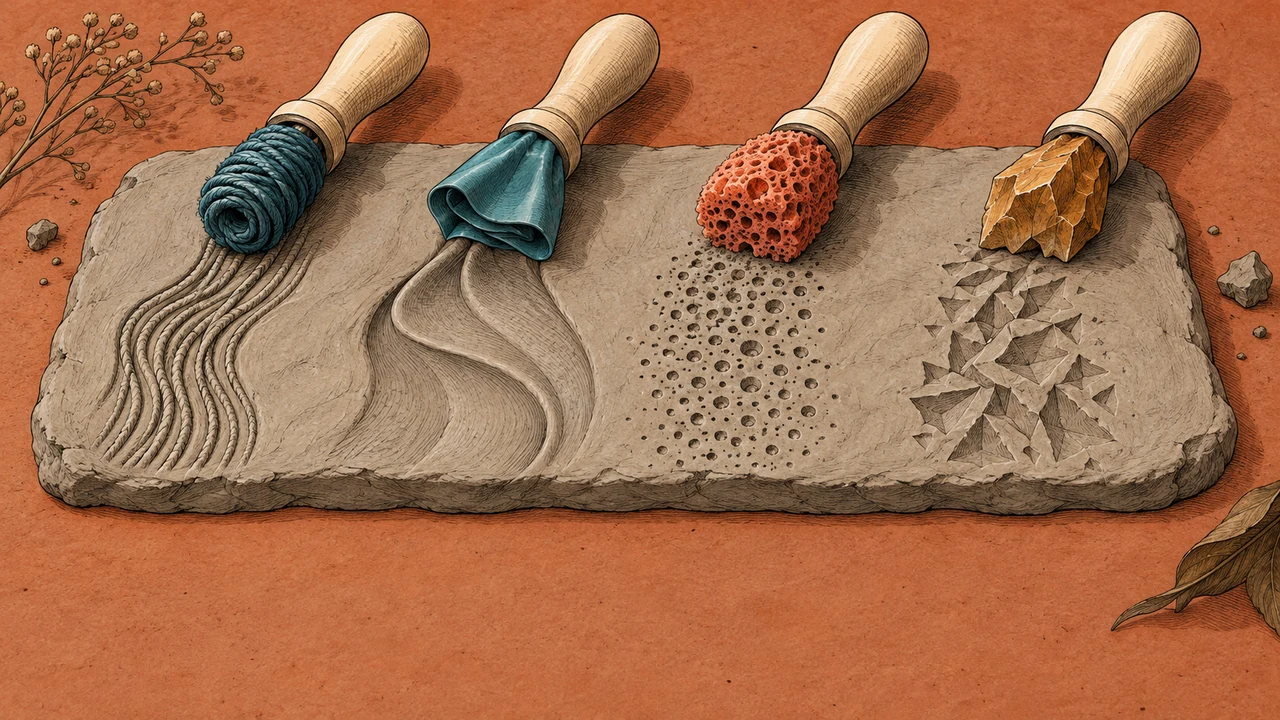
A corner of soil-microplastics research is quietly taking off, and the reviews have not caught up. For years the only question was whether plastic was in the soil at all. Now a few studies are asking what the particles are shaped like, and the early answer is that shape changes what the plastic does.
Start with the study that made me pay attention. Zhao, Lozano and Rillig took twelve microplastics across four shapes (fibers, films, foams, fragments) and eight polymer types, mixed them into a loamy sandy soil at 0.4% by weight, and watched soil pH, respiration, and four enzymes over 31 days. Foams and fragments pushed soil pH up. Cellobiosidase, an enzyme that helps break down carbon compounds, dropped under fibers, films, and foams, and N-acetyl-glucosaminidase dropped under fibers and fragments. A plastic foam and a plastic fiber, at the same dose in the same soil, do different things to the chemistry underground.
So the particle's form is part of what the plastic does to the soil.
That sits awkwardly with how the field still talks. The big reviews describe microplastics mostly by where they come from and how much there is. Sajjad and colleagues name plastic film mulching as the largest source, plus sludge, compost, atmospheric fallout, tyre wear, and plastic-coated fertiliser, all adding to a load that changes soil structure and water-holding. The microbe review tells a similar story: microplastics reshape microbial communities and nutrient cycling, but the effects depend on dose, plastic type, and soil, and most of the evidence comes from short high-dose lab jars rather than fields (Aralappanavar and colleagues). Both reviews say type and shape matter. Both also admit we don't have the careful particle measurements to pin those effects down.
The timing makes this urgent. Cusworth and colleagues rebuilt a microplastic record from archived soil at the Broadbalk wheat experiment at Rothamsted. They found none from 1846 to 1914, which fits modern plastics being about a century old, then a clear rise across every treatment from 1966 to 2022, with fertilised plots above the untreated baseline. Farm soils are holding onto the plastic. The pile is growing and it is hard to reverse.
So we are building a bigger and bigger pile of plastic in the ground while describing it with words too rough to predict what it will do. Guo and colleagues argued years ago that soil was understudied next to the ocean and freshwater. The size-and-shape corner is where that neglect is sharpest, because it is the fine-grained question inside an already neglected field.
- Type
- Emerging, not consolidated
- Field
- Soil microplastic ecology
- Comparative basis
- Shape effects vs. source-and-amount framing
- Methods
- Soil incubations, enzyme assays, fluorescence counting
Why this is answerable now
Shape is turning out to matter
One controlled experiment already shows soil pH and several enzymes responding differently to fibers, films, foams, and fragments (Zhao, Lozano & Rillig, 2021). If form changes the outcome this much, measuring it carefully becomes part of the science itself.
The load keeps climbing
The Rothamsted archive shows microplastics rising in farm soil since the 1960s with no sign of reversal (Cusworth et al., 2024). We are collecting the very particles whose shapes we can't describe consistently yet.
The reviews name the gap
Both the microbe review and the critical soil review flag type- and shape-dependence while admitting the evidence is thin and non-standard (Aralappanavar et al., 2024; Sajjad et al., 2022). The field is pointing at its own hole.
No agreed way to measure
There is still no standard way to sample and extract soil microplastics (Sajjad et al., 2022). The measurement habits are forming right now, which is a rare chance to shape them before they harden.

Sources cited
Papers I read for this question. These notes distinguish reviews from primary studies and identify the limits of my access.
Review arguing soil is understudied next to the ocean and freshwater.
Best current summary of microplastics and soil microbes; effects are type-dependent.
Sources and effects; no standard way to sample soil microplastics yet.
Rothamsted archive: plastic rising in farm soil since the 1960s.
05Microplastics increase soil pH and decrease microbial activity by shape and polymer
Primary experimentShape and polymer type change soil pH and enzyme activity.

What’s missing — the gap
If fibers, films, foams, and fragments push soil pH and enzymes in different directions at the same dose, can measuring particle shape and size the same way across studies explain a real share of the dose-, type-, and soil-dependent variation the reviews keep reporting but can't pin down?
Right now the field describes soil microplastics mostly by source and total amount, while its own experiments keep finding that form changes the result. If systematic shape and size measurement accounts for a big chunk of the scatter, then particle characterization is doing real causal work. If it doesn't, we can stop blaming form and look elsewhere. No one can say which yet, because few studies measure shape and size the same way.
First moves
- 1
Report shape and size every time
In your next soil-microplastic experiment, measure and report the size distribution and shape class of every treatment, the way Zhao, Lozano and Rillig did, next to dose and polymer type. One lab doing this consistently makes future results comparable.
- 2
Run a shape gradient at real concentrations
The strongest shape effects so far come from a 31-day jar at 0.4% by weight (Zhao, Lozano & Rillig, 2021). Take the same shapes down to the lower, realistic amounts the microbe review asks for (Aralappanavar et al., 2024), and hold it longer, to see if the shape effects last.
- 3
Add shape to the archive
The Rothamsted record shows the load climbing since the 1960s but doesn't sort particles by form (Cusworth et al., 2024). Measuring shape and size in archived soils would show whether the shape profile of that buildup has changed over time.
My working hypothesis
I think shape and size are a real driver here, and the field is measuring them too loosely to prove it. My guess is that careful, shared shape measurement would explain a good part of the scatter the reviews keep calling type-dependent. What bothers me is that the plastic is piling up in farm soil faster than we are learning to describe it. One lab reporting shape and size consistently could do more than another round of jar experiments.
An invitation
If you work on soil microplastics, in a lab, on a farm, or in an archive, I'd like to know whether particle shape and size are the underrated driver here, or whether I'm reading too much into a few early studies. It looks to me like we're piling up plastic in the ground faster than we're learning to describe it. Where would you push back?
Questions about this gap
Why report shape alongside abundance?
The same count can contain fibers, films, foams, or fragments. Recording form makes it possible to test whether particle traits help explain different soil responses.
Does an association with shape prove shape caused the response?
Not if shape also changes with polymer, size, or dose. A controlled design must separate those factors before making a causal interpretation.
Why repeat a short incubation for longer?
It asks whether an early shape-dependent response persists, reverses, or disappears. Duration is part of the exposure rather than a detail to ignore.
What could shape measurements add to an archive?
They could show whether the form of accumulated material changes through time, not just its total count. Recovery limits must stay comparable across samples.
What should accompany each shape category?
A clear definition, size distribution, polymer information, dose, and detection limit make the category interpretable and easier for another laboratory to reproduce.