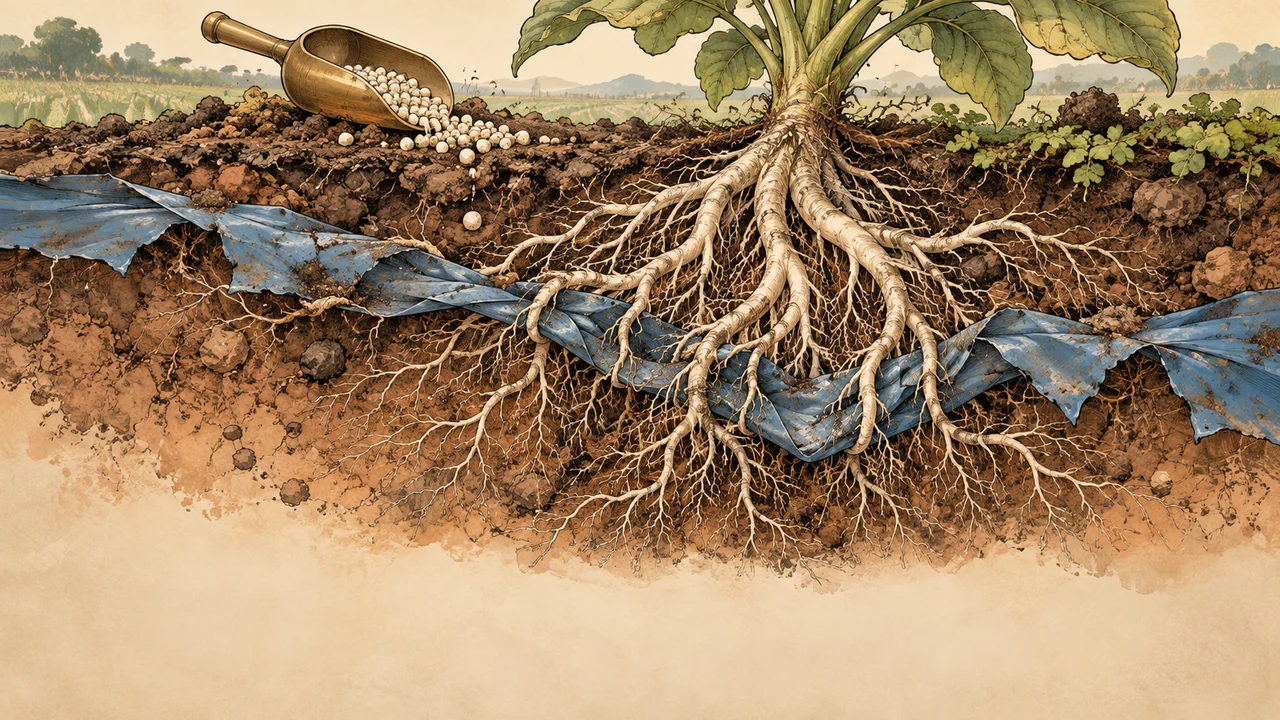
Soil almost never gets plastic from one source at a time. A single field can be mulched with film, dressed with sewage sludge, and fed fertiliser, sometimes in one season. Each of those loads the ground with plastic on its own. The study that watches two of them together is the one I keep failing to find.
Start with how many separate sources fill this one soil. Sajjad and colleagues, reviewing microplastics under 5 mm in soil, name plastic film mulching as the single largest source, then add sludge and biosolids, compost, dust from the air, tyre wear, and plastic-coated fertilisers, with roughly 700,000 tonnes of plastic reaching farmland in Europe and North America every year. They also flag that the particles carry other pollutants along with them: phthalates, antibiotics, toxic metals, PAHs, and PCBs. So several unrelated farm practices each drip plastic into the same ground, and the plastic smuggles other poisons with it.
Guo and colleagues make the framing point that this soil story is badly understudied next to the marine and freshwater ones. I think that is exactly why the sources have mostly been studied one at a time.
Here is the one study I found that deliberately crosses two of them, and it is telling. Li and colleagues worked a field trial in China running since 1987, built to test plastic film mulching and nitrogen fertilisation against maize yield, so the two were already crossed in the ground. After 32 years, the mulched-and-fertilised plots held about 10 times more macroplastic than mulched-but-unfertilised ones, 6796 versus 653 pieces per square metre, and about twice as much film microplastic, 3.7 million versus 2.2 million particles per kilogram. Their read: the fertiliser grew bushier plants whose roots gripped the film, so more of it tore off and stayed behind.
The two practices were not independent. One amplified the other. That is an interaction made visible, and it is the shape of the thing I wish more people were chasing.
Set Li's result beside Cusworth and colleagues' and the two studies start talking. Reconstructing plastic history in the Rothamsted Broadbalk wheat experiment from archived soil back to 1846, Cusworth's team found none before about 1914, then a clear rise across all plots from 1966 on, with the manured and inorganic-fertiliser plots running higher than the untreated plot. So Li says fertiliser amplifies the plastic that mulch leaves behind, while Cusworth says fertiliser is itself a carrier bringing plastic in. Both couple fertiliser to plastic, by different routes, and neither can tell you what the other route adds on top.
Van den Berg and colleagues add the same stacking logic from a third angle: in eastern Spanish fields, each sewage-sludge application added on average about 280 light-density and 430 heavy-density microplastics per kilogram, so the load climbed with how many times sludge was spread. The sources clearly stack over time. I still cannot find the design that runs two of them together at once to see whether they sum or interact. Part of why is mundane: Guo and Sajjad both note there is still no agreed way to sample and measure soil plastic, and at the nanoplastic scale, which these density and staining methods barely catch, co-studying sources is rarer still.
- Type
- Interaction, understudied
- Field
- Agricultural soil plastics, nanoplastics
- Comparative basis
- Single-source vs. combined-source studies
- Methods
- Field trials, density separation, staining
Why this is answerable now
Single sources are mapped
Reviews now agree on the main sources: mulch film as the largest, plus sludge, compost, fertiliser, and dust from the air. The one-source stories are mature enough that how the sources combine is the obvious next question.
A crossed result exists
Li and colleagues inherited a trial that crossed mulching with fertilisation, and the plastic load was far from additive: fertilised mulched plots held 10 times the macroplastic. That begs to be reproduced on purpose, with more than two sources.
Loads stack every season
Sludged fields gain a few hundred more particles per kilogram with every application, and fertilised plots outrun untreated ones over decades. Fields are already piling up several plastic inputs at once, so the interaction is happening whether or not anyone measures it.
The method gap is fixable
There is still no standard soil sampling or extraction method, and nanoplastics slip through most of what we have. Agreeing on a shared method now is what would let two labs run the same multi-source experiment and compare the numbers.

Sources cited
Papers I read for this question. These notes distinguish reviews from primary studies and identify the limits of my access.
Soil is understudied next to the ocean, so sources get studied one at a time.
Names the sources and the 700,000 tonnes a year. No standard method yet.
Fertilised mulched plots held 10 times the macroplastic. A visible interaction.
Each sludge application added roughly 280 light and 430 heavy particles per kilogram.
Rothamsted archive: none before 1914, fertiliser plots above baseline from 1966.
What’s missing — the gap
When two farm practices that each deliver plastic to soil, say film mulching and nitrogen fertilisation, or sludge and fertiliser, are applied to the same ground, does their combined plastic load beat the sum of each applied alone, the way Li's ten-fold result hints, or is it simply additive so we can keep studying each source in isolation?
Every field carries several of these inputs at once, and almost every study isolates one. Li's crossed trial is the only clear sign that two sources can amplify each other rather than stacking, and it fell out of a trial designed for something else. Until someone crosses the sources on purpose and measures the load in each combination, we are adding up numbers that may not add up.
First moves
- 1
Reproduce the crossed result on purpose
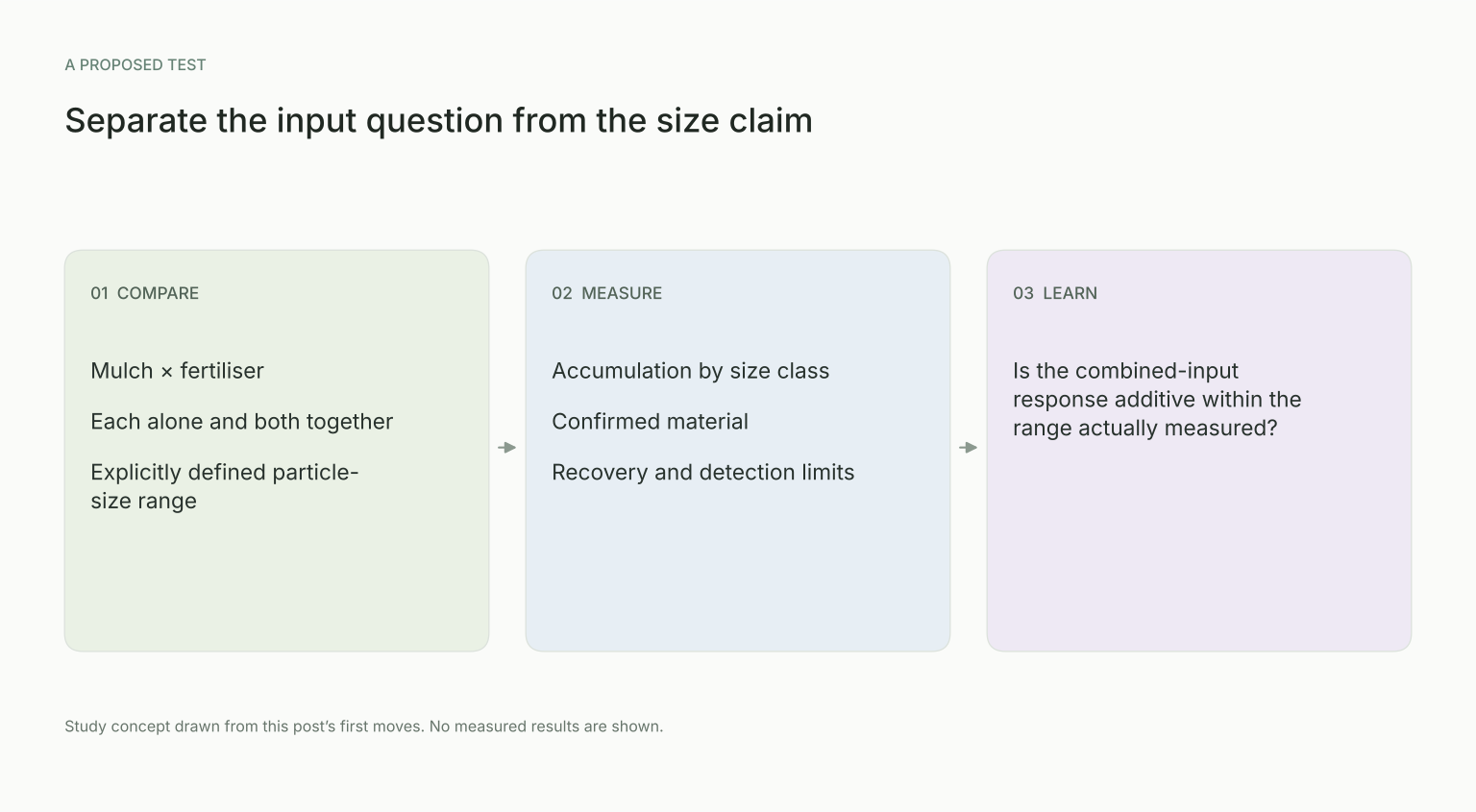
Li's mulch-by-fertiliser interaction fell out of a trial built for something else. The smallest honest test is a factorial plot, mulch on or off crossed with fertiliser on or off, measuring plastic load in each cell to ask whether the combined cell beats the sum of the single ones.
- 2
Cross two carriers
Cusworth shows fertiliser carries plastic in, van den Berg shows sludge does too. Apply each alone and both together at field rates and count the particles, so we learn whether two input streams stack or one changes how much of the other stays in the soil.
- 3
Fix the ruler first
Guo and Sajjad both flag the missing standard method. Before any multi-source trial, agree one sampling-and-extraction protocol that can also see toward the nanoplastic scale, so two labs running the same crossed design produce numbers that line up.
My working hypothesis
I think these sources interact more often than they add, and treating them one at a time has hidden how much plastic real fields actually hold. Li's ten-fold jump is one trial, so I hold it loosely, but the mechanism is plain enough that I would expect it to repeat. What unsettles me is that we keep publishing single-source numbers for soils that never see a single source. One deliberate crossed trial, with a shared method, would tell us whether every existing estimate is too low.
An invitation
If you work on soil plastics, on mulch, sludge, fertiliser, or the methods that count any of them, I would genuinely like to know whether you have ever run two inputs together in one design, and if you did, whether the plastic added up or ran past the sum the way Li's plots did. What keeps me circling this is that every field carries several inputs at once, yet almost every study isolates one. Am I wrong to find that strange?
Questions about this gap
Does this post directly measure nanoplastics?
No. Its examples concern broader plastic inputs and accumulation. A nanoscale extension would require a validated method with an explicit detection range.
What does Li’s ten-fold comparison refer to?
The cited comparison concerns macroplastic counts in fertilized versus non-fertilized mulched plots. It should not be relabeled as a measured ten-fold nanoplastic increase.
Why cross mulch and fertiliser deliberately?
Separate and combined treatments can test whether retention or accumulation differs from the expected combination of the individual practices.
Would a combined-input effect identify its cause?
Not alone. Root growth, retention, input composition, and measurement could contribute. Additional observations are needed to distinguish the mechanism.
What must happen before reporting a nano fraction?
The separation, detection limit, recovery, and contamination controls must be validated for that size range. A microscale count cannot establish an unmeasured nanoscale quantity.