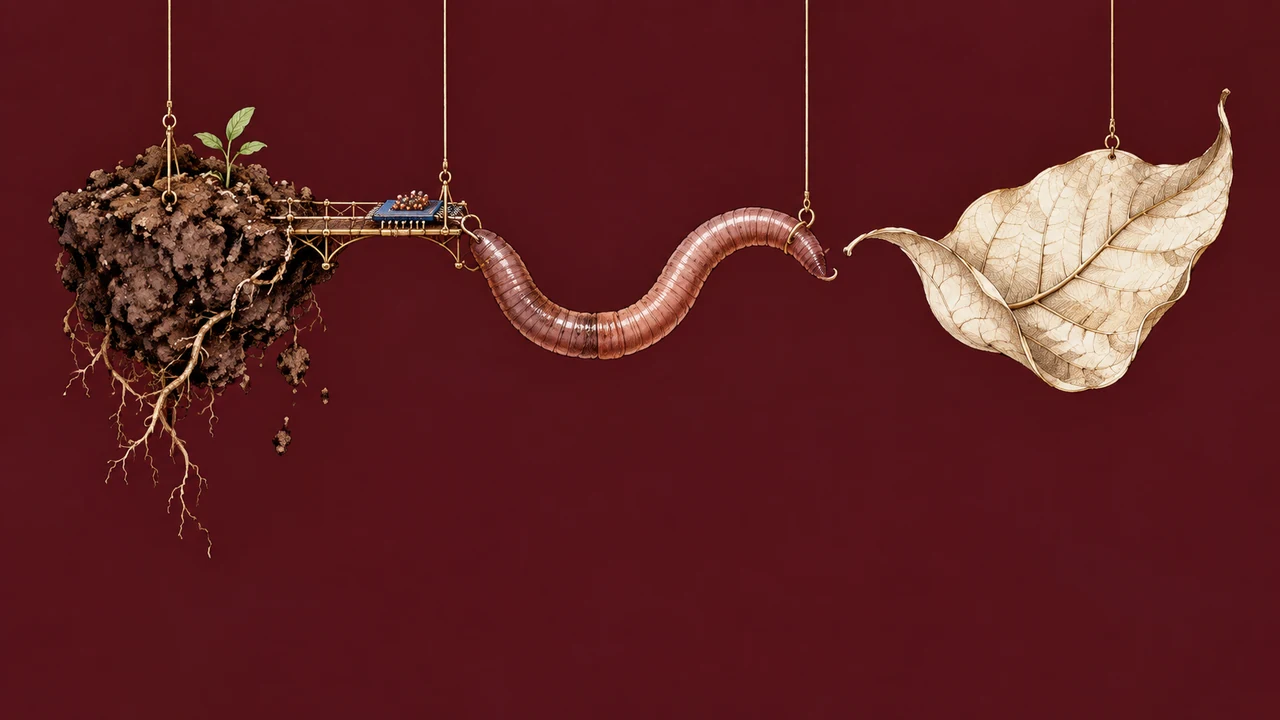
Almost every piece of this has been studied hard on its own, and almost none of it together.
Start with how much plastic is arriving. Sajjad and colleagues estimate that about 700,000 tonnes of microplastics reach farmland each year in Europe and North America, with plastic mulch film the single largest source, and report that up to 90% of Swiss floodplain soils are already polluted. The fields are not a clean starting line. The same review makes the point I keep circling: these particles do not travel alone. They carry co-contaminants with them, phthalates, antibiotics, toxic metals, PAHs and PCBs. A plastic particle in soil often carries several other pollutants at the same time.
Now hold that against the biology. Aralappanavar and colleagues find that plastic-polluted soils, and the film of microbes growing on the particles, carry less varied communities, with more plastic-degraders like Actinobacteria and Proteobacteria. Plastic also tends to raise nitrogen-fixers and phosphorus-solubilizers while lowering nitrifiers and ammonia oxidizers. The mix of microbes that handle the soil's nitrogen gets rearranged, not only reduced in number.
Zhao, Lozano and Rillig sharpen why this is hard to pin down. Testing twelve microplastics across four shapes and eight polymers at 0.4% in a loamy sandy soil, they found shape, polymer, and exposure time each changed soil pH and enzyme activity, with foams and fragments raising pH and different shapes knocking down different enzymes. The review says microbial effects depend on dose, type, and soil. The experiment shows that dependency happening.
Guo and colleagues, reviewing the whole field, argue soil is badly understudied next to water, and name transfer up soil food chains and the health risks that follow as real concerns. Kumar and colleagues go further on the human end, listing biomagnification and toxic effects on humans and animals as open research needs, and noting there is still no standard way to detect and quantify plastic in soil.
So each link exists in the literature on its own. The loaded particle, the rearranged microbes, the harmed earthworms and nematodes, the path up the food chain, the human at the end. What I cannot find is the study that follows one contaminated particle across those links at once. That is the missing piece.
- Type
- Under-studied interaction
- Field
- Food-chain transfer and human exposure
- Comparative basis
- Separate links vs. combined path
- Methods
- Microcosm assays, enzyme assays, fauna endpoints
Why this is answerable now
The load is already here
About 700,000 tonnes a year reach farmland in Europe and North America, and up to 90% of some floodplain soils are polluted. This is not a future scenario. The exposure route is running now.
The single-factor phase has matured
We have solid separate answers on sources, microbes, fauna, and shape effects. That is when you stop studying factors one at a time and start studying where they collide, because the groundwork to design a combined study finally exists.
Tools are the bottleneck
Two reviews note there is still no standard way to sample, extract, and count soil plastic. Building that shared measurement now is what makes any interaction study comparable to the next.
The human end is named but empty
Kumar and colleagues list biomagnification and toxic effects on humans as open needs, not answered questions. The field has flagged the end of the food chain and left it unstudied.

Sources cited
Papers I read for this question. These notes distinguish reviews from primary studies and identify the limits of my access.
Names the whole exposure pathway but follows no single particle along it.
Plastic rearranges soil microbes; effects depend on dose, type, and soil.
Mulch film the top source; plastics carry other pollutants; no standard method.
Lists human biomagnification and toxicity as open, unanswered research needs.
05Microplastics change soil pH and microbial activity by shape and polymer
Primary experimentShape, polymer, and time all change soil pH and enzymes.
What’s missing — the gap
Does a plastic particle that has already picked up a co-contaminant, like an antibiotic or a phthalate, move through the soil food chain and toward human exposure differently than a clean particle of the same shape and polymer?
Each link is in the literature on its own: the loaded particle, the rearranged microbes, the harmed soil animals, the path up the food chain, the human at the end. No one has followed one contaminated particle across them in a single study. Until someone does, we are assuming the links simply add up, when the biology already tells us the effects depend on shape, polymer, dose, and soil.
First moves
- 1
Load one particle, then track it
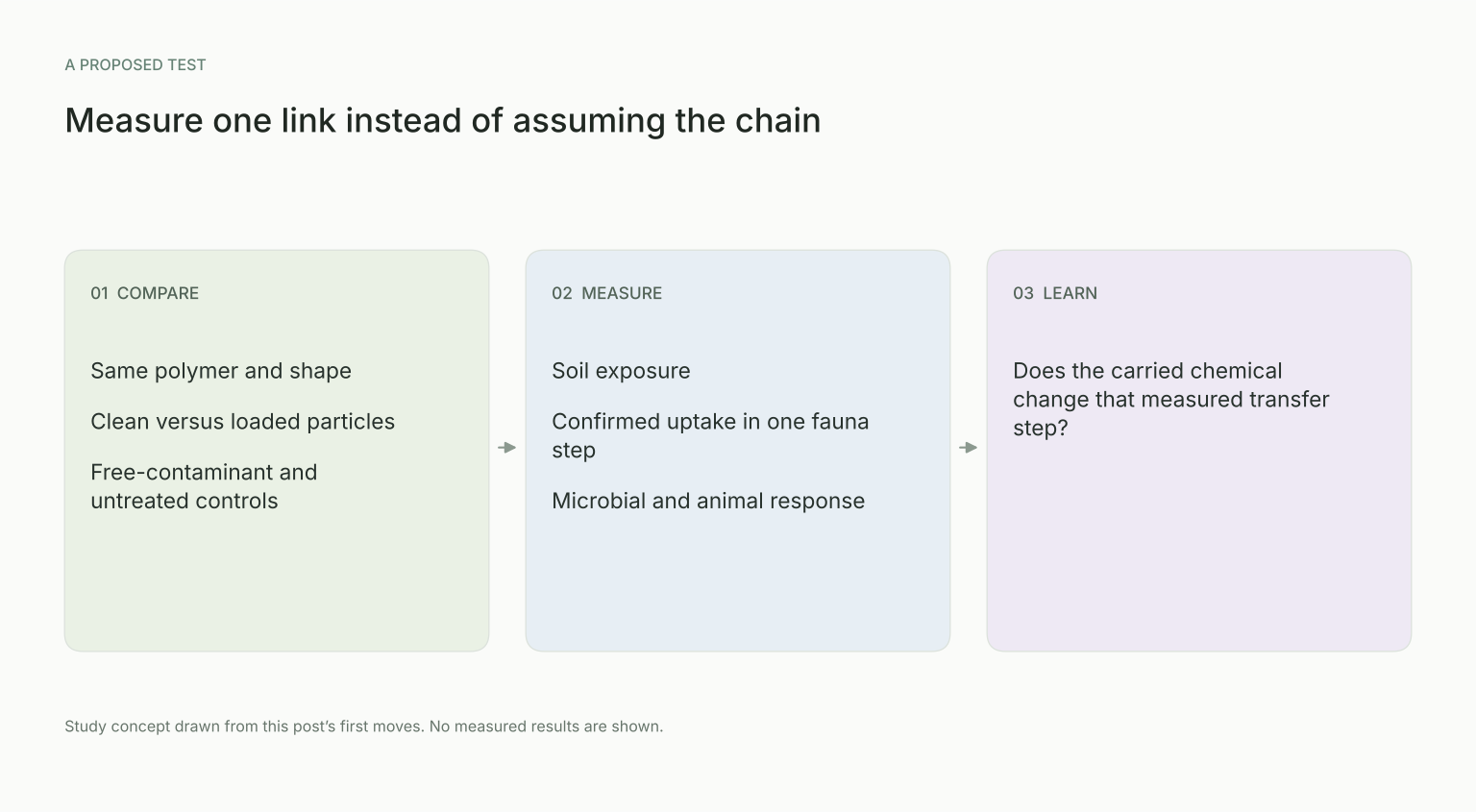
Hold one shape and polymer constant, following Zhao's logic, and prepare two versions: clean, and pre-loaded with one named co-contaminant such as an antibiotic. Compare their uptake and effects in one soil-fauna feeding step, so the carrier role and the food-chain step are tested together.
- 2
Pin down the method first
Since two reviews say no standard sampling and extraction method exists, run a small round-robin where a few labs count the same spiked soil the same way. A shared protocol is the unglamorous move that makes every later result comparable.
- 3
Link microbe shifts to the food chain
Pair the nutrient-microbe reshuffling from Aralappanavar with a fauna endpoint in one microcosm: does the same dose that lowers nitrifiers also change what a nematode or earthworm takes up, at realistic amounts over a longer window?
My working hypothesis
I think the separate links are real, and I think studying them apart is quietly hiding the answer that matters. A contaminated particle is doing several things at once, changing the microbes, carrying a second pollutant, moving up through the animals, and the reviews already say these effects depend on shape, polymer, and dose. My guess is that a loaded particle behaves differently from a clean one on the way to our food, and that we will not know how until someone measures two links in the same soil. The human end of this chain has been named for years and still sits empty.
An invitation
If you study soil microbes, or soil fauna, or how these particles pick up other pollutants, you already own one link in this chain, and I am writing to the people who could connect two of them in one experiment. The reviews have named the path from loaded particle to human plate, and the pieces sit in different papers waiting for someone to measure them in the same soil at the same time. When you look at these findings lined up, where would you push back?
Questions about this gap
Does this question establish human exposure?
No. It proposes testing a defined soil-food-chain step. A measured effect in that step cannot by itself establish a human dose or health outcome.
Why compare clean and contaminated particles of the same shape?
Holding physical traits constant helps isolate the contribution of the carried chemical. Loading and free-chemical controls are needed to interpret the difference.
What is a manageable first food-chain link?
One soil-to-fauna uptake step provides a bounded starting point. It should confirm material in the organism rather than infer uptake from plastic present in the soil.
Why measure microbes alongside fauna?
It tests whether a microbial response and an animal endpoint occur under the same exposure, instead of linking observations from separate experiments by assumption.
What makes the result suitable for a later exposure study?
A reproducible protocol, confirmed particles, documented dose, and uncertainty would provide a stronger foundation for testing the next link in the chain.