
The headline results get cited everywhere: microplastics thin out microbial diversity, scramble the nitrogen cycle, stunt roots, make enzyme activity spike. When I go looking for the confirmation under the citations, the people who know the literature best keep admitting most of it is one-off and might not hold.
There is real agreement to start from. Zhang and colleagues pooled 6223 observations and found plastic residues and microplastics decreased dissolved organic carbon and total nitrogen by 9% and 7%, cut plant height and root biomass by 13% and 14%, and lowered soil-animal body mass and reproduction by 5% and 11%. Pool thousands of measurements and the average soil comes out a little poorer in the carbon and nitrogen that feed it, and harder to grow in. That is a genuine signal, the strongest evidence here that the effect is real.
Then look at the meta-analysis's stranger number. Soil enzyme activity didn't fall, it rose, by anywhere from 7% to 441%. A range that wide is a warning: the direction and size of the effect depend heavily on which plastic, which dose, which soil. Aralappanavar and colleagues make the same point from inside the microbes, reporting that plastic tends to raise nitrogen-fixers and phosphorus-solubilizers while lowering nitrifiers and ammonia oxidizers, but that whether nutrients and greenhouse gases go up or down is dose-, type-, and soil-dependent. The bacteria that pull nitrogen from the air get more common while the ones that turn it into plant food get rarer, and even that flips with the setup.
This is why I call it a replication gap and not just a messy field. The same microbial review says the plainest thing in the stack: most evidence comes from short high-dose lab microcosms, and it calls for long-term field studies at realistic concentrations. The meta-analysis backs into the same worry from its inputs, where microplastic doses span 0.01 to 600,000 mg/kg, from a trace to a soil that is meaningfully plastic.
Wang and colleagues push the frontier further, noting that nanoplastics, 1 to 1000 nm, are far less studied than microplastics and asking specifically for work on naturally weathered particles at realistic conditions. Guo and colleagues add that soil is understudied next to marine and freshwater systems even though the inputs pour straight into farmland. Three separate corners of the field, all quietly saying they have effects but haven't confirmed them where they'd matter.
Dhaka and colleagues stretch the stakes further: PET reaches groundwater, drinking water, and soils, and they link human plastic uptake to reduced growth of certain bone-marrow and blood-vessel stem cells, though I read that from a paywalled abstract. If the risk end reaches human cells, getting the soil confirmations right matters more.
- Type
- Under-confirmed, unreplicated
- Field
- Soil ecotoxicology and risk
- Comparative basis
- Pooled effects vs. field confirmation
- Methods
- Meta-analysis, field trials, microbial assays
Why this is answerable now
Claims set, confirmations missing
We have the meta-analysis and the critical reviews naming the effects. What is missing is the boring, decisive work of re-running them at field-realistic doses. The scaffolding for a replication push is in place.
The literature's doses are unrealistic
Pooled studies run from 0.01 to 600,000 mg/kg. If most of the headline toxicity came from the high end, we have been describing a soil almost no field ever sees. Now is the moment to find which effects survive at real concentrations.
The reviewers are asking out loud
The microbial review calls for long-term field studies at realistic concentrations, and the nanoplastics review asks for naturally weathered particles under realistic conditions. The invitation is already written.
Soil is where exposure lands
Soil is understudied next to marine and freshwater systems even though mulch film, sludge, irrigation, and air pour into farmland (Guo). The place we grow food is the place we have confirmed the least.

Sources cited
Papers I read for this question. These notes distinguish reviews from primary studies and identify the limits of my access.
The 2020 review that said soil is ignored next to the ocean.
Says most evidence is short lab work and asks for field studies.
Asks for work on naturally weathered nanoplastics at realistic conditions.
04Occurrence, toxicity and remediation of PET plastics
Abstract onlyPET reaches soil, water, and human cells. Abstract only.
6223 observations: steady carbon and nitrogen losses, but a 7-441% enzyme range.
What’s missing — the gap
If the headline effects here, the diversity decline, the shift from nitrifiers toward nitrogen-fixers, the enzyme spike, were rerun at field-realistic microplastic concentrations, over several seasons and across several soils, would they reproduce, or dissolve into the dose-, type-, and soil-dependence the reviews keep flagging?
The steady losses in the meta-analysis look solid because they pool thousands of measurements. The wide enzyme range and the dose-, type-, and soil-dependence tell me a lot of the specific findings may be riding on high lab doses and short timelines. Until someone reruns them at concentrations a farm actually carries, we can't tell the durable core from the artifacts.
First moves
- 1
Rerun three headline effects at real doses
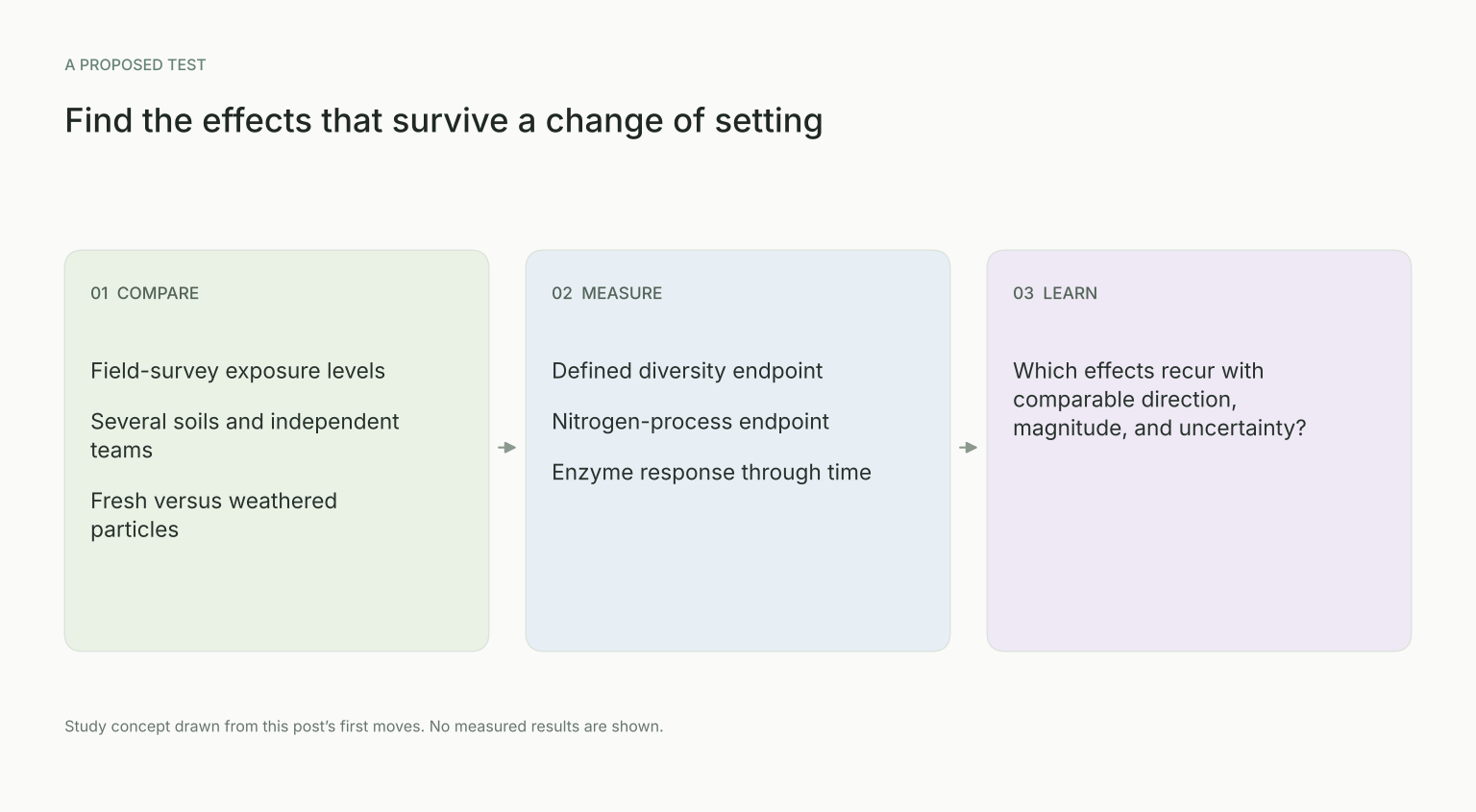
Take the most-cited results, lower microbial diversity, the nitrifier-to-nitrogen-fixer shift, the enzyme spike, and reproduce them at concentrations drawn from field surveys rather than the top of the 0.01-600,000 mg/kg range. If they hold, we have a confirmed core; if they vanish, the literature was describing overdosing.
- 2
Move one microcosm result into a real field
The microbial review's own ask is long-term field studies at realistic concentrations. Take a single well-replicated lab finding and run it in a planted field plot across a full growing season, same plastic, same measurements. One clean lab-to-field transfer beats another microcosm.
- 3
Test whether weathered particles behave like fresh ones
Nearly all the toxicity data uses fresh lab-made plastic, yet the nanoplastics review asks for naturally weathered particles at realistic conditions. Run the same assay with pristine and field-weathered material side by side; if they differ, a large slice of the evidence needs re-confirming.
My working hypothesis
The field has a shelf full of effects and very few of them confirmed where a farmer's soil lives. My guess is the steady losses in carbon, nitrogen, and plant growth will survive replication, and a good share of the sharper, setting-specific numbers won't hold once they are run at realistic doses over real seasons. The decisive work here is boring on purpose, and it is the work the reviews keep asking for.
An invitation
If you work in soil ecotoxicology, I would love to know which of these headline effects you'd bet on surviving a field-realistic replication, and which you suspect are riding on high doses and short timelines. I've tried to read the reviews honestly and keep landing in the same uneasy place. What am I missing here?
Questions about this gap
Why repeat findings summarized in a meta-analysis?
Pooled evidence can reveal patterns, but specific effects may still depend on dose, material, soil, and duration. A targeted repeat tests a defined claim under new conditions.
Does a large observation count remove differences between studies?
No. Many observations can still span incompatible methods and exposure ranges. The underlying conditions remain important when interpreting a pooled result.
Why use field-survey exposure levels?
They connect the experiment to a documented environment. Particle properties and units must also be characterized so the laboratory treatment represents that exposure.
What does fresh-versus-weathered material test?
It asks whether the state of the particle changes the response under matched conditions, rather than assuming pristine laboratory material represents aged field plastic.
What would a durable core of effects look like?
Defined endpoints would recur across independent teams, relevant doses, and contrasting soils, with reported uncertainty. The proposed work is intended to discover which effects meet that standard.