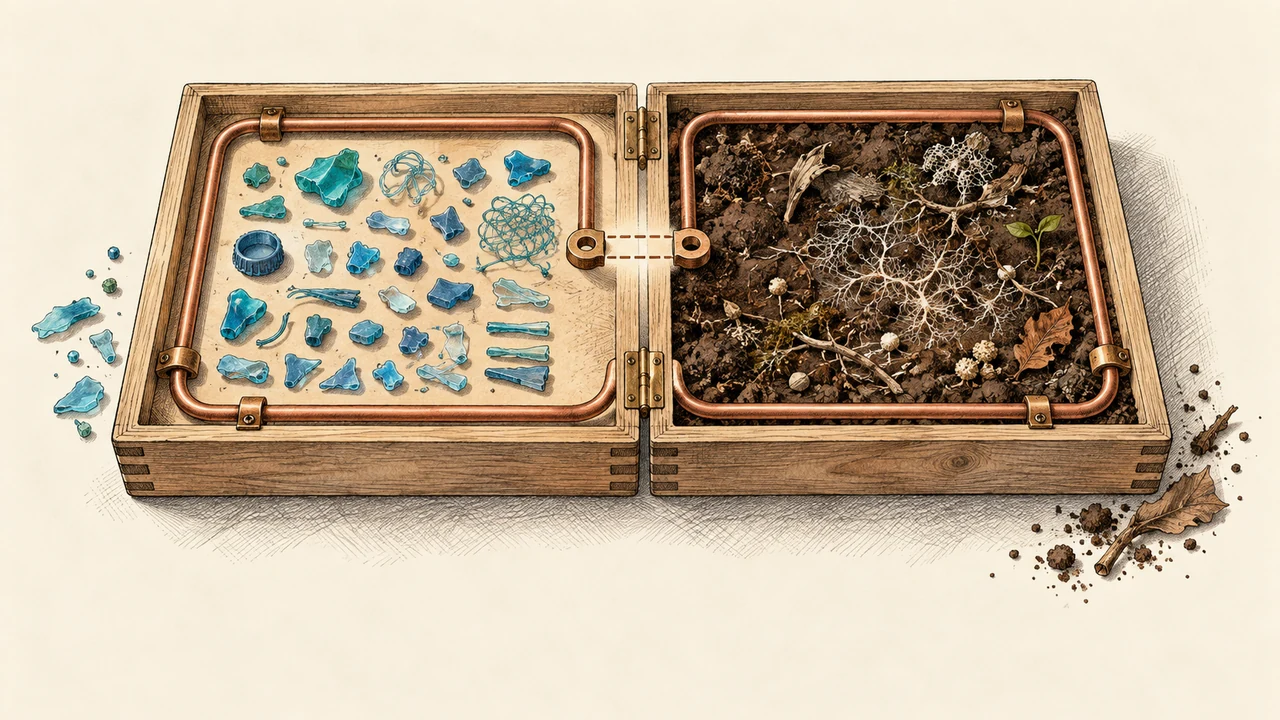
Soil science has gotten good at two things separately: counting how much plastic is in the ground, and cataloging what that plastic does. Both in the same experiment almost never happens. So a number on its own, say a few thousand particles per kilogram, still can't tell you much about the soil it came from.
Start with the counting. In eastern Spain, van den Berg and colleagues sampled farms that had received sewage sludge. The sludge itself carried about 18,000 light and 32,000 heavy particles per kilogram, and the soils built up roughly 280 light and 430 heavy particles per kilogram with each application. Put plainly: the more times you spread sludge, the more plastic stacks up, in a fairly straight line. That fits the wider accounting in Sajjad and colleagues' 2022 review, which estimates about 700,000 tonnes of microplastic reach farmland across Europe and North America every year, with up to 90% of Swiss floodplain soils already polluted. We can produce abundance numbers.
Now the effects side, where the studies stop speaking the same language. Han and colleagues mixed polyethylene and PLA into a silty loam at 0.5% by weight and watched the soil's crumb structure come apart. Big clumps fell from about 84% to 65%, small clumps climbed from 17% to as high as 35%, and the average clump size dropped from 1.4 to about 1.0 mm. Smaller clumps mean a soil that holds water and air less well.
That same study found plastic explained about 54% of the shift in the bacterial community, a large share. It fits the 2024 review by Aralappanavar and colleagues, which reports that contaminated soils carry lower-diversity communities favoring plastic-degraders like Actinobacteria while nitrifiers fall away. The trouble is the dose. 0.5% by weight is enormous next to the few thousand particles per kilogram the field surveys actually measure.
So the two halves don't touch. The counting studies report particles per kilogram. The effects studies report harm at percent-by-weight loadings, in short, high-dose lab jars that the same reviewers admit rarely match the field. I keep wondering why almost no one runs the experiment where the dose is the measured abundance, where you take the load from a place like those Spanish farms and ask what that specific count does to soil structure or the nitrogen cycle.
It gets worse for the easy fix. Han's greenhouse work found biodegradable PLA damaged structure about as much as regular polyethylene. Abundance is the one variable nearly everyone measures and nearly no one connects to a consequence.
- Type
- Under-studied interaction
- Field
- Soil microplastic science
- Comparative basis
- Abundance counts vs. effect studies
- Methods
- Density separation, 16S sequencing, aggregate assays
Why this is answerable now
The counting is mature
Field methods can now separate light and heavy particles and show a clean dose-response, soils gaining roughly 280 light and 430 heavy particles per kilogram per sludge application. The abundance side is finally solid enough to hand an effects study a real number.
The inputs keep rising
About 700,000 tonnes of microplastic reach European and North American farmland each year, with mulch film the biggest single source. The loads worth testing climb every season.
The safe-substitute story is cracking
Biodegradable PLA broke down soil structure about as much as regular polyethylene in Han's greenhouse. Better to test that at realistic doses now, before policy leans hard on bioplastics as the answer.
The reviewers already asked
The 2024 microbial review closes by calling for long field studies at realistic amounts. The people who know the literature best have named exactly this missing experiment.

Sources cited
Papers I read for this question. These notes distinguish reviews from primary studies and identify the limits of my access.
Maps how plastic enters soil, but ties no load to an effect.
Reviews microbe effects and asks for field work at realistic amounts.
Inventory of sources and loads. No standard method to compare counts.
04Microplastics alter soil structure and microbial community composition
Primary experimentHarm at 0.5% by weight, far above real field counts.
Clean field dose-response, the real count worth testing effects with.
What’s missing — the gap
Does microplastic abundance at the levels actually measured in farm soil, a few thousand particles per kilogram, produce the aggregate breakdown and microbial shift that lab studies report at percent-by-weight doses, or do those effects largely vanish once the dose is set to the real field count?
We can measure the dose and we can measure the damage, but almost never in the same field. Until one experiment sets its dose to a real measured count and looks for the structural and microbial harm, we can't tell whether realistic amounts do little, or whether no one has yet checked. That single missing link is what keeps the counting numbers and the harm numbers from meaning anything together.
First moves
- 1
Dose to the field, not the flask
Rerun the aggregate-structure and microbial assay at the particle loads actually measured in sludge-amended soils, a few thousand particles per kilogram, instead of 0.5% by weight. See whether the structural collapse and community shift survive a realistic abundance.
- 2
One soil, abundance as the only knob
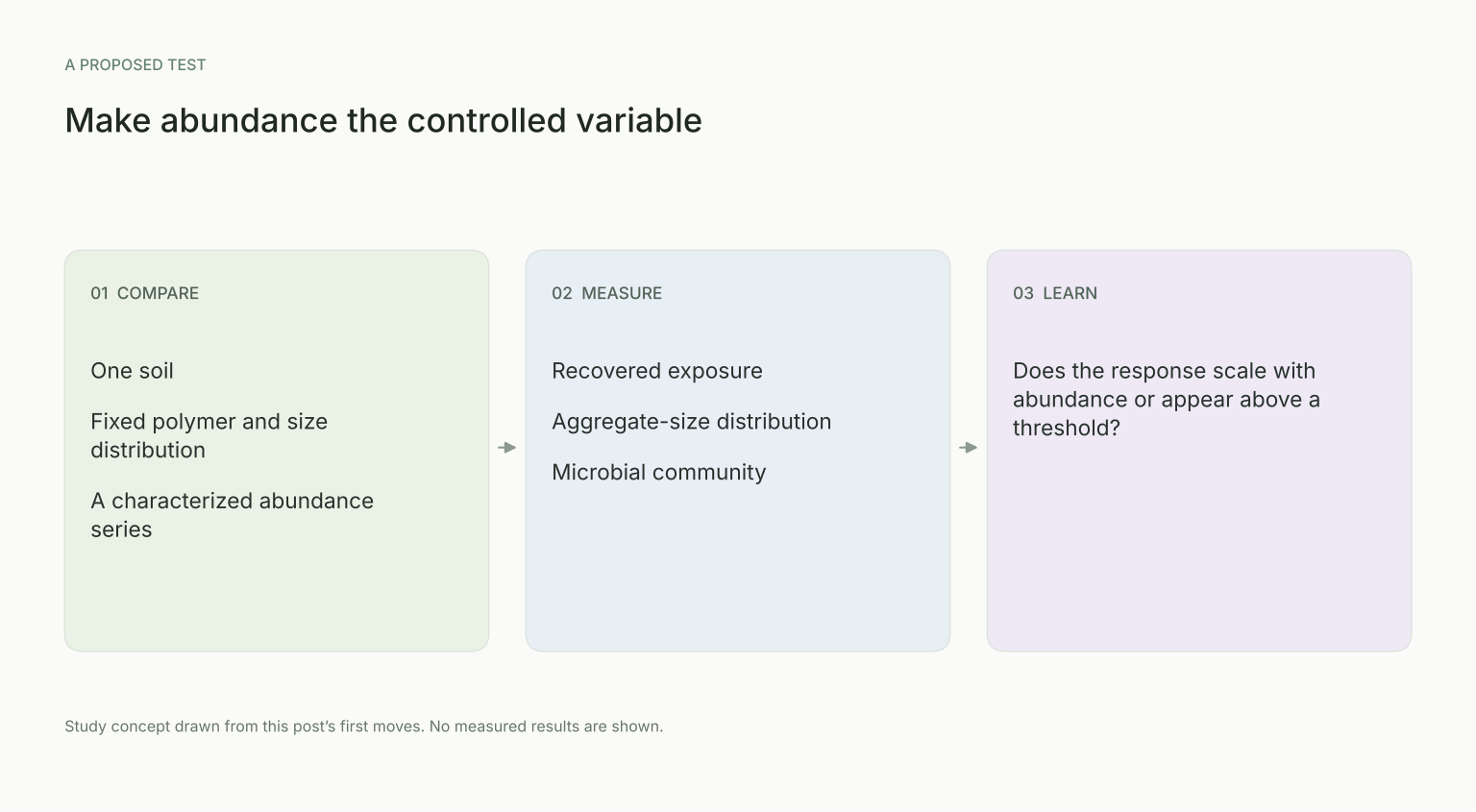
Hold plastic type, particle size, and soil constant, and vary only measured abundance across the real field range. Test whether the community shift scales with the count or has a threshold below which little happens.
- 3
Standardize the count first
No standard soil sampling or extraction method exists yet, so pair any effects experiment with a fully reported extraction protocol. The abundance number then means the same thing in the next lab that tries to repeat it.
My working hypothesis
I suspect realistic field doses do less than the lab jars suggest, but I honestly can't tell, because the experiment that would settle it barely exists. It bothers me that abundance is the number everyone reports and no one ties to a consequence. One study that sets its dose to a real measured count would teach me more than another high-dose jar.
An invitation
If you count microplastics in soil, or you study what they do, I'd love to understand why these two lines of work so rarely share a single experiment. Is the honest answer that realistic amounts just don't do much, or that we've never looked? Am I wrong to find it strange that we can measure the dose and measure the damage, but almost never in the same field?
Questions about this gap
What should vary in the first controlled experiment?
The post proposes varying characterized abundance while holding polymer, particle size, and soil as consistent as possible, so the response can be attributed more clearly to exposure.
Why look for a threshold?
A response need not scale linearly with particle abundance. A dose series can test whether an effect appears only above a particular range in the tested soil.
Why measure the microbes and soil aggregates together?
It connects two reported responses to the same exposure. Separate measurements from unrelated experiments cannot establish how those responses covary.
How should field counts guide a mass-based experiment?
The field particles need additional size and material characterization. A count alone is not enough to set an equivalent mass fraction.
What would make the result repeatable?
Report the extraction, particle properties, exposure units, and endpoint methods in enough detail for another team to reproduce the comparison.