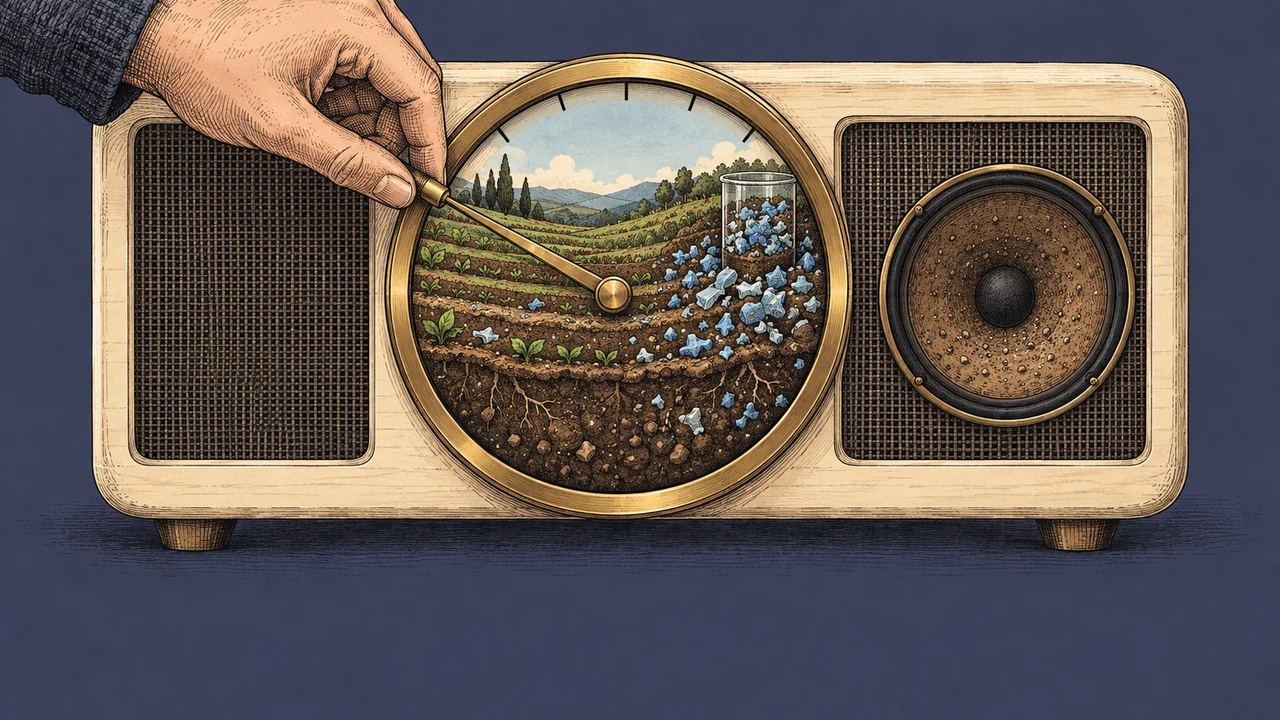
Counting how much plastic is in farm soil is a small corner of this field that is picking up fast, and the map hasn't caught up. The plainer question underneath it is still shaky: how many particles are in a kilogram of dirt, and can you trust one lab's number against another's?
Start with why anyone looked. In 2020, Guo and colleagues gathered what was known and argued that soil had been ignored next to the ocean. Plastic gets in through several doors at once: mulch film, sewage sludge, irrigation water, and plastic falling out of the sky. It does not sit at the surface either. It works its way down through the soil. Their point was that plastic belongs on the list of soil pollutants in its own right.
Once you accept the plastic is there, you have to measure it, and this is where the field moves fast and trips over itself. A 2022 review by Sajjad and colleagues names mulch film as the biggest source and estimates that about 700,000 tonnes of plastic reach farmland in Europe and North America each year, with up to 90% of Swiss floodplain soils already carrying microplastic. The same review makes a quieter point: there is no standard way to sample and extract microplastics from soil. So we are confident the plastic is everywhere and unsure whether any two abundance numbers were measured the same way.
One field study shows what a careful count can deliver. Working in eastern Spain, van den Berg and colleagues sampled farms that had received sewage sludge. Sludged soils held about 2,130 light and 3,060 heavy particles per kilogram, against about 930 and 1,100 in soils that never got sludge. Each application added roughly 280 light and 430 heavy particles per kilogram. That is a clean, dose-proportional number, the kind most of the rest of the literature can't offer. (Only the abstract was available here.)
Now the harm side, and it runs at very different amounts. Han and colleagues dosed a silty loam with regular polyethylene and biodegradable PLA at 0.5% of the soil's weight over a rice-and-wheat rotation. Small soil clumps rose from 17% to as much as 35%, big clumps fell from 84% to about 65%, and plastic explained around 54% of the shift in bacteria. Aralappanavar and colleagues, reviewing the microbe work in 2024, are blunt that most of it comes from short, high-dose lab jars, and they ask for long field studies at realistic amounts.
So one branch of the field counts plastic precisely in real fields but says little about harm. The other shows real harm at doses far above what those fields actually hold. The abundance numbers and the harm numbers have been measured at amounts so far apart that nobody has firmly lined them up.
- Type
- Emerging, not settled
- Field
- Soil microplastic measurement
- Comparative basis
- Field counts vs. lab-dose harm
- Methods
- Density separation, 16S sequencing, aggregate assays
Why this is answerable now
The base is still small
Counting soil microplastics is rising off a modest base, the honest signature of a corner just before it settles. Now is when a standard method could shape the field, instead of being added to a decade of numbers that don't match.
No agreed method yet
Sajjad's 2022 review states flatly that no standard way to sample and extract soil microplastics exists. Whoever pins down a reproducible method sets what everyone else measures against.
A working example exists
The eastern Spain sludge study shows density-separated counting can produce clean, dose-proportional field numbers. Comparable abundance data is achievable, not just a wish, and worth copying fast.
The doses don't line up
Harm studies run at 0.5% by weight while field counts sit in the low thousands of particles per kilogram. Closing that gap now, while the measuring field is young, is far cheaper than fixing it later.

Sources cited
Papers I read for this question. These notes distinguish reviews from primary studies and identify the limits of my access.
The 2020 review that said soil was ignored next to the ocean.
The best current summary of the microbe and nutrient effects.
Top source is mulch film. No standard way to measure yet.
04Microplastics alter soil structure and microbial community composition
Primary experimentGreenhouse test: biodegradable harmed soil about like regular plastic.
Sludged Spanish soils gained plastic with each application. Abstract only.
What’s missing — the gap
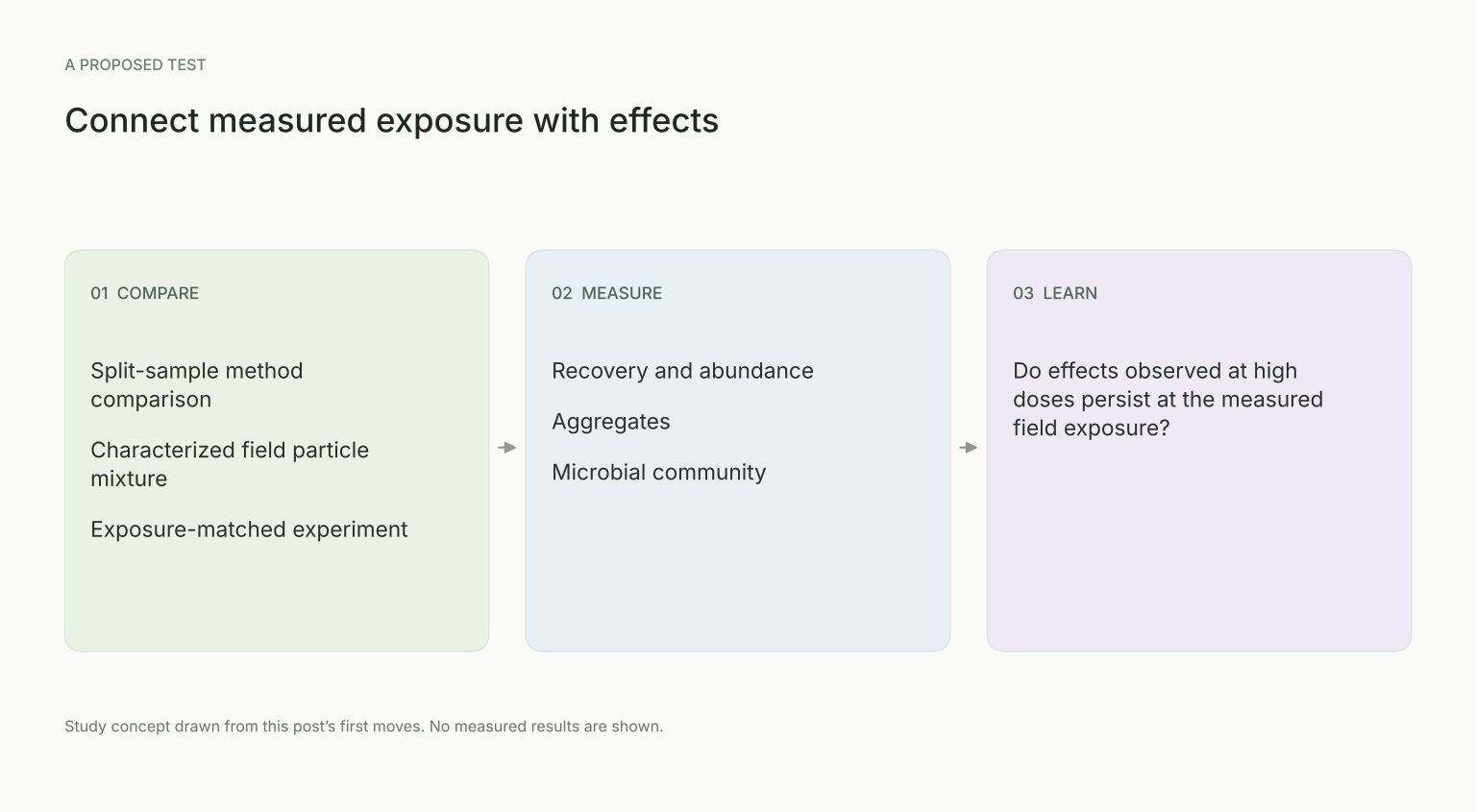
Do the plastic amounts actually found in real farm soil, in the low thousands of particles per kilogram, cause the soil-structure and microbe harms that greenhouse studies only ever produce at percent-by-weight doses?
This could go either way, and no one can say which yet. If the harm holds at real amounts, the plastic building up in sludged and mulched fields is slowly changing soil structure and the microbes that run it. If the harm fades, a lot of alarming lab results are telling us about jars, not farms. Right now the counts and the harm studies are measured at doses so far apart that the two have never been lined up.
First moves
- 1
Pin down one extraction method
Take the density-separation approach that worked in the eastern Spain study and run it beside two or three other common extractions on splits of the same soil. That shows how far a single number moves just by changing method, and how badly a standard is needed.
- 2
Dose to the real field range
Rerun the aggregate-and-microbe greenhouse design at the low-thousands-per-kilogram amounts fields actually hold, not 0.5% by weight. If the structural harm survives, that is the headline. If it vanishes, that is a bigger one.
- 3
Count along an input gradient
Sample fields with different histories of mulch-film use or irrigation and count with one fixed method. The goal is a second clean dose-response curve that shows the Spanish result holds beyond sewage sludge.
My working hypothesis
I think a lot of the loudest lab harm will shrink once someone tests it at real field amounts, but not all of it. What bothers me is that we are confident about the counts and confident about the harm, and we have almost never measured them in the same place. This corner is young enough that one shared measuring method could still be agreed on instead of added years later.
An invitation
If you measure microplastics in soil for a living, I would like to know whether the amounts you find in real fields are anywhere near the doses that make plastic look dangerous in the lab. I would also like to know whether your numbers would survive being measured by someone else's method. This corner is young enough that a shared method could still be agreed on. Are we counting carefully but measuring harm in a completely different setting, and if so, which side has the scale wrong?
Questions about this gap
What is missing between the counting and effects studies?
The question asks for an experiment that characterizes a real field exposure and tests structural and microbial responses at that exposure, using compatible measurements.
Why are particle counts and mass fractions not interchangeable?
The mass represented by a count depends on particle dimensions and material. The same number of small and large particles can imply very different mass exposures.
Why compare extraction methods on split samples?
Using the same soil makes the method the changing factor. Differences in reported abundance can then be examined without confounding them with differences between fields.
What would an input gradient show?
It could connect management history with measured accumulation. Other field differences still need to be considered before interpreting the relationship as causal.
Could an undetectable effect be useful?
Yes. It would constrain the effect under a documented exposure and method. The detection limits and uncertainty should be reported with that result.